Tutankhamun was not Egypt’s greatest pharaoh. He was not its longest-reigning, its most powerful, or its most accomplished. He was a boy king who ascended to the throne at approximately 9 years old, ruled for 10 years, and died at 19 from causes that still generate scientific debate. Yet he is the most famous pharaoh in human history — because when British archaeologist Howard Carter broke into his tomb in the Valley of the Kings on November 4, 1922, he found it exactly as it was sealed 3,245 years earlier: intact, unrobbed, packed floor to ceiling with the most extraordinary collection of ancient objects ever discovered. 5,398 artefacts. Gold, lapis lazuli, alabaster, cedar wood, linen, ivory, iron from a meteorite. The complete picture of what a New Kingdom pharaoh was buried with — a picture destroyed by robbers in every other royal tomb.
Tutankhamun — Fast Facts
| Fact | Detail |
|---|---|
| Full name | Tutankhaten (born) → renamed Tutankhamun ("Living image of Amun") when he restored the old gods |
| Dynasty | 18th Dynasty, New Kingdom — the most powerful period in Egyptian history |
| Father | Akhenaten — the "heretic pharaoh" who abolished the Egyptian gods in favour of the sun disk Aten |
| Ascended throne | Approximately 1332 BC — aged 8 or 9 |
| Reign length | Approximately 10 years (1332–1323 BC) |
| Age at death | Approximately 18–19 years old |
| Cause of death | Unknown — malaria + bone disease most likely · leg fracture shortly before death · murder theory not supported by evidence |
| Tomb discovered | November 4, 1922 by Howard Carter in the Valley of the Kings (KV62) |
| Tomb condition | Virtually intact — entered by robbers twice in antiquity but re-sealed before significant looting |
| Total artefacts | 5,398 objects — all now at the Grand Egyptian Museum (GEM), opened November 2025 |
Tutankhamun’s Life — The Boy King Who Restored Egypt
Tutankhamun inherited a kingdom in religious crisis. His father Akhenaten had dismantled Egypt’s entire religious system, closed the temples of the traditional gods, moved the capital from Thebes to a new city called Akhetaten (modern Amarna), and proclaimed the sun disk Aten the sole god. When Akhenaten died and the young Tutankhaten took the throne — probably guided by two powerful advisors, the vizier Ay and the general Horemheb — one of his first acts was to reverse everything. He restored the temples, re-opened the priesthoods, moved the capital back to Thebes, and renamed himself Tutankhamun — “the living image of Amun.” He was approximately 9 years old. This religious restoration was the most politically significant act of his reign, even if the decisions were likely made by those around him rather than by the child king himself. He married his half-sister Ankhesenamun, daughter of Akhenaten and Nefertiti. Two foetuses found in his tomb — now confirmed by DNA analysis to be his daughters — show the couple had children who died before birth or shortly after.
The Most Important Objects From Tutankhamun’s Tomb
| Object | Material | Weight/Size | Now at |
|---|---|---|---|
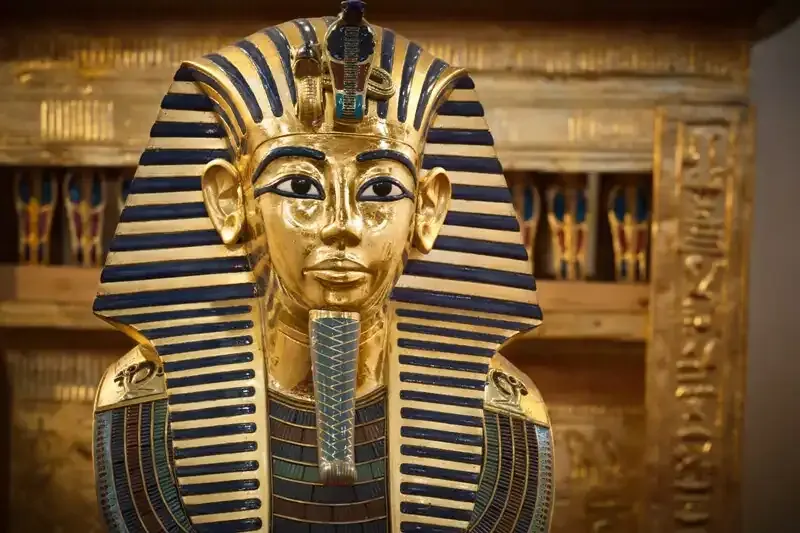
| Death mask | Solid gold, lapis lazuli, carnelian, obsidian | 10.23 kg | GEM |
| Innermost coffin | Solid 22-carat gold | 110 kg | GEM |
| Golden throne | Wood covered in gold + silver + glass + gemstones | 102cm tall | GEM |
| Ceremonial chariots | Wood, gold leaf, leather | 6 chariots — 2 reassembled | GEM |
| Iron dagger | Iron from a meteorite — nickel-iron composition confirmed | 34.2cm blade | GEM |
| Canopic shrine | Gold-covered wood · 4 gold canopic jars inside | 196cm tall | GEM |
| Shabti figures | Gold, gilded wood, alabaster, faience | 413 figures total | GEM |
The Grand Egyptian Museum — Tutankhamun’s Complete Treasure in One Place
For the first time in history, all 5,398 objects from Tutankhamun’s tomb are displayed together in a single museum. The Grand Egyptian Museum (GEM), which opened in November 2025 adjacent to the Pyramids of Giza, was designed specifically to house the entire Tutankhamun collection in a dedicated wing. Previously, objects were split between the old Egyptian Museum in Tahrir Square, storage rooms, and conservation facilities. The GEM reunites everything: the 10.23kg solid gold death mask, the 110kg innermost gold coffin, the golden throne with its extraordinary back panel showing Tutankhamun and his wife Ankhesenamun, the meteorite-iron dagger, the six chariots, the 413 shabti figures, the botanical specimens — every object from KV62 in a purpose-built space with world-class lighting, labelling and presentation. Plan a minimum of 2 hours in the Tutankhamun wing alone. Egypt For Travel includes the GEM in every Cairo program.
The Tomb — KV62 in the Valley of the Kings
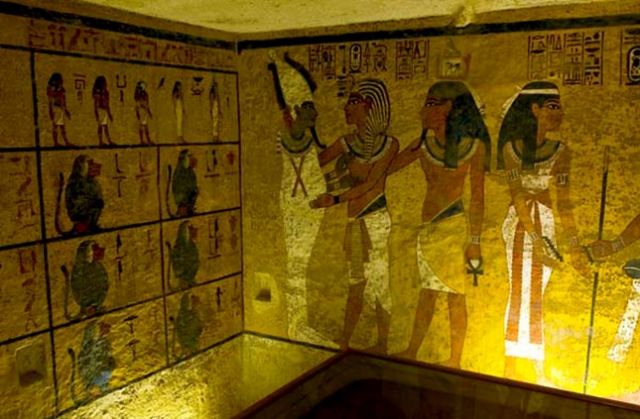
Tutankhamun’s tomb, designated KV62 (King’s Valley Tomb 62), is among the smallest in the Valley of the Kings — just four rooms and a staircase entrance. Howard Carter discovered it after 5 years of excavation, on November 4, 1922, when his team uncovered a stone step at the base of the entrance to the earlier tomb of Ramesses VI (KV9). Clearing the steps revealed a sealed doorway. On November 26, Carter made a small hole and held a candle to the darkness inside. His sponsor Lord Carnarvon asked “Can you see anything?” Carter replied: “Yes, wonderful things.” The tomb is open to visitors today. The mummy of Tutankhamun remains inside KV62 in its outermost coffin — the only royal mummy still in its original tomb in the Valley of the Kings.
The Curse of the Pharaohs — What Really Happened
Lord Carnarvon died in Cairo on April 5, 1923 — five months after the tomb was opened. British newspapers immediately invented the “curse of the pharaohs.” The reality: Carnarvon was 57, had been in poor health for years following a 1901 car accident, and died of blood poisoning from an infected mosquito bite on his cheek. Howard Carter, who entered the tomb more than anyone, lived until 1939 — 17 years after the opening. Statistical analysis of the survival rates of everyone present at the tomb opening shows no correlation with early death. There is no curse. There is no evidence of any unusual substance in the sealed tomb air. The curse is a compelling story entirely without archaeological or medical foundation.
See the Tutankhamun Collection in 2026
Every Egypt For Travel Cairo program includes the GEM with the complete Tutankhamun collection, accompanied by a licensed Egyptologist guide (ETA Category A Licence No. 1947) who provides full context for every significant object:
| Program | Includes | From |
|---|---|---|
| Cairo 3 Days | GEM Tutankhamun wing · Pyramids · Islamic Cairo | $349 |
| 5 Days Cairo & Luxor | GEM · Pyramids · Tutankhamun’s actual tomb KV62 · Karnak | $749 |
| 7-Night Egypt from USA | GEM · Nile cruise · Valley of Kings (KV62) · Philae | $1,599 |
| Egypt Vacation Package | GEM · Pyramids · Nile cruise · Abu Simbel | $1,549 |
WhatsApp: +20 155 555 2466 · ETA Category A Licence No. 1947
Frequently Asked Questions
Where is Tutankhamun’s gold mask now?
The solid gold death mask of Tutankhamun is now displayed at the Grand Egyptian Museum (GEM), which opened in November 2025 adjacent to the Pyramids of Giza. It weighs 10.23 kilograms and is made of solid 22-carat gold inlaid with lapis lazuli, carnelian, quartz, obsidian, turquoise and glass. It is displayed in the dedicated Tutankhamun Galleries alongside all 5,398 objects from his tomb — the first time the complete collection has ever been shown together.
How did Tutankhamun die?
The exact cause of Tutankhamun’s death remains uncertain. DNA analysis conducted in 2010 found evidence of multiple malaria infections and a severe bone disease (Kohler disease II) in the left foot that would have made walking very painful. A leg fracture found in his mummy occurred shortly before death and may have become infected. The combination of malaria, bone disease and leg fracture — in an already genetically weakened individual (his parents were siblings) — is the current scientific consensus cause of death. The murder theory, popular in the 1990s based on a head wound, has been largely discredited — the wound appears to have occurred after death during the mummification process, not before.
Can you visit Tutankhamun’s tomb in the Valley of the Kings?
Yes — KV62, Tutankhamun’s tomb, is open to visitors in the Valley of the Kings at Luxor. It is one of the smaller tombs and requires a separate ticket (~1500 EGP / ~$30). The mummy of Tutankhamun remains inside in the outermost coffin — he is the only royal mummy still in its original tomb in the Valley. The decorated walls of the burial chamber show scenes from the Book of the Dead and the Opening of the Mouth ceremony. Egypt For Travel’s 5-Day Cairo & Luxor program includes the Valley of the Kings on Day 4.
How old was Tutankhamun when he became pharaoh?
Tutankhamun is believed to have been approximately 8 or 9 years old when he ascended to the throne of Egypt around 1332 BC. He was effectively a child ruler surrounded by powerful advisors — primarily the vizier Ay and the general Horemheb — who made most governmental decisions. He died approximately 10 years later, at around 18–19 years of age, having reigned for a decade during which Egypt’s religious system was restored to its traditional form after his father Akhenaten’s radical monotheistic experiment.
 -.webp)