Time is the most fundamental of all human measurements — more abstract than length or weight, more difficult to observe directly, and more consequential to get right. The ancient Egyptians developed their system of measuring time not from philosophical speculation but from urgent practical necessity: the annual flood of the Nile that sustained their entire agricultural civilisation was a precise annual event, and knowing when it would arrive — to prepare dykes, plan planting schedules, and assess tax revenues — was a matter of survival. The calendar they developed to answer this need was the most accurate solar calendar in the ancient world, and its influence extends, through a 3,000-year chain of adoption and modification, to the Gregorian calendar on the wall of your kitchen today.
Quick Facts: The Ancient Egyptian Calendar
| Total days | 365 days — 12 months of 30 days each, plus 5 epagomenal (extra) days |
| Seasons | Three — Akhet (inundation) · Peret (emergence/growing) · Shemu (harvest/dry) |
| Months per season | Four months each — 12 months total |
| Days per month | 30 days — three 10-day weeks (decans) |
| Epagomenal days | 5 extra days added at year's end — birthdays of Osiris, Horus the Elder, Set, Isis, and Nephthys |
| New Year marker | Heliacal rising of Sirius (Sothis) — when the star first appeared on the eastern horizon just before dawn |
| Developed | c. 3000 BC — possibly earlier; the 365-day civil calendar formalised by c. 2800 BC |
| Legacy | Direct ancestor of the Julian calendar (46 BC) → Gregorian calendar (1582 AD) → modern calendar |
| The Sothic cycle | 1,460 years — time for the civil and astronomical calendars to realign (missing leap year caused drift) |
| Also used | Lunar calendar alongside the civil calendar — for religious festivals and agricultural months |
The Three Seasons of Kemet
The ancient Egyptian year was divided into three seasons, each of four months, each directly reflecting the agricultural and hydrological cycle of the Nile Valley. The seasons were not arbitrary divisions — they described the actual state of the landscape and determined what work was done, what religious festivals were celebrated, and how the state administered its resources.
Akhet — The Inundation (June–October)
Akhet — "the flooding" — was the first season of the Egyptian year, the period of the Nile flood when the river rose dramatically and inundated the farmland on both sides. During Akhet, agricultural work was impossible: the fields were under water. This was the season for major construction projects — the state mobilised the agricultural labour force, who had nothing to farm, to quarry stone, move blocks, and build monuments. The pyramids of Giza were built primarily during Akhet. It was also the season of major religious festivals, including the Opet Festival, which occurred in the second month of Akhet.
Akhet began with the Egyptian New Year — marked by the heliacal rising of Sirius (the Egyptians called the star Sopdet, or in Greek, Sothis). After approximately 70 days below the horizon (the Egyptians associated this disappearance with Sirius's "death"), the star reappeared on the eastern horizon just before dawn in what we would now call mid-July. This reappearance reliably preceded the Nile flood by a few weeks, giving Egyptian farmers advance warning that the waters were coming. The coincidence between the star's return and the river's rise was so consistent that the Egyptians interpreted it as causal — Sirius brought the flood.
Peret — The Growing Season (October–February)
Peret — "the emergence" — was the second season, the period when the floodwaters receded and the freshly deposited black silt was exposed for planting. Peret was the agricultural heart of the Egyptian year: as the waters pulled back, farmers planted their crops in the wet, nutrient-rich mud — emmer wheat, barley, flax, legumes, vegetables. The work was intensive but the conditions were ideal: the soil required no ploughing to depth, no irrigation, and no fertilisation. Seeds pressed into the silt germinated rapidly and grew quickly in the Egyptian winter sunshine.
Shemu — The Harvest (February–June)
Shemu — "the harvest" or "the dry season" — was the third season, when the crops were harvested and the Nile was at its lowest. This was the driest, hottest time of year — the season of dust and heat, when the desert encroached and the river shrank. After the harvest, grain was threshed, measured, and stored in state granaries, with a portion retained by farmers and the remainder paid as tax. The Nile's low point exposed the riverbed in some sections, allowing for boat repairs, canal cleaning, and the kind of heavy construction work along the riverbanks that was impossible during the flood.
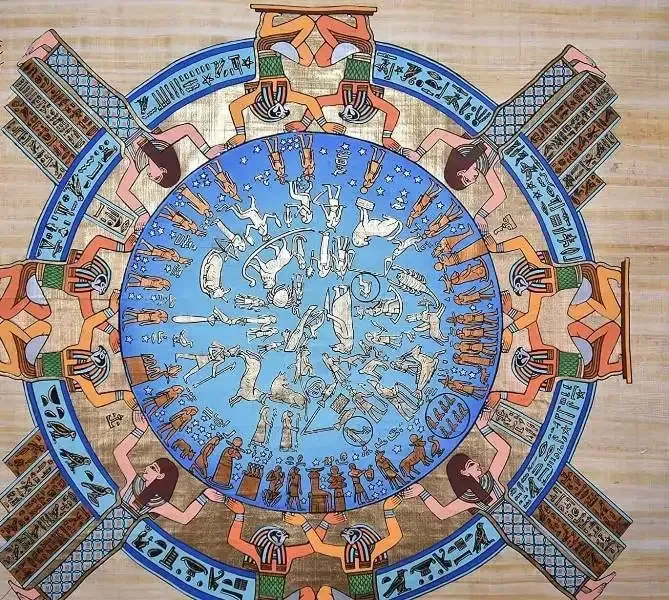
 The Dendera Zodiac — the most complete ancient Egyptian astronomical ceiling, showing the sky as it appeared around 50 BC, with both Egyptian and Greek-Babylonian constellations.
The 12 Months of the Ancient Egyptian Year
| Season | Month (Egyptian) | Modern Equivalent | Named After / Notes |
|---|---|---|---|
| Akhet (Inundation) |
Thoth (Djehuti) | Mid-July to mid-August | Named for the god Thoth; Nile flood begins; Opet Festival in Month 2 |
| Paopi (Pa-en-Ipet) | Mid-August to mid-September | Opet Festival month — Amun's procession from Karnak to Luxor | |
| Hathor (Hwt-Hrw) | Mid-September to mid-October | Named for the goddess Hathor; peak of the flood | |
| Koiak (Ka-Hr-Ka) | Mid-October to mid-November | Flood begins to recede; major Osiris mystery festivals | |
| Peret (Growing) |
Tybi (Ta-Aabet) | Mid-November to mid-December | Planting begins in the newly exposed silt |
| Mechir (Pa-en-Mekhir) | Mid-December to mid-January | Peak growing season; Egyptian "winter" | |
| Phamenoth | Mid-January to mid-February | Crops maturing; preparations for harvest begin | |
| Pharmuthi | Mid-February to mid-March | Early harvest; barley ripens first | |
| Shemu (Harvest) |
Pachons (Pa-en-Khonsu) | Mid-March to mid-April | Main grain harvest; threshing and winnowing |
| Payni | Mid-April to mid-May | Grain stored; tax assessment; Nile at low point | |
| Epeiph | Mid-May to mid-June | Driest, hottest month; Sirius approaches horizon | |
| Mesori | Mid-June to mid-July | Final month; Sirius disappears below horizon; year's end approaches | |
| Epagomenal | 5 extra days | Mid-July | Birthdays of Osiris, Horus the Elder, Set, Isis, Nephthys — "outside the year" |
The Star That Started the Year: Sirius and the Sothic Cycle
The most brilliant star in the night sky — Sirius, which the ancient Egyptians called Sopdet — played a role in Egyptian life that no other star has played in any other civilisation's timekeeping system. For approximately 70 days each year, Sirius is too close to the sun in the sky to be visible from Earth. When it reappears on the eastern horizon just before dawn — the astronomical event called the heliacal rising — the Egyptians marked this as the beginning of the new year, because this appearance reliably coincided with the start of the Nile flood.
The connection was not perfect — the civil calendar of 365 days drifted slightly from the astronomical calendar (because the true solar year is approximately 365.25 days), losing one day every four years. Over time, the official Egyptian New Year crept earlier and earlier relative to the heliacal rising of Sirius. The full cycle — from alignment to realignment — takes 1,460 years, a period the Greeks called the Sothic Cycle. Egyptian texts record three historical coincidences between the civil New Year and the Sirius rising (c. 1322 BC, 139 AD, and by calculation 2781 BC), which Egyptologists use as fixed anchor points for dating Egyptian history.
What no other guide tells you: The five epagomenal days — the extra days added at the end of the Egyptian year to bring the total to 365 — were considered outside the normal calendar and therefore outside the normal protection of the gods. Egyptian magical texts describe them as days of ill omen, when dangerous cosmic forces were active that required special ritual protection. The myth explaining their existence was that the god Thoth won them from the moon in a dice game, providing Nut (the sky goddess) with the extra time needed to give birth to her five children — Osiris, Horus the Elder, Set, Isis, and Nephthys — who had been forbidden by Ra from being born during any regular month.
 — the brightest star in the night sky — was called Sopdet by the ancient Egyptians. Its annual heliacal rising marked the Egyptian New Year and predicted the Nile flood.
The Ancient Egyptian Calendar's Legacy: How Egypt Shaped Modern Time
The most consequential legacy of the ancient Egyptian calendar is one that almost nobody is aware of: it is the direct ancestor of the calendar you use every day. The chain of transmission runs as follows:
The ancient Egyptian civil calendar of 365 days — three seasons, twelve months, five extra days — was adopted by the Greek Ptolemaic rulers of Egypt after Alexander's conquest in 332 BC. When Julius Caesar visited Egypt in 48–47 BC and spent time with Cleopatra VII, he was introduced to the Egyptian calendar by the Alexandrian astronomer Sosigenes. Caesar was struck by its superiority to the chaotic Roman calendar of his era (which had drifted so far from the solar year that January was being celebrated in autumn). In 46 BC, Caesar reformed the Roman calendar — adding a leap year every four years to correct the quarter-day drift — and introduced the Julian calendar, which was essentially the Egyptian calendar with one modification. The Julian calendar remained in use throughout the Roman Empire and most of Christian Europe for over 1,500 years. In 1582 AD, Pope Gregory XIII made a small further correction (removing leap years in century years not divisible by 400) to produce the Gregorian calendar — the calendar used worldwide today.
The ancient Egyptian farmer who tracked the rising of Sirius to predict the flood was using the same annual solar cycle that determines what date it is on your phone right now.
Frequently Asked Questions — Ancient Egyptian Calendar
How many days were in the ancient Egyptian year?
The ancient Egyptian civil calendar had 365 days — 12 months of 30 days each (360 days), plus 5 additional epagomenal days added at the end of the year. This made it the most accurate solar calendar in the ancient world.
What were the three seasons of ancient Egypt?
The three seasons were Akhet (the inundation — flood season, approximately July–October), Peret (the emergence — growing season, approximately October–February), and Shemu (the harvest — dry season, approximately February–June). Each season had four months of 30 days.
What role did Sirius play in the ancient Egyptian calendar?
The heliacal rising of Sirius — its first reappearance on the eastern horizon before dawn after approximately 70 days below the horizon — marked the ancient Egyptian New Year. This event reliably coincided with the beginning of the annual Nile flood, making Sirius the most astronomically and agriculturally important star in Egyptian culture. The Egyptians named it Sopdet (in Greek: Sothis) and depicted it as a goddess wearing a star on her head.
Did the ancient Egyptian calendar have leap years?
No — the ancient Egyptian civil calendar had no leap year provision, which caused it to drift relative to the true solar year at a rate of approximately one day every four years. Over 1,460 years (the Sothic Cycle), the civil New Year drifted all the way around the solar year and back into alignment with the heliacal rising of Sirius. This drift was corrected when Julius Caesar adopted the Egyptian calendar and added the leap year rule to create the Julian calendar in 46 BC.
Is the ancient Egyptian calendar still used today?
The Coptic calendar — used by the Coptic Orthodox Church of Egypt and by Egyptian farmers for traditional agricultural scheduling — is a direct descendant of the ancient Egyptian calendar, preserving the same three seasons, twelve months, and five epagomenal days. The Coptic calendar year begins on what corresponds to 11 September in the Gregorian calendar. Many rural Egyptian farmers still track the Coptic calendar for planting and harvesting decisions.
What were the five extra days in the Egyptian calendar?
The five epagomenal days — added at the end of the 360-day year to total 365 — were considered the birthdays of the five children of the sky goddess Nut: Osiris (Day 1), Horus the Elder (Day 2), Set (Day 3), Isis (Day 4), and Nephthys (Day 5). Myth explained that Thoth won these days from the moon god in a dice game, giving Nut the extra time needed to give birth to her children after Ra had forbidden them to be born during any regular month of the year.
Discover ancient Egypt in depth with Egypt For Travel — browse Egypt tour packages from $749 per person. Private Egyptologist guide who brings the history alive at every site · All monuments · All entrance fees. WhatsApp: +20 155 555 2466. ETA Licence No. 1947.