If you want to understand what an ancient Egyptian temple actually looked like when it was functioning — complete, intact, with original ceilings, walls still carrying paint in sheltered corners, and pylons rising to their full height — go to Edfu.
The Temple of Horus at Edfu is the best-preserved ancient Egyptian temple in existence. Built between 237 and 57 BC during the Ptolemaic period, it was buried under centuries of Nile silt and desert sand, which protected it from the destruction that robbed most other temples of their upper structures. When Auguste Mariette began excavating it in 1860, he found a temple almost intact from foundations to roof — the pylons at their full 36-metre height, the hypostyle halls with their ceilings, the sanctuary with its original shrine. No other temple in Egypt gives you as complete a picture of how these buildings actually looked and functioned.
Edfu Temple 2026 — Complete Visitor Guide
Quick Facts
| Location | Edfu, Upper Egypt — on the west bank of the Nile, 105km south of Luxor |
| Dedicated to | Horus — the falcon god, son of Osiris and Isis, protector of the pharaohs |
| Built | 237–57 BC under Ptolemy III to Ptolemy XII (Ptolemaic period) |
| Entrance Fee 2026 | ~500 EGP (~$10) adults · ~250 EGP students |
| Opening Hours | 6:00 AM – 6:00 PM (summer) · 6:00 AM – 5:00 PM (winter) |
| Access from Cruise | Calesh (horse-drawn carriage) from the cruise dock to the temple — included in Egypt For Travel tours |
| Best Time to Visit | Early morning (6:00–9:00 AM) or late afternoon (4:00–6:00 PM) |
| UNESCO Status | World Heritage Site — part of Ancient Thebes and its Necropolis |
The Calesh — How You Arrive at Edfu Temple
.jpg?1780574347551)
One of the unexpected pleasures of visiting Edfu from a Nile cruise is the calesh — the traditional horse-drawn carriage that takes passengers from the cruise dock through the streets of Edfu town to the temple entrance, approximately 2km. The calesh is included in all Egypt For Travel Nile cruise itineraries. The ride through the local market streets of Edfu — past vegetable sellers, schoolchildren, and Egyptian daily life — creates a vivid contrast with the ancient world you are about to enter. On the return from the temple, the calesh takes you back to the dock. It is a practical transport arrangement that has become one of the most fondly remembered small details of the Nile cruise experience.
What Makes Edfu Temple Unique
Most ancient Egyptian temples were dismantled, quarried for building stone, converted to churches, or simply eroded over millennia. Edfu was buried. By the time of the Islamic era, the town of Edfu had grown directly on top of the ancient temple complex, with mud-brick houses built on the accumulated silt that had covered the temple. When Mariette began excavating in 1860, he had to demolish entire neighbourhoods of 19th-century houses to reach the temple below. What he found was extraordinary: a temple with its complete superstructure intact, including both massive entrance pylons at full height, three complete hypostyle halls, the offering hall, the sanctuary and its surrounding chapels — all roofed or partially roofed. The original wooden shrine that held the sacred statue of Horus still stands in the sanctuary.
Key Highlights at Edfu Temple
The Entrance Pylons
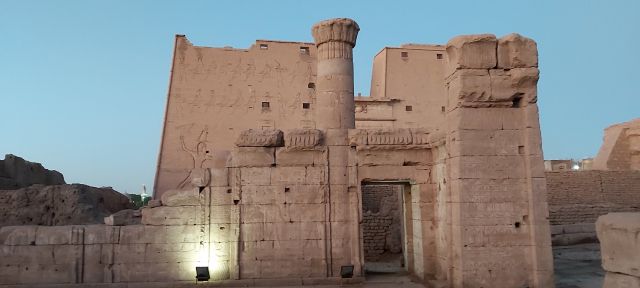
The two entrance pylons rise 36 metres — the height of a 12-storey building — and are the tallest and most complete pylon facade of any Egyptian temple. The exterior faces are carved with scenes of Ptolemy XII smiting enemies before Horus, following the 3,000-year Egyptian tradition of showing the pharaoh defeating chaos on behalf of the gods. Standing at the base of these pylons and looking up gives you the most accurate sense available anywhere in Egypt of what walking into a major ancient Egyptian temple felt like.
The Granite Statues of Horus
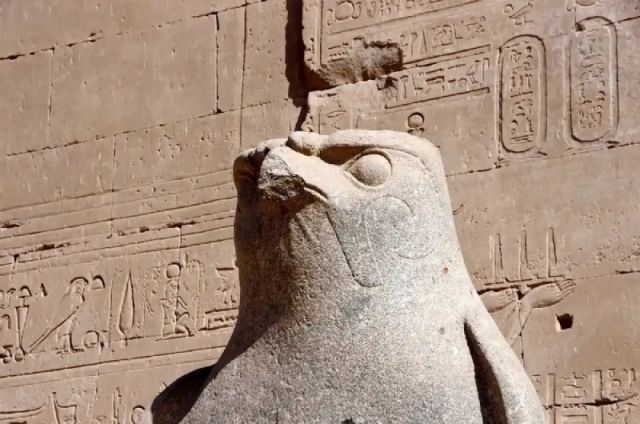
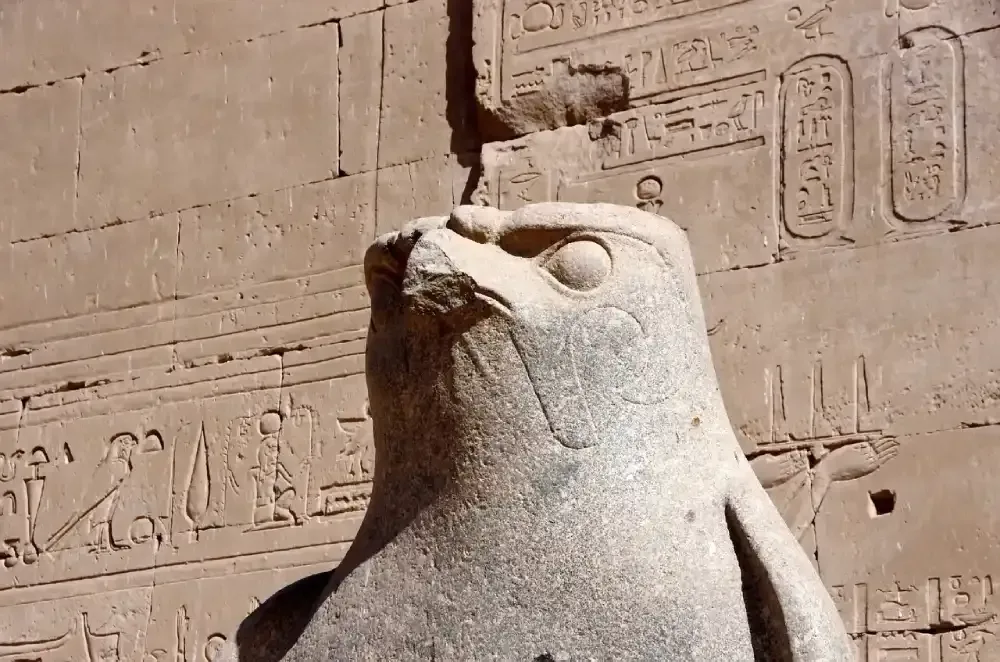
Two magnificent granite statues of Horus as a falcon flank the entrance to the first hypostyle hall. These are among the finest ancient Egyptian statues in their original temple setting — most comparable statues have been removed to museums. Seeing them in situ, in the courtyard of the temple they were made to guard, is an experience of particular power. The falcon head, the human body, the divine stillness — this is Horus as the ancient Egyptians imagined and worshipped him, in the place where he was worshipped.
The Sanctuary and the Original Naos
At the heart of the temple, in the innermost sanctuary, stands the original granite naos (shrine) from which the sacred statue of Horus would have been brought for daily ritual. The naos is a monolithic granite box approximately 1.8 metres tall, carved with inscriptions. Most Egyptian temples have lost their naos to theft, erosion or later conversion. Edfu’s survives in place, in the room it was made for, adding an extraordinary dimension of authenticity to the visit.
The Birth House (Mammisi)
To the left of the main entrance, the Birth House (Mammisi) is a smaller chapel dedicated to the birth of Horus the Child (Harsomtus) as the son of Horus the Elder and Hathor. The Mammisi was used for rituals celebrating the divine birth of the pharaoh as the earthly incarnation of Horus. The carvings inside are finely executed Ptolemaic work.
The Story of Horus and Seth at Edfu
The walls of Edfu Temple are covered with the most detailed surviving account of the Myth of Horus and Seth — the cosmic battle between the falcon god Horus (son of Osiris) and the chaos god Seth for control of Egypt. The texts describe a series of battles fought on the Nile, with Horus and his followers defeating Seth’s forces in boat combat. The mythological drama played out on the temple walls was re-enacted in annual festivals at Edfu — including the Feast of the Beautiful Reunion, when the sacred barque of Hathor travelled from Dendera to visit Horus at Edfu, and the Horus Festival in which the victory over Seth was ceremonially repeated.
Practical Tips for Visiting Edfu in 2026
- The calesh is included in Egypt For Travel tours: You do not need to arrange or negotiate for the calesh independently. Your guide coordinates the carriages from the dock. Independent visitors can hire a calesh from the dock for a negotiated price — agree the round-trip price before departing.
- Allow 90 minutes: A thorough visit with explanations of the main hall, hypostyle halls, sanctuary and Birth House takes approximately 90 minutes. Add 30 minutes for the calesh rides in each direction.
- Arrive early or late afternoon: The temple interior is shaded — but the courtyards and the calesh ride are exposed. Early morning or late afternoon visits avoid the most intense midday heat and the tour buses from Hurghada that arrive mid-morning.
- Climb to the roof (if available): Edfu’s roof is occasionally accessible via interior staircases and gives extraordinary views of the temple’s complete plan and the surrounding town. Ask your guide if the roof is open during your visit.
Edfu Temple and the Nile Cruise
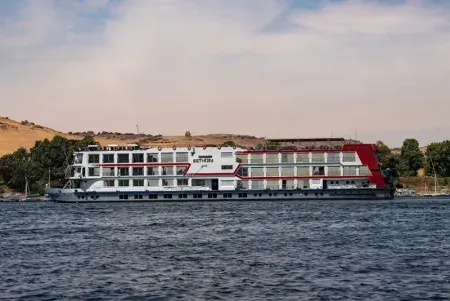
Edfu Temple is visited on Day 3 of every Nile cruise travelling from Luxor to Aswan. The cruise moors at Edfu overnight and passengers disembark in the morning for the calesh ride and temple visit before sailing on to Kom Ombo and Aswan. All entrance fees and calesh transport are included in Egypt For Travel Nile cruise packages. Browse Nile cruises from $499.
Frequently Asked Questions
What is the entrance fee for Edfu Temple in 2026?
The entrance fee for Edfu Temple in 2026 is approximately 500 EGP (~$10) for adult foreign visitors and approximately 125 EGP for students with a valid ID. Card payment is accepted at the ticket office. All Egypt For Travel Nile cruise packages include the Edfu Temple entrance fee — there is no additional cost at the site for our clients.
What is a calesh and do I need one to visit Edfu Temple?
A calesh is a traditional horse-drawn carriage, still used in Edfu and Luxor as everyday transport. When Nile cruise ships dock at Edfu, the temple is approximately 2km from the dock in the centre of the town — too far to walk comfortably in the heat. The calesh takes passengers from the dock through the market streets to the temple entrance (approximately 15 minutes) and returns after the visit. Egypt For Travel includes the calesh in all cruise itineraries. Independent visitors hire a calesh from the dock — always agree the round-trip price before boarding.
Is Edfu Temple worth visiting?
Yes — Edfu Temple is consistently rated by Egyptologists as one of the three most important temples in Egypt alongside Karnak and Abu Simbel. Its outstanding completeness — the only major temple with its full superstructure intact — gives it an authority that no other Nile cruise stop except the Valley of the Kings can match. The experience of standing under the original ceiling of the inner hypostyle hall, surrounded by walls carved from floor to ceiling with 2,000-year-old reliefs, is profound in a way that the more fragmentary temples cannot match.
Edfu Temple is included in all Egypt For Travel Nile cruises from $499 per person, with calesh transport and private Egyptologist guide. Browse Nile cruises or WhatsApp: +20 155 555 2466. ETA Licence No. 1947.