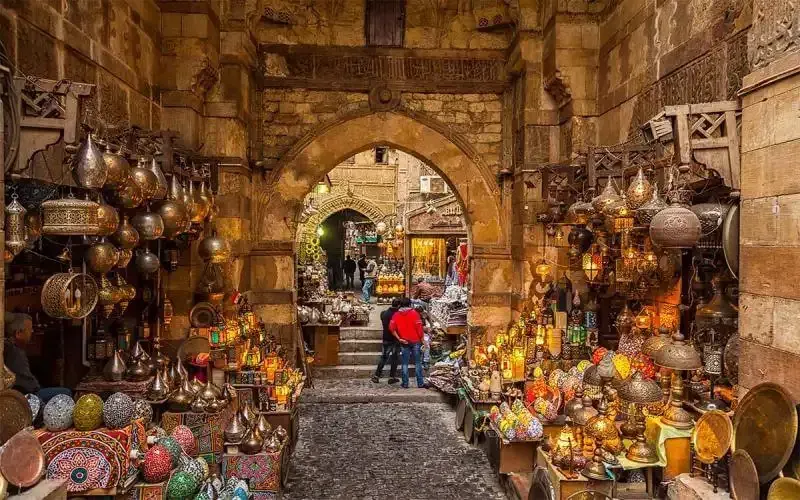
Shopping in Egypt is an experience in itself. The Khan El-Khalili bazaar in Cairo — a medieval market in continuous operation since 1382 AD — is one of the great shopping experiences of the world: a labyrinth of narrow lanes where gold and silver smiths work beside spice merchants beside papyrus painters beside makers of inlaid wooden boxes, every surface hung with objects, every doorway an invitation into another speciality. The Aswan market offers a completely different atmosphere — quieter, more focused on Nubian crafts and Upper Egyptian specialities, the vendors less aggressive, the products more distinctive. And in Luxor, the bazaar beside the Luxor Temple and the stalls in the Valley of the Kings car park offer their own selection, skewed toward the pharaonic and the immediately recognisable.
The challenge of shopping in Egypt is not finding things to buy — it is finding good things to buy. The tourist market is flooded with low-quality mass-produced goods (machine-printed "papyrus" on banana leaf, resin "alabaster", factory-stamped "scarabs") that look authentic but are not. This guide identifies the genuine articles, explains how to tell them from the copies, and gives you realistic price ranges so you can bargain with confidence.
The 10 Best Egyptian Souvenirs — What to Buy & What to Pay
1. Papyrus Paintings
Authentic papyrus — made from the stalks of the papyrus reed plant (Cyperus papyrus), which grows along the Nile — is one of Egypt's most genuinely historic souvenirs: it was the writing and painting surface of choice in ancient Egypt for 3,000 years, and its production was one of the country's most important industries. Quality hand-painted papyrus reproductions of famous ancient Egyptian artworks — the Book of the Dead vignettes, scenes from Tutankhamun's tomb, the goddess Isis with outstretched wings — are among the most beautiful and portable souvenirs available.
What to look for: Real papyrus has a slightly rough, fibrous texture and a warm cream-to-brown colour with visible reed fibre layering. It is flexible without cracking and does not tear easily. Fake "papyrus" (usually banana leaf or rice paper) is smoother, more uniform, tears easily when bent, and often has a plastic sheen. The simplest test: fold a corner gently — real papyrus survives without cracking; fake papyrus cracks or tears.
What to pay: Small pieces (A4 size) from a reputable papyrus workshop or Khan El-Khalili quality shop: 150–400 EGP (~$3–8). Medium pieces (A3): 400–1,000 EGP. Large museum-quality hand-painted pieces: 1,000–5,000+ EGP. The Dr Ragab Papyrus Institute in Cairo (the original papyrus revival workshop, established 1962) is the most reliable source of certified authentic papyrus.
2. Alabaster Carvings
Egyptian alabaster — technically calcite alabaster or travertine — is a beautiful translucent stone quarried in Upper Egypt (primarily at Luxor's West Bank and near Minya) with a warm cream-and-honey colour that glows when held to the light. It was used in ancient Egypt for everything from canopic jars to cosmetic vessels, and today's carvers in the Luxor area produce a wide range of objects in the same tradition: bowls, vases, canopic jar sets, scarabs, small pyramids, cat statues, and decorative plates.
What to look for: Real alabaster is cool to the touch (unlike resin), has visible natural veining, is translucent when held to light, and is significantly heavier than plastic copies. Tap it gently — real stone has a clean ring; resin has a dull thud. The best workshop area is along the West Bank road in Luxor, where you can watch craftsmen working the stone by hand.
What to pay: Small scarab or pyramid: 50–150 EGP. Medium bowl or vase: 200–600 EGP. Full canopic jar set (4 jars): 500–2,000 EGP depending on size and quality. Prices at workshops are significantly lower than in bazaars — buy where you can see production.
3. Gold & Silver Cartouche Jewellery
A cartouche is the oval hieroglyphic frame that enclosed royal names in ancient Egypt — and today it is one of the most popular and genuinely meaningful souvenirs: a piece of jewellery inscribed with your name (or a loved one's name) transliterated into ancient Egyptian hieroglyphs. Available in 18-carat gold, 14-carat gold, and sterling silver, in pendant, bracelet, earring, and key-ring forms. The jeweller transliterates your name phonetically into hieroglyphs on the spot and hand-engraves the cartouche to order.
What to look for: Ask to see the hallmark stamped on the metal (750 for 18-carat gold, 585 for 14-carat, 925 for sterling silver). Reputable jewellers in Khan El-Khalili will have government-certified hallmarks. Avoid any piece that looks cast rather than engraved — the hieroglyphs should have clean, crisp edges cut by hand or laser.
What to pay: Sterling silver cartouche pendant: 300–800 EGP. 14-carat gold pendant: 1,500–4,000 EGP depending on size and weight. 18-carat gold: significantly higher. The gold and silver bazaar area of Khan El-Khalili (around the central mosque) has the highest concentration of cartouche jewellers.

Khan El-Khalili bazaar Cairo — in continuous operation since 1382 AD, the medieval market is the best place in Egypt to buy quality souvenirs.
4. Spices & Herbal Products
The spice traders of Khan El-Khalili and the Aswan market sell products that have been traded along the Nile Valley for millennia — and Egyptian spices are genuinely excellent. The most distinctive are: karkade (dried hibiscus flowers, used to make a brilliant red tea that can be served hot or cold — one of the great drinks of Egypt); black seed (Nigella sativa, known as habbet el-baraka — "seed of blessing" — used in traditional medicine for centuries); dried chamomile; Egyptian cumin (stronger and more aromatic than European varieties); and ful nabd (dried fenugreek). Good spice traders also sell quality Egyptian cotton products, natural loofah, and henna.
What to pay: Karkade: 100–200 EGP per 500g. Black seed: 80–150 EGP per 250g. Mixed spice selection: 200–400 EGP. Aswan has the best spice market in Egypt — calmer and more fairly priced than Cairo. The spice area of the Aswan market is on the main bazaar street just north of the Corniche.
5. Scarabs
The scarab beetle was one of the most significant symbols in ancient Egyptian religion — an embodiment of the sun god Khepri and a symbol of regeneration and protection. Scarab amulets were worn by the living and placed in the tombs of the dead throughout Egyptian history, and they remain one of the most recognisable Egyptian symbols. Quality scarabs are carved from faience (glazed ceramic, the original ancient material), stone (turquoise, lapis lazuli, carnelian, alabaster), or cast in silver and gold.
What to look for: Stone scarabs should feel cool and substantial; faience ones should have a consistent glaze; metal ones should be hallmarked. Plastic and resin copies are ubiquitous — feel the weight and temperature. Better-quality stone and faience scarabs often have hieroglyphic inscriptions on the flat underside.
What to pay: Small glazed faience scarab: 20–80 EGP. Stone scarab (alabaster or carved stone): 50–300 EGP. Silver scarab pendant: 200–600 EGP. Genuine ancient scarabs (if you are offered one) cannot legally be exported from Egypt and are almost certainly fakes — do not buy.
6. Nubian Crafts
The Nubian people of southern Egypt produce a distinct craft tradition quite different from mainstream Egyptian tourist goods: hand-woven Nubian baskets in geometric patterns (palm frond and dyed grass, extraordinarily intricate), silver Nubian jewellery with coral and glass bead decoration, hand-painted ceramic tiles with Nubian village motifs (the blue and white palette distinctive to Nubian domestic architecture), and traditional Nubian textiles. The best place to buy Nubian crafts is directly in the Nubian villages on the west bank of the Nile near Aswan — bought directly from the makers rather than through bazaar middlemen.
What to pay: Nubian basket (small): 150–400 EGP. Silver bracelet or necklace: 300–1,000 EGP. Ceramic tile set: 100–300 EGP. Prices at source (village direct) are 30–50% lower than in Aswan market.
7. Egyptian Cotton Products
Egyptian cotton — grown in the Nile Delta and famous worldwide for its extra-long staple fibre that produces exceptionally soft, strong, and breathable fabric — is one of the great genuine Egyptian products. Quality Egyptian cotton towels, sheets, and garments are sold throughout Egypt, though quality varies enormously. The best products come from established textile shops (not bazaar stalls) and are labelled with the cotton grade and thread count.
What to look for: Thread count 400+ for genuine premium Egyptian cotton. The feel should be immediately soft and smooth; lower-quality cotton blends feel slightly rough. Avoid anything labelled "Egyptian-style" rather than "Egyptian cotton" — this is a blend.
What to pay: Quality bath towel (hand-woven): 200–500 EGP. Cotton galabiya (traditional Egyptian robe): 150–400 EGP. Premium cotton throw: 400–1,000 EGP.
8. Inlaid Wooden Boxes
Traditional Egyptian woodwork — wooden boxes, backgammon sets, and decorative panels inlaid with mother-of-pearl, ebony, ivory (now synthetic), and camel bone in geometric Islamic patterns — is one of the most genuinely skilled craft traditions still practised in Cairo's artisan quarters. The work ranges from crude tourist-market pieces to museum-quality items produced by master craftsmen in the workshops around Khan El-Khalili.
What to look for: Quality inlay work has perfectly fitted pieces with no visible gaps or glue; the patterns should be symmetrical and the inlay flush with the wood surface. Cheap pieces have visible gaps and slightly raised inlay. The wood should feel solid and substantial. Turn the box over and examine the hinge and clasp — quality hardware indicates quality construction.
What to pay: Small jewellery box (15×10 cm): 200–600 EGP. Medium box: 500–1,500 EGP. Full-size backgammon set with quality inlay: 1,500–5,000 EGP. The best source is the Khan El-Khalili artisan workshops — ask your guide to take you to the craftsmen rather than the retail stalls.
9. Galabiya (Traditional Robe)
The galabiya — the traditional full-length Egyptian robe worn by men throughout the country — makes an excellent and genuinely worn (not just decorative) souvenir. Egyptian cotton galabiyas are comfortable, breathable, and extremely practical as loungewear or beachwear. They come in plain cotton (everyday wear), striped cotton (Upper Egyptian style), and embroidered silk/cotton blends (for special occasions). Women's versions with embroidery are also widely available.
What to pay: Plain cotton galabiya: 150–300 EGP. Striped cotton: 200–400 EGP. Embroidered occasion galabiya: 400–1,500 EGP.
10. Coptic and Islamic Decorative Items
Egypt's 2,000 years of Christian history and 1,400 years of Islamic tradition have produced rich decorative traditions that make distinctive souvenirs: Coptic cross pendants in silver (the Coptic cross has a distinctive form — a loop at the top, sometimes called an ankh cross from its resemblance to the ancient Egyptian ankh symbol of life); hand-painted Coptic icons on wood (in the tradition of the paintings in the churches of Old Cairo); and Islamic geometric patterned ceramics from workshops in Islamic Cairo. These are meaningful religious objects as well as beautiful decorative items — appropriate for religious and non-religious buyers alike.
Where to Shop: The Best Markets by City
| City | Best Market | Speciality | Bargaining? |
|---|---|---|---|
| Cairo | Khan El-Khalili | Gold & silver jewellery · papyrus · spices · inlaid wood · glass · textiles | ✅ Always — start at 50% of first price |
| Cairo | Wekalet El-Balah (wholesale fabric market) | Egyptian cotton at wholesale prices | ✅ Yes |
| Luxor | Luxor bazaar (near Luxor Temple) | Alabaster (West Bank workshops) · scarabs · statues · papyrus | ✅ Yes — West Bank workshops often more honest |
| Aswan | Aswan market (main bazaar street) | Nubian crafts · spices · silver · scarves · textiles | ✅ Yes — but prices generally fairer than Cairo |
| Aswan | Nubian villages (west bank) | Authentic Nubian baskets · jewellery · ceramics — bought direct from makers | ✅ Gentle negotiation acceptable |
| Sharm el-Sheikh | Old Market, Sharm El-Sheikh | Bedouin crafts · jewellery · Red Sea shells · dive gear | ✅ Yes |
Bargaining in Egypt: The Essential Guide
Bargaining is expected and respected in Egypt's bazaars — not attempting to negotiate is actually considered slightly unusual by vendors who are accustomed to it. The process follows a loose set of conventions that, once understood, is genuinely enjoyable rather than stressful.
Start at 40–50% of the first price quoted. The first price in a bazaar context is not the asking price — it is the opening of a negotiation. A vendor quoting 500 EGP for an item that is worth 200 EGP is not being dishonest; they are beginning the expected ritual. Counter with 200 EGP. They will come down. You will come up slightly. You will meet somewhere in the middle.
Be friendly throughout. The negotiation is a social exchange, not a confrontation. Smiling, showing genuine interest in the object, and maintaining warmth throughout the process is both more pleasant and more effective than aggressive bargaining. The vendor is also reading how much you want the item — if you pick it up, examine it closely, and show obvious enthusiasm, they know they have you.
Walk away if necessary. If the price hasn't come down to a level you're comfortable with, a genuine move toward the door will frequently produce the final offer. If it doesn't, accept that the item is worth what they're asking — or move to the next stall.
Fixed-price shops exist. Government-certified craft shops, museum gift shops, and upmarket souvenir galleries have fixed prices that are not negotiable. These prices are typically higher than bazaar prices for equivalent goods, but the quality is more consistent and the authenticity more reliable.
What no other guide tells you: The most important bargaining tool in Egypt is not the first counter-offer — it is knowing what the item is actually worth before you walk into the bazaar. Ask your Egypt For Travel guide the previous day what a fair price for papyrus / alabaster / cartouche jewellery is in that city. Armed with that knowledge, you will never significantly overpay.
What NOT to Buy: Souvenirs to Avoid
| Item | Problem | What to Buy Instead |
|---|---|---|
| "Ancient" antiquities | Illegal to export · almost certainly fakes · potential criminal charges at customs | Quality museum reproduction from the Grand Egyptian Museum gift shop |
| Banana-leaf "papyrus" | Not papyrus — tears easily, has no cultural value, looks cheap quickly | Certified papyrus from a reputable workshop — ask your guide |
| Resin "alabaster" | Plastic — warm to touch, light, uniform colour with no veining | Real alabaster from West Bank Luxor workshops (cool, heavy, veined) |
| Stuffed animals | Protected species — illegal to export · customs confiscation risk | Nubian wooden carved animal figures (perfectly legal) |
| Cheap perfume oils | Often synthetic with no relation to the "ancient recipes" claimed | Karkade (hibiscus) and Egyptian spices — genuine, verifiable, delicious |
Frequently Asked Questions — Egyptian Souvenirs
What are the best souvenirs to buy in Egypt?
The best Egyptian souvenirs depend on your budget and taste. For lasting quality: a personalised gold or silver cartouche pendant, a hand-painted papyrus from a certified workshop, or a genuine alabaster piece from a Luxor workshop. For everyday gifts: karkade (hibiscus tea), Egyptian spices, and Nubian baskets. For uniqueness: Nubian silver jewellery bought directly from artisans in the Aswan west bank villages.
Where is the best place to buy souvenirs in Egypt?
Khan El-Khalili bazaar in Cairo has the widest selection. The Aswan market has the best Nubian crafts and fairly priced spices. The West Bank workshops in Luxor have the best alabaster. Nubian villages near Aswan have the most authentic Nubian crafts at the best prices. The Grand Egyptian Museum gift shop (opened November 2025) has the best quality-controlled museum reproductions.
Is it safe to buy jewellery in Egypt?
Yes, with reasonable caution. Gold and silver jewellery from reputable jewellers in Khan El-Khalili should be hallmarked (750 for 18-carat gold, 925 for sterling silver). Ask to see the hallmark and weigh any gold pieces if in doubt — gold is sold by weight and an electronic scale should be available in any serious jewellery shop. Your Egypt For Travel guide can recommend trusted jewellers in each city.
Can I bring Egyptian souvenirs back to my country?
Yes — most Egyptian souvenirs (papyrus, alabaster, jewellery, spices, textiles, crafts) can be exported freely. The critical exception is anything claimed to be a genuine antiquity — exporting ancient artefacts from Egypt is illegal and punishable under Egyptian law and customs regulations in most countries. Any item that looks genuinely ancient should be approached with extreme caution; genuine museum-quality reproductions come with certificates of origin.
Shop Egypt's best markets with a private guide from Egypt For Travel who knows the honest vendors and fair prices in every bazaar — browse Cairo and Luxor day tours. Private Egyptologist guide · Khan El-Khalili visit included in Museum & Islamic Cairo tours. WhatsApp: +20 155 555 2466. ETA Licence No. 1947.