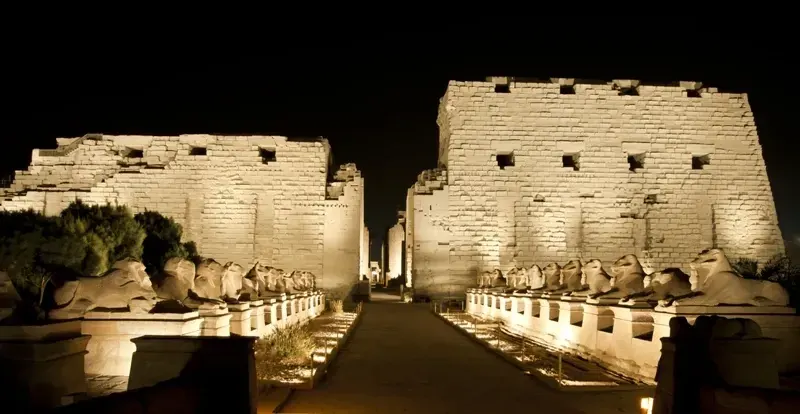
Karnak is not a temple. It is a city of temples. The largest ancient religious complex ever built, Karnak covers more than 100 hectares — an area large enough to contain ten medieval cathedrals — and was constructed, expanded, demolished, and rebuilt by more than 30 different pharaohs over 2,000 years, from the Middle Kingdom (around 2000 BC) through the Ptolemaic period (ending 30 BC). It is the second most visited archaeological site in Egypt after the Giza Pyramids, and it is consistently described by visitors — including those who have seen the Pyramids, the Colosseum, Angkor Wat, and the Taj Mahal — as the single most overwhelming ancient site they have ever stood inside. This guide covers everything you need to make the most of Karnak in 2026.
Karnak Temple 2026 — Complete Visitor Guide
Key Facts
| Location | East Bank of Luxor, 3km north of Luxor Temple |
| Total Area | 100+ hectares — 10× larger than St. Peter’s Basilica in Rome |
| Construction Period | ~2000 BC to 30 BC — 30+ pharaohs contributed |
| Columns | 134 in the Great Hypostyle Hall — the largest columned hall in any religious building ever built |
| Entrance Fee 2026 | 450 EGP (~$9) adults · 225 EGP students |
| Opening Hours | 6:00 AM – 5:30 PM daily (summer 6:00 AM – 6:00 PM) |
| Sound & Light Show | Nightly at 6:30 PM — 300 EGP (~$6) · 2 shows per night (check schedule) |
| UNESCO Status | World Heritage Site since 1979 — part of Ancient Thebes |
| Best Time to Visit | 6:00–9:00 AM — opens at dawn, before tour groups |
What is Karnak? Understanding the Scale
The word “Karnak” is used loosely to refer to the entire complex, but the site actually consists of four main precincts:
- Precinct of Amun-Ra — The main area, open to the public. Dedicated to the supreme god Amun-Ra. Contains the Great Hypostyle Hall, the Sacred Lake, multiple pylons, obelisks, and chapels. This is what most visitors see when they say “Karnak.”
- Precinct of Mut — South of the main enclosure. Dedicated to Amun’s wife Mut. Currently closed for restoration but visible from outside.
- Precinct of Montu — North of the main enclosure. Dedicated to the war god Montu. Not open to the public.
- Temple of Amenhotep IV — Dismantled in antiquity by pharaohs who opposed the Aten religion of Akhenaten. Reconstructed blocks displayed in the Open Air Museum (extra ticket required).
The Great Hypostyle Hall — The Heart of Karnak
The single most extraordinary space inside Karnak is the Great Hypostyle Hall — a forest of 134 columns in 16 rows, covering an area of 5,000 m². The 12 central columns rise to 24 metres (79 feet) — each column is taller than a 7-storey building. The 122 flanking columns reach 15 metres. Every square centimetre of every column is carved with hieroglyphic texts and painted with scenes of pharaohs making offerings to the gods. Standing in the centre of the Hypostyle Hall at dawn, when the first light enters through the clerestory windows above and illuminates the column tops, is one of the most purely overwhelming experiences available anywhere in the ancient world. There is nothing else like it.
Key Highlights at Karnak
The Sacred Lake
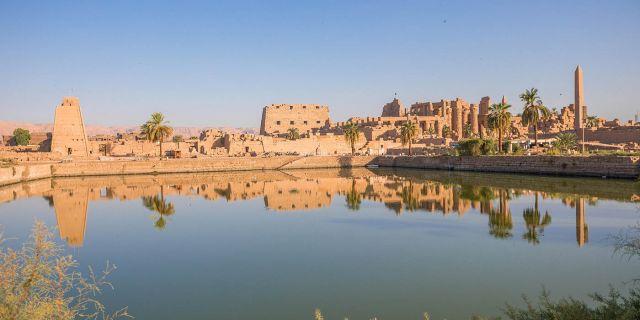
The Sacred Lake of Karnak is one of the best-preserved features of the complex — still filled with water, as it was 3,000 years ago when priests bathed here at dawn before entering the sanctuary. The lake is 80 metres long and 40 metres wide, fed by groundwater from the Nile. The granite scarab beetle on the northwest corner of the lake is one of Karnak’s most-photographed objects: tradition says that walking around it seven times clockwise grants a wish. A colossal statue of Ramesses II holding a small figure of his daughter Meritamun stands near the first pylon — one of the finest statues in the complex.
The Obelisks
Two obelisks of Queen Hatshepsut once stood in the Hypostyle Hall. One remains standing at 29.5 metres, still carrying its electrum cap that once gleamed in the Luxor sun. Hatshepsut ordered her obelisks inscribed with the words: “O ye people who see this monument in years to come and who shall speak of what I have made, beware lest you say ‘I know not, I know not why this was done.’” She was right to be concerned — her successor Thutmose III tried to erase her name from every surface in Karnak. He failed.
The Avenue of Sphinxes
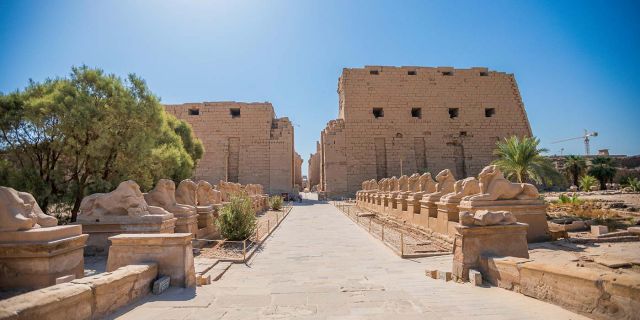
The Avenue of Sphinxes — a 3km processional road lined with ram-headed sphinx statues — once connected Karnak Temple to Luxor Temple 3km to the south. During the annual Opet Festival, the sacred barques of Amun, Mut and Khonsu were carried along this avenue in a procession involving thousands of priests, dancers and citizens. The avenue was recently restored and is now walkable in its entirety — one of the most impressive ancient streets in the world.
The Karnak Sound & Light Show
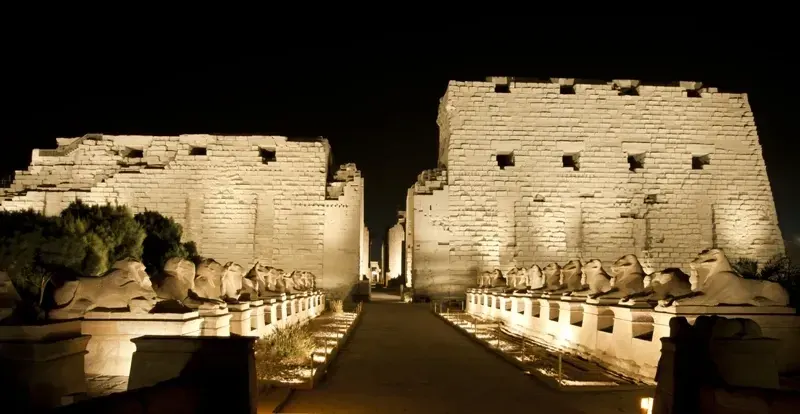
Every night, Karnak hosts a Sound and Light Show — a 90-minute narrated experience where the temple complex is illuminated and the story of its construction told through light, sound, and the voices of ancient pharaohs. The show moves visitors through the complex from the Avenue of Sphinxes through the pylons to the Sacred Lake, where the finale takes place. It is one of the best Sound and Light shows in Egypt. Tickets: approximately 300 EGP (~$6) per person. Shows are typically at 6:30 PM and 8:00 PM — English, French, Italian, German and Arabic performances available. Book in advance in peak season (December–February). Egypt For Travel includes Sound & Light Show tickets as an optional add-on to all Luxor itineraries.
Practical Tips for Visiting Karnak in 2026
- Arrive at opening (6:00 AM): Karnak at dawn, before the tour buses from Hurghada arrive, is a fundamentally different experience from Karnak at 10:00 AM. In October and November, you may have the Hypostyle Hall almost to yourself at 6:30 AM. By 9:00 AM the same space is crowded. This is the most important practical tip for Karnak.
- Wear comfortable shoes: The site covers 100+ hectares. A thorough visit involves 3–5km of walking on uneven stone surfaces.
- Bring water: There is minimal shade between the structures. Carry at least 1 litre. Refreshment stalls are available near the entrance. Egypt For Travel provides bottled water on all excursions.
- Don’t skip the Open Air Museum: Located inside the complex (small extra ticket), the Open Air Museum displays reconstructed temple blocks including the stunning Chapelle Rouge (Red Chapel) of Hatshepsut — one of the most beautifully carved objects in all of Egypt. Most visitors miss it. Your guide will take you there.
- Hire a licensed guide: Karnak without a guide is impressive. Karnak with an Egyptologist is transformative. The stories — Hatshepsut erased by Thutmose III, Akhenaten’s failed religion, Ramesses II’s military campaigns on the walls — need explanation to come alive. All Egypt For Travel Nile cruises include a private Egyptologist guide who covers Karnak in full.
Karnak and the Nile Cruise
Karnak is the first major monument visited on every Nile cruise departing from Luxor. Egypt For Travel’s Nile cruise passengers visit Karnak on the first morning of the cruise, typically at 6:00–9:00 AM before the heat builds and before the day-trip coaches arrive. This timing advantage — one of the key reasons the cruise format is superior to hotel-based travel — means your Egyptologist guide can take you through the Hypostyle Hall, the Sacred Lake, Hatshepsut’s obelisks, and the Open Air Museum in near-solitude. Every Nile cruise from $499 per person includes Karnak as standard. See Egypt For Travel’s complete Nile cruise fleet.
Frequently Asked Questions About Karnak Temple
How many columns does Karnak Temple have?
The Great Hypostyle Hall at Karnak Temple has 134 columns in 16 rows. The 12 central columns are 24 metres tall (79 feet) — as tall as a 7-storey building. The 122 flanking columns reach 15 metres. The Hall covers 5,000 m², making it the largest columned hall of any religious building ever constructed in human history — including all Greek, Roman, or medieval Christian structures. The columns were carved and painted under Ramesses I, Seti I, and Ramesses II during the 19th Dynasty (approximately 1295–1213 BC).
What is the best time to visit Karnak Temple?
The best time to visit Karnak Temple is at opening, 6:00 AM. The complex is dramatically less crowded in the first two hours after opening. The quality of the morning light entering the Hypostyle Hall through the clerestory windows is at its most beautiful between 6:30 and 8:00 AM. By 10:00 AM, large group tours from Hurghada and the Red Sea resorts begin arriving. In October and November, visiting at 6:00 AM can mean having the entire Hypostyle Hall to yourself for 20–30 minutes. In December and January, even at 6:00 AM there are other visitors — but significantly fewer than midday. Egypt For Travel schedules all Nile cruise Karnak visits at dawn specifically for this reason.
Is the Karnak Sound and Light Show worth attending?
Yes — the Karnak Sound and Light Show is one of the best in Egypt and offers a completely different perspective on the complex from the daytime visit. The illumination of the pylons and columns at night, combined with the narrated story of Karnak’s construction, creates an experience that complements rather than duplicates the day visit. At approximately 300 EGP (~$6) per person, it is excellent value. The show that ends at the Sacred Lake — with the temple reflections in the water and the narration of the Opet Festival — is genuinely moving. Book the English-language show in advance in December–February when it sells out.
Karnak is included in all Egypt For Travel Nile cruises from $499 per person, visited at dawn with a private licensed Egyptologist guide. Entrance fees and Sound & Light Show (optional) included. Browse Nile cruises or WhatsApp: +20 155 555 2466. ETA Licence No. 1947.