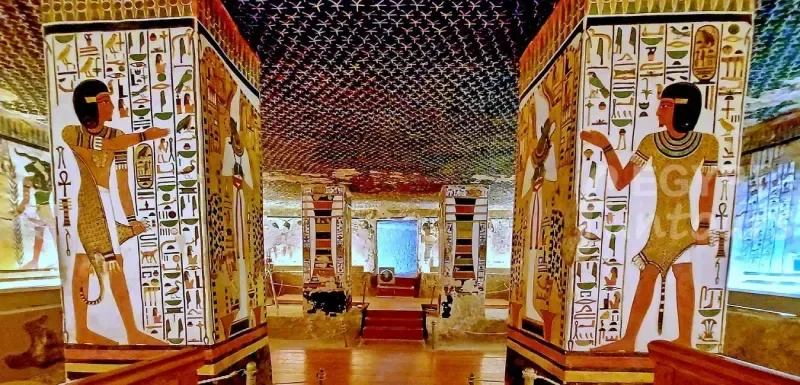
In the Valley of the Queens on the West Bank of Luxor, behind a locked gate that requires a special additional ticket and admits only a limited number of visitors per day, lies the most beautiful room in ancient Egypt. The Tomb of Queen Nefertari (QV66) was sealed for over three thousand years after the queen's burial around 1255 BC — and when Italian archaeologist Ernesto Schiaparelli opened it in 1904, he found the walls covered in paintings so vivid, so technically accomplished, and so emotionally powerful that they have been described by every subsequent Egyptologist who has studied them as the finest surviving examples of ancient Egyptian painting anywhere in the world. To understand why this tomb exists, and why Ramesses II made Nefertari the most honoured queen in Egyptian history, you need to understand the woman herself.
Quick Facts: Queen Nefertari
| Name meaning | Nefertari Merytmut — "Beautiful Companion, Beloved of Mut" |
| Title | Great Royal Wife of Ramesses II · Lady of the Two Lands · Mistress of Upper and Lower Egypt |
| Dynasty | 19th Dynasty — New Kingdom, c. 1295–1255 BC |
| Father | Unknown — possibly a noble family from Thebes or the 18th Dynasty royal line |
| Marriage | Married Ramesses II before his accession — she was his first and most beloved wife throughout his reign |
| Children | At least 4 sons and 2 daughters with Ramesses II, including Prince Amunherkhepeshef |
| Death | c. 1255 BC — approximately Year 25 of Ramesses II's reign; cause unknown |
| Tomb | QV66 — Valley of the Queens, West Bank Luxor; discovered 1904 by Schiaparelli |
| Temple | Small Temple at Abu Simbel — dedicated jointly to Nefertari and the goddess Hathor |
| Tomb entrance fee (2026) | 1,200 EGP (~$24 USD) — separate ticket on top of Valley of the Queens general admission (220 EGP) |
| Visitor limit | Maximum 150 visitors per day — advance booking through Egypt For Travel recommended |
Who Was Nefertari? The Woman Behind the Legend
Nefertari entered history as the wife of Ramesses II before his accession to the throne — which means she was with him from the beginning, shaping the reign that would last 66 years and define the 19th Dynasty. We know relatively little about her origins; the texts that survive tell us about her titles, her appearances in ritual contexts, and Ramesses' evident devotion to her, but her parentage and background remain uncertain. Some scholars have proposed she was of royal 18th Dynasty blood — a granddaughter of the pharaoh Ay — but this is not proven.
What is clear from the textual and archaeological record is that Nefertari held an unusually elevated status among Ramesses' many wives (he had over 200 documented wives and concubines over his 66-year reign). She is consistently named first among his queens, depicted beside him in ritual scenes at a scale equal to the pharaoh himself — a rare honour — and addressed in the inscriptions of her Abu Simbel temple with epithets of divine status normally reserved for goddesses: "one for whom the sun shines."
She accompanied Ramesses on official occasions, including the dedication ceremonies at Abu Simbel, and appears to have played a diplomatic role: a letter in the Hittite royal archive at Hattusa (modern Turkey) records a communication from "Naptera" (Nefertari) to the Hittite queen Puduhepa following the famous peace treaty of Ramesses II with the Hittites — one of the earliest known international peace agreements. The Hittite queen responded warmly, and the exchange of letters between the two queens represents one of the earliest documented examples of royal female diplomacy in history.
What no other guide tells you: The mummy of Nefertari was never found intact. Schiaparelli's 1904 excavation found the tomb ransacked — the mummy destroyed, the grave goods looted in antiquity. What remained was the painted walls, a few fragments of stone sarcophagus, scattered ushabti figurines, and, remarkably, two human knees — preserved in wrapping — that DNA analysis in 2016 confirmed belonged to a woman of approximately 40 years of age at the time of death. These knees in a Turin museum case are the only physical remains of Queen Nefertari.
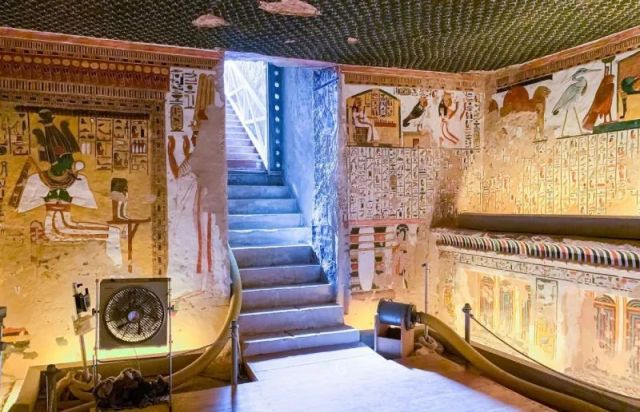
The Tomb of Nefertari (QV66): The Most Beautiful Room in Egypt
The tomb is entered via a short descending staircase into an antechamber — and the moment you step inside and your eyes adjust from the Luxor sunlight to the interior, the impact is immediate and total. The walls are covered from floor to ceiling in paintings executed on a smooth white plaster ground, their colours — after 3,250 years — still vivid enough to appear freshly applied. Deep turquoise sky ceilings scattered with five-pointed gold stars. Walls of warm cream plaster covered in hieroglyphic columns of the Book of the Dead in black and red and blue. Figures of Nefertari herself — tall, elegant, in a translucent white linen dress and elaborate headdress of cow horns and sun disc — moving through scenes of the afterlife with the calm confidence of a woman who knew exactly where she was going.
The painting programme follows Nefertari through the stages of the afterlife as described in the Book of the Dead and the Book of Gates: her heart weighed against the feather of Ma'at in the Hall of Two Truths; her reception by the gods of the Duat; her transformation into a divine being worthy of eternal existence alongside Osiris and Ra. In every scene she is depicted with golden skin — the colour of divine beings — rather than the yellow-ochre conventionally used for living women. Ramesses was saying, in painted pigment, that his wife was already divine.
The burial chamber itself has a vaulted ceiling painted as the night sky — deep blue scattered with gold stars — beneath which the sarcophagus of Nefertari once rested on a granite base. The paintings here include some of the most technically accomplished in the entire tomb: a figure of the goddess Neith drawing her bow, a kneeling Nefertari before the seated gods of the Ennead, and on the side walls the mummified form of Osiris — Nefertari's destination and ultimate identification — painted in the deep green of resurrection and vegetative rebirth.
The Temple of Nefertari at Abu Simbel
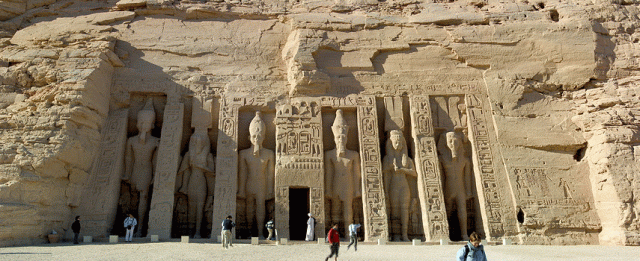
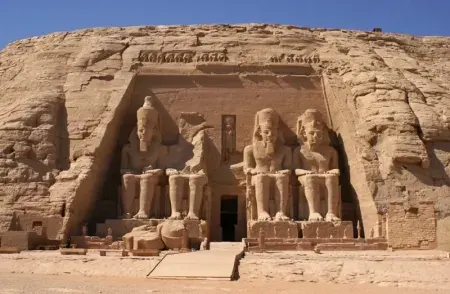
Ramesses II built two temples carved into the sandstone cliff at Abu Simbel in Nubia: a Great Temple dedicated to himself and the gods Ra-Horakhty, Amun, and Ptah, and a Small Temple dedicated to Nefertari and the goddess Hathor — the only occasion in ancient Egyptian history where a pharaoh dedicated a major rock-cut temple to his wife rather than to himself or the gods. The facade of the Small Temple features six standing colossal figures: four of Ramesses II and two of Nefertari, all at the same scale — an extraordinary statement of equality between king and queen in a tradition where queens were typically depicted at knee height beside their husbands.
The inscription on the facade reads: "Ramesses II, he has made a temple, excavated in the mountain, of eternal workmanship, for the Chief Queen Nefertari Beloved of Mut, in Nubia, forever and ever." Inside, the reliefs show Nefertari in ritual roles normally reserved for the pharaoh himself — making offerings, wearing the double crown of Upper and Lower Egypt, identified with Hathor in her role as the divine feminine principle of the universe. Visit our complete Abu Simbel guide for everything you need to plan your visit.
Visiting the Tomb of Nefertari: Practical Guide
| Detail | Information |
|---|---|
| Location | Valley of the Queens, West Bank Luxor — QV66 |
| Special entrance fee (2026) | 1,200 EGP (~$24 USD) — separate ticket in addition to Valley of the Queens admission (220 EGP) |
| Visitor limit | Maximum 150 visitors per day — book in advance; sell out during peak season (Oct–Apr) |
| Photography | Strictly prohibited inside the tomb — to protect the pigments; exterior and entrance area permitted |
| Time inside | Visits are timed — typically 10–15 minutes inside; guards monitor numbers carefully |
| Best approach | Book through Egypt For Travel — we secure the special ticket and include in the Luxor West Bank itinerary |
| Combine with | Valley of the Queens general visit (QV55, QV44) · Valley of the Kings · Deir el-Medina · Medinet Habu |
Frequently Asked Questions — Queen Nefertari
Who was Queen Nefertari?
Nefertari (c. 1295–1255 BC) was the first and most beloved Great Royal Wife of Pharaoh Ramesses II of the 19th Dynasty. Her name means "Beautiful Companion." She is the most honoured Egyptian queen after Hatshepsut, having been dedicated a temple at Abu Simbel and given the most elaborately decorated tomb in the Valley of the Queens (QV66).
What is special about Nefertari's tomb?
Tomb QV66 contains the finest painted wall decoration of any ancient Egyptian tomb — superior in technical quality, colour preservation, and compositional elegance even to the royal tombs in the Valley of the Kings. The paintings cover every wall and the vaulted ceiling of the burial chamber in scenes from the Book of the Dead, executed with a mastery of line, colour, and spatial composition that has never been surpassed in Egyptian art.
How much does it cost to enter Nefertari's tomb?
The special tomb ticket costs 1,200 EGP (~$24 USD) per person, in addition to the standard Valley of the Queens admission (~220 EGP). It is the most expensive single-tomb ticket in Egypt — and worth every pound. Egypt For Travel includes the ticket in its Luxor West Bank tour pricing where the tomb visit is included.
Is Nefertari the same as Nefertiti?
No — they are two different queens from different dynasties. Nefertari (c. 1295–1255 BC) was the wife of Ramesses II (19th Dynasty). Nefertiti (c. 1370–1330 BC) was the wife of Akhenaten (18th Dynasty) — famous for the painted limestone bust in the Berlin Museum. Both names contain the root nefer (beautiful) but the queens are separated by nearly a century and are completely unrelated.
Did Nefertari have a temple at Abu Simbel?
Yes — the Small Temple at Abu Simbel was dedicated by Ramesses II to his wife Nefertari and the goddess Hathor. It is one of only two occasions in Egyptian history where a pharaoh dedicated a major temple to his wife. The six colossal standing figures on the facade — four of Ramesses and two of Nefertari, all at equal scale — are a unique statement of royal devotion in Egyptian monumental art.
Was Nefertari's mummy found?
No intact mummy was found. The tomb had been robbed in antiquity and the mummy destroyed. When Schiaparelli excavated QV66 in 1904, he found only the painted walls, fragments of a granite sarcophagus, scattered ushabtis, and two mummified human knees. DNA analysis in 2016 confirmed the knees belonged to a woman of approximately 40 years at death — almost certainly Nefertari herself. Her knees are preserved in the Museo Egizio in Turin, Italy.
Visit the Tomb of Queen Nefertari as part of a private Luxor West Bank day tour with Egypt For Travel — browse Luxor day tours. Special QV66 ticket arranged · Private Egyptologist guide · Valley of the Queens · Valley of the Kings · All entrance fees. WhatsApp: +20 155 555 2466. ETA Licence No. 1947.




.webp)