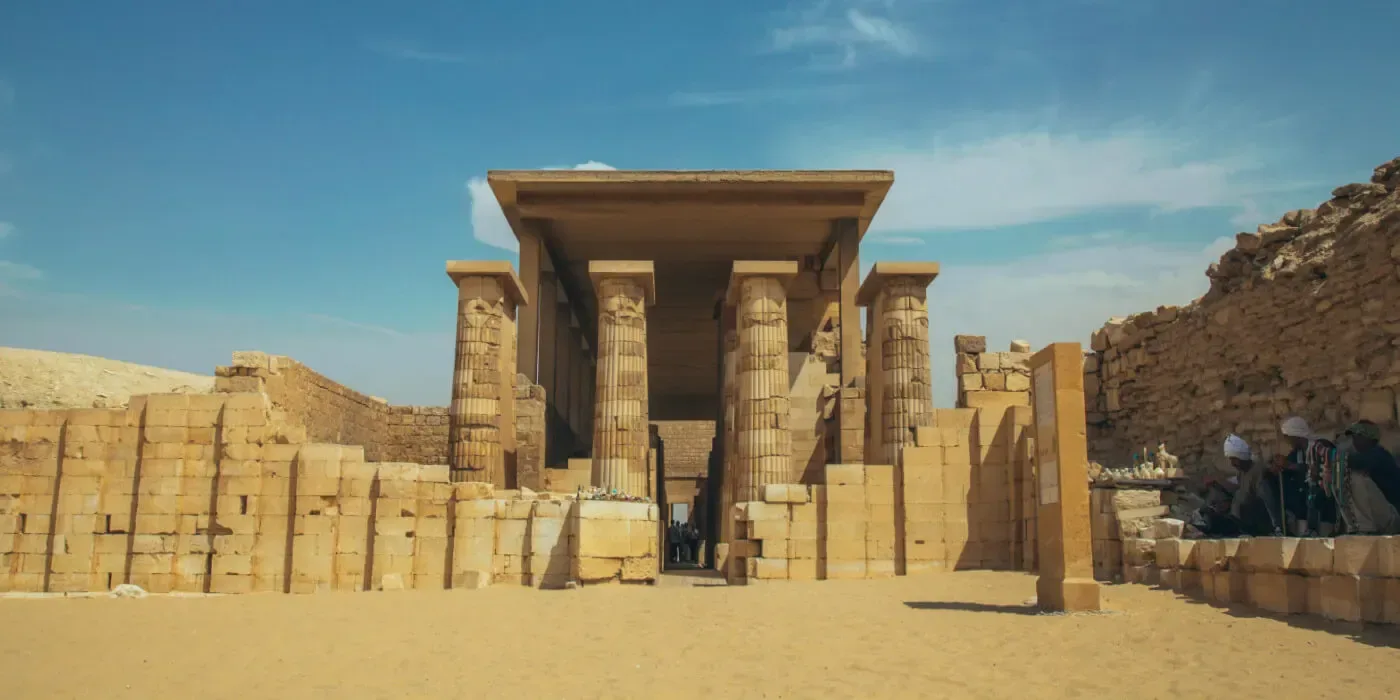
Egypt has two great ancient cemeteries. The famous one is the Valley of the Kings in Luxor. The overlooked one — older, larger, and in many respects more remarkable — is Saqqara. Stretching for 8km along the desert plateau above Memphis, the ancient capital, Saqqara served as the royal and noble necropolis of Egypt for over 3,000 years. Its centrepiece, the Step Pyramid of Djoser, is the world’s oldest large-scale stone structure and the direct architectural ancestor of every pyramid that followed. Most visitors to Cairo see only the Giza Pyramids. The ones who include Saqqara return home with a significantly deeper understanding of ancient Egypt — and a private experience of one of its most extraordinary sites.
.jpg?1780579375570)
Saqqara 2026 — Complete Visitor Guide
Quick Facts
| Location | 30km south of central Cairo · 15km from the Giza Pyramids |
| Area | 8km of desert plateau — one of the largest ancient cemeteries in the world |
| Entrance Fee 2026 | ~600 EGP (~$12) main area including Step Pyramid · Serapeum: separate ~100 EGP extra |
| Opening Hours | 8:00 AM – 4:00 PM daily |
| Key Highlights | Step Pyramid · Serapeum · Pyramid of Unas · Mastaba tombs · Ongoing excavations |
| Best Combined With | Giza Pyramids (same morning/afternoon) or Memphis open-air museum (nearby) |
| Time Needed | 2–3 hours for the main sites · Half-day for a thorough visit including the Serapeum |
The Step Pyramid of Djoser — The World’s Oldest Stone Structure
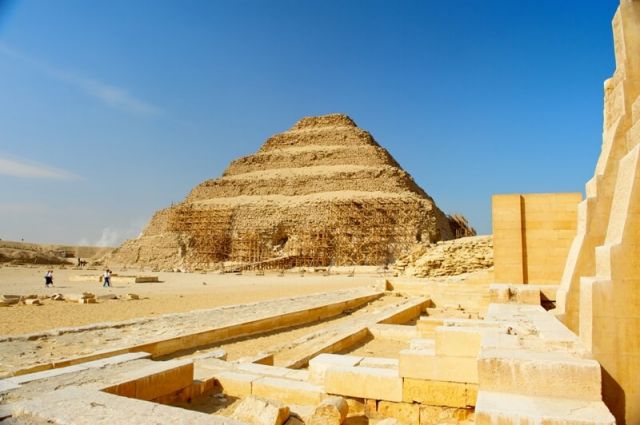
The Step Pyramid of Djoser, built around 2650 BC by the architect Imhotep for Pharaoh Djoser of the 3rd Dynasty, is the oldest monumental stone construction on earth and the single most important building in architectural history. Before Imhotep, Egyptian royal tombs were flat-topped mastabas made of mudbrick. Imhotep’s revolutionary idea was to stack six mastabas of decreasing size on top of each other in limestone, creating a stepped structure 62 metres high and 125 metres wide. This was the prototype. Every pyramid that followed — including the Great Pyramid of Khufu 100 years later — is the direct architectural descendant of this building.
The Step Pyramid is surrounded by a funerary complex enclosed within a 10-metre limestone wall, the oldest stone-walled enclosure in the world. The complex includes dummy buildings — facades with no interior rooms, designed purely to create the appearance of a royal court in the afterlife. The sophistication of this concept — an entire architectural landscape created specifically for the dead — is extraordinary for 2650 BC.
The Serapeum — Saqqara’s Most Unusual Site
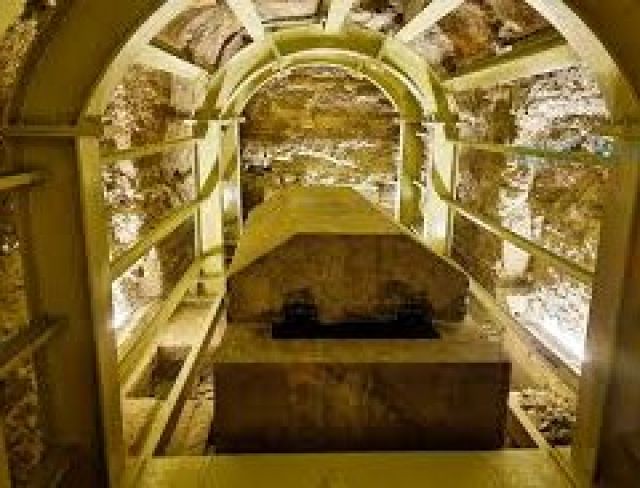
Saqqara’s most extraordinary and least-known site is the Serapeum — a network of underground tunnels cut into the bedrock of the plateau where the sacred Apis bulls were buried for over 1,300 years. The Apis bull was the living incarnation of Ptah, god of creation and craftsmanship, and was kept in great honour at Memphis. When each Apis bull died, it was mummified and buried in a monolithic granite sarcophagus weighing over 70 tonnes each, placed in the underground galleries. The galleries contain 24 such sarcophagi, some intact with their 80-tonne granite lids still in place. Auguste Mariette discovered the Serapeum in 1851 — the discovery of the underground galleries, the massive sarcophagi, and the enormous effort required to bring 70-tonne blocks underground was one of the greatest archaeological discoveries of the 19th century. The Serapeum is dimly lit, atmospheric, and one of the most genuinely haunting ancient spaces in Egypt.
The Pyramid Texts — The World’s Oldest Religious Writing
The Pyramid of Unas at Saqqara (5th Dynasty, ~2375 BC) contains the earliest surviving examples of Pyramid Texts — the world’s oldest known corpus of religious writing. These 283 spells are inscribed in blue-green hieroglyphics on the white limestone walls of the burial chamber and passages, covering topics including the deceased king’s resurrection, transformation into a star, and ascent to the solar barque of Ra. They are the direct ancestors of the later Coffin Texts and the Book of the Dead. Standing inside the Pyramid of Unas, reading 4,400-year-old religious spells written in the world’s first great literary language, is an experience with few equivalents anywhere on earth.
Saqqara’s New Discoveries 2022–2026
Saqqara is the most actively excavated archaeological site in Egypt. Recent seasons have produced extraordinary results. In 2022–2023, Egyptian archaeologists discovered over 150 complete bronze statuettes and 250 wooden and bronze figurines at Saqqara, dating from the Late Period (7th–4th centuries BC). Additional sealed tombs with intact mummies, including a 4,300-year-old mummy of a man named Hekashepes covered entirely in gold leaf, were found in 2023. Excavations are ongoing — your Egyptologist guide will be aware of the most recent finds. The excavation tents and ongoing work visible at the site add a contemporary dimension of discovery to the ancient context that the Valley of the Kings, for all its power, no longer offers.
The Decorated Mastaba Tombs
Beyond the Step Pyramid, Saqqara contains dozens of decorated mastaba tombs belonging to the nobility of the Old Kingdom (2686–2181 BC). Several are open to the public and contain some of the finest painted relief scenes in ancient Egypt. The Mastaba of Ti has extraordinary scenes of everyday life — cattle being led, papyrus being cut, bread being baked, musicians performing — painted with a naturalism and warmth that makes 4,500-year-old Egyptian life feel immediate and recognisable. The Mastaba of Mereruka is the largest private tomb in Saqqara with 32 chambers. These tombs give a picture of how non-royal Egyptians lived and what they valued — a humanising counterpoint to the immense formal monuments of the kings.
How to Visit Saqqara — Combining with Giza
The optimal Cairo day: Giza Pyramids in the morning (7:00–11:00 AM), lunch break during the hottest midday hours, Saqqara in the afternoon (1:00–4:00 PM). The two sites are 15km apart — a 20-minute drive. This combination gives you both the most famous pyramids in Egypt and the most historically important one in a single day, with the optional addition of the Memphis open-air museum (30 minutes, 100 EGP) on the way between them. Egypt For Travel’s Tour to Pyramids, Memphis and Saqqara ($60) covers all three sites in one private guided day.
Frequently Asked Questions
Can I visit Saqqara and the Giza Pyramids on the same day?
Yes — this is the recommended approach. Giza Pyramids and Saqqara in the same day is the most efficient way to see both sites. The Giza Pyramids are best visited at opening (7:00 AM) when they are least crowded and the light is ideal for photography. Saqqara can be visited in the afternoon without rushing. The two sites are 15km apart, a 20-minute drive. Egypt For Travel’s Tour to Pyramids, Memphis and Saqqara ($60) covers all three in one day including the private guide, private vehicle and entrance fees.
Is the Step Pyramid of Djoser open to visitors in 2026?
Yes — the Saqqara archaeological area including the Step Pyramid complex is open to visitors in 2026. The Step Pyramid itself is not accessible for interior entry — it is viewed from outside. The surrounding complex, including the House of the South, House of the North, and the Heb Sed Court, is accessible. The Serapeum is open separately (approximately 100 EGP extra ticket). Several decorated mastaba tombs are open on a rotating basis — your guide will know which are currently accessible on the day of your visit.
Visit Saqqara with Egypt For Travel — combined with the Giza Pyramids and Memphis in one private guided day from Cairo. Tour to Pyramids, Memphis & Saqqara — $60 per person. Private Egyptologist guide, private vehicle, all fees included. WhatsApp: +20 155 555 2466. ETA Licence No. 1947.