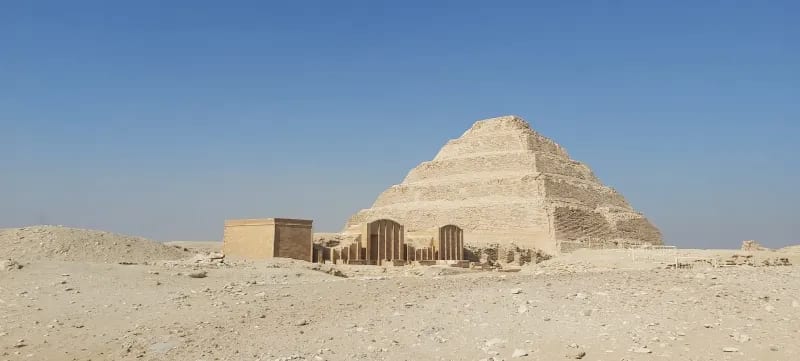
In the desert south of Cairo, on a limestone plateau overlooking the ancient capital of Memphis, stands the monument that changed everything. The Step Pyramid of Djoser — built around 2667 BC during the reign of the Third Dynasty pharaoh Djoser — is not simply Egypt's first pyramid. It is the oldest large-scale stone building ever constructed by human beings, a structure that predates Stonehenge by over a thousand years and the Parthenon by more than two thousand. When Imhotep, Djoser's chief architect and vizier, began planning this monument, no one on Earth had ever built anything like it in stone. What he created at Saqqara did not just change Egyptian architecture — it changed the history of human building itself.
For travellers visiting the Giza Pyramids, Saqqara and the Step Pyramid are frequently left as an afterthought or skipped entirely. This is one of the great missed opportunities in Egyptian tourism. The Giza Pyramids are undeniably magnificent, but they are the perfected form of an idea. Saqqara is where the idea was born. Coming here, you see the thinking behind the monuments — the six stages of construction, the experimental courtyard shrines, the underground galleries that no one intended anyone to see — and the whole astonishing enterprise of pyramid-building becomes comprehensible in a way that standing at Giza simply cannot provide.
Quick Facts: Step Pyramid of Djoser
| Pharaoh | Djoser (also spelled Djeser, Zoser) — Third Dynasty, c. 2667–2648 BC |
| Architect | Imhotep — later deified as a god of medicine and wisdom |
| Date built | c. 2667–2648 BC — approximately 4,700 years ago |
| Original height | 62.5 metres (205 feet) |
| Base dimensions | 121 metres × 109 metres |
| Number of tiers | 6 steps (originally 4, then expanded twice) |
| Building material | Local Saqqara limestone — small blocks (unlike the massive Giza blocks) |
| Enclosure complex size | 544 × 277 metres — the largest funerary complex in Egypt at the time |
| Underground galleries | Over 5.7 km of shafts and tunnels beneath the pyramid |
| UNESCO status | World Heritage Site (Memphis & its Necropolis, inscribed 1979) |
| Entrance fee (2026) | ~600 EGP (~$12 USD) — Saqqara site ticket covers all monuments |
| Distance from Cairo | ~30 km south — approximately 45 minutes by car |
Imhotep: The Man Who Invented the Pyramid
The Step Pyramid cannot be discussed without understanding the man who conceived it. Imhotep — whose name means "He who comes in peace" — was Djoser's chief architect, physician, vizier, high priest of Ra, and the most celebrated intellectual of the Old Kingdom. He is one of only two commoners in Egyptian history to be fully deified after death (the other being Amenhotep son of Hapu, a New Kingdom official). By the Ptolemaic period, the Greeks had identified him with Asclepius, their own god of medicine, and temples were built to him as a healing deity throughout Egypt and Greece.
What Imhotep did at Saqqara was conceptually radical. Before him, royal burials used the mastaba — a flat-topped rectangular structure of mud brick or small stone, essentially a bench over a burial pit. Imhotep began with a mastaba for Djoser, then had an unprecedented idea: he stacked a second, smaller mastaba on top of the first. Then a third on top of that. Then three more, each smaller than the last — and in doing so created the world's first large-scale stone structure. But Imhotep did not stop at the pyramid. He surrounded it with an enormous mortuary complex of 14 hectares, enclosed within a 10.5-metre-high limestone wall with 14 dummy doorways and one real entrance — a complete ceremonial city for the dead pharaoh, built to last eternity.
What no other guide tells you: The limestone blocks used to build the Step Pyramid are significantly smaller than those used at Giza — averaging about 30×15 cm, roughly the size of a large modern brick. Imhotep and his builders were thinking in mud brick; they simply translated familiar mud-brick dimensions into stone. The architects of the Fourth Dynasty, building for Khufu and Khafre a century later, had learned enough to work with massive multi-tonne blocks. The Step Pyramid is literally the moment humanity was still learning to think in stone.
.jpg?1781899704795)
The Pyramid's Construction: Six Stages in One Monument
One of the most remarkable things about the Step Pyramid is that archaeologists have been able to reconstruct its entire construction sequence — because Imhotep changed the design not once but five times during the process, each revision visible in the structure today.
Stage 1: A square mastaba, 63 metres per side, built over the underground burial shaft. Cased in fine white Tura limestone. This was the original plan — a large but conventional mastaba.
Stage 2: The mastaba was extended on all four sides, making it rectangular (larger). Imhotep was already rethinking the form.
Stage 3: Four mastabas were stacked on top of the rectangular base, creating a four-tiered stepped structure facing east. This was a genuinely new concept — nothing like it had ever been built.
Stages 4–6: The base was again extended west and north; two more tiers were added; the whole was re-cased in fine limestone and the enclosure complex expanded. The final structure — six tiers, 62.5 metres high — was the result of continuous creative revision rather than a single plan executed to completion.
This revision process is not a sign of indecision or failure. It is a sign of invention: Imhotep was working out a new idea in real time, adjusting as he went, and the fact that the building survived 4,700 years of desert heat, earthquake, and plunder is testament to how well he solved each problem as it arose.
The Underground World: 5.7 km of Secret Galleries
Beneath the Step Pyramid lies a labyrinth that most visitors never see and few travel guides adequately describe. Imhotep and his builders excavated a central shaft 28 metres deep directly beneath the pyramid's centre, at the bottom of which lies the granite-lined burial chamber of Djoser. But the shaft is only the beginning. Radiating from this central core are more than 5.7 kilometres of tunnels and galleries, cut through the bedrock and lined with blue-green faience tiles imitating the reed matting of a royal palace.
These underground galleries served several purposes. Some were storage chambers for the 40,000 stone vessels — in alabaster, schist, and serpentine — found during 20th-century excavations: the largest single cache of stone vessels ever discovered in Egypt, inscribed with the names of kings going back five dynasties before Djoser. Others were symbolic spaces: faience-tiled rooms representing the royal apartments of the living palace, recreated underground so that Djoser's spirit could inhabit them for eternity. Three doorways in the faience galleries frame carved relief panels of Djoser himself performing the Heb-Sed festival — among the finest and best-preserved royal reliefs of the Old Kingdom, now in the Egyptian Museum in Cairo.
Djoser's actual mummy was never found. The burial chamber was robbed in antiquity, and only a mummified left foot — believed by some Egyptologists to be Djoser's — was recovered during excavations. The sarcophagus itself was sealed, which strongly suggests the burial was completed, meaning the body was removed at some point in the 4,700 years since interment.
The Mortuary Complex: A Complete City for the Dead
The pyramid is the centrepiece of a vast funerary complex that Imhotep designed to serve Djoser's spirit in the afterlife. The complex covers 14 hectares — an area larger than many ancient cities — and is surrounded by a 10.5-metre-high panelled limestone wall stretching 544 metres north-south and 277 metres east-west. Of the 14 doorways in the wall, 13 are false (dummy facades carved to look like open doors but actually solid stone) — only one real entrance exists, in the south-east corner, leading through a colonnaded hall of 40 engaged columns into the complex beyond.
The Heb-Sed Court
South of the pyramid, the Heb-Sed Court was designed to allow Djoser's spirit to perform the Heb-Sed festival — the royal jubilee ceremony, held after 30 years of reign, in which the pharaoh ritually proved his continued fitness to rule by running between boundary markers and performing symbolic rites. The shrines lining the court are dummy structures — facades only, with no interior space — built purely as permanent stage-sets for the eternal performance of the ceremony. This concept — that the afterlife required not real buildings but the appearance of buildings — reveals something profound about how the Egyptians understood death and eternity.
The Serdab
On the north face of the pyramid, a small stone box with two small holes drilled through its north wall contains a life-size painted limestone statue of Djoser — the oldest life-size royal statue in Egyptian history. The statue sits with its gaze directed precisely upward through the holes toward the circumpolar stars (the stars that never set, which the Egyptians associated with eternal life). The original statue is in the Egyptian Museum in Cairo; the one in the serdab today is a replica, but the effect — of a king sitting in silent, eternal vigil — is extraordinarily powerful.
What to See at Saqqara Beyond the Step Pyramid
Saqqara is a vast necropolis stretching 7 km along the desert plateau, and the Step Pyramid complex is only the most famous of its many extraordinary monuments. Egypt For Travel's Pyramids, Saqqara & Memphis day tour from $60 per person covers all the key sites in a single well-paced day.
| Site at Saqqara | What It Is | Highlight |
|---|---|---|
| Step Pyramid Complex | Djoser’s pyramid + enclosure walls + courts + serdab | World’s oldest stone building — the essential first stop |
| Pyramid of Unas | 5th Dynasty pyramid (c. 2375 BC) — exterior modest, interior extraordinary | Oldest Pyramid Texts ever found — hieroglyphic spells covering the burial chamber walls |
| Mastaba of Ti | 5th Dynasty noble tomb (c. 2400 BC) | Egypt’s finest Old Kingdom painted reliefs — scenes of agriculture, hunting, boat-building, daily life |
| Tomb of Mehu | 6th Dynasty vizier’s tomb — discovered 1940, opened to public 2018 | Vivid, brilliantly coloured reliefs nearly unique in their preservation — one of Saqqara’s best-kept secrets |
| The Serapeum | Underground catacombs for the sacred Apis bulls — Ptolemaic period | 27 colossal granite sarcophagi, each weighing 70 tonnes, in underground galleries — genuinely breathtaking |
| New Kingdom Tombs | Generals and officials of Tutankhamun’s era — discovered from 1975 onward | Tomb of Maya (Tutankhamun’s treasurer) and Horemheb — painted reliefs rivalling the Valley of the Kings |
Practical Visitor Guide — Step Pyramid of Djoser
| Detail | Information |
|---|---|
| Location | Saqqara necropolis, ~30 km south of Cairo, ~12 km south of Giza |
| Entrance Fee (2026) | ~600 EGP (~$12 USD) — covers all of Saqqara including Step Pyramid, Unas, Serapeum |
| Opening Hours | Daily 08:00–17:00 (last entry 16:00) |
| Interior access | Pyramid interior (descending shaft) — access periodically restricted for restoration; confirm before visiting |
| Time needed | 2–3 hours for Step Pyramid complex only; 4–5 hours for full Saqqara necropolis |
| How to get there | Private car from Cairo (~45 min); no public transport to the site — combine with Giza and Memphis in one day |
| Best time to visit | Arrive at 08:00 — Saqqara gets afternoon tour groups; morning is quieter and cooler |
| What to wear | Comfortable walking shoes (uneven desert terrain); sun hat and water essential; sunscreen |
| Combined day tour | Giza Pyramids (morning) + Saqqara (midday) + Memphis (afternoon) — the classic Cairo full day, from $60 per person |

How Djoser's Pyramid Changed Egyptian History
The impact of Imhotep's invention at Saqqara cannot be overstated. Within three generations, the builders of the Fourth Dynasty — Sneferu, Khufu, Khafre, Menkaure — took Imhotep's concept and refined it into the smooth-sided true pyramid, culminating in the Great Pyramid of Khufu at Giza: the largest building ever constructed by human beings. But without Saqqara, there is no Giza. The entire trajectory of Egyptian pyramid-building — from the Step Pyramid to the Great Pyramid of Giza — spans less than 200 years. In two centuries, Egyptian builders went from mud brick to the most sophisticated stone construction programme the ancient world ever produced.
The intermediate steps of this journey — Sneferu's Meidum Pyramid, the Bent and Red Pyramids at Dahshur — are visible evidence of an engineering tradition learning from its mistakes in real time, each new pyramid more confident than the last. To visit Saqqara, Dahshur, and Giza in sequence is to witness one of the great accelerations of human capability in a single day.
Frequently Asked Questions — Step Pyramid of Djoser
Is the Step Pyramid the oldest pyramid in Egypt?
Yes. The Step Pyramid of Djoser, built approximately 2667–2648 BC, is the oldest pyramid in Egypt and the oldest large-scale stone structure ever built by human beings anywhere on Earth.
Who built the Step Pyramid?
The Step Pyramid was built for Pharaoh Djoser of the Third Dynasty, designed by his chief architect and vizier Imhotep — one of the most celebrated intellects of the ancient world, later deified as a god of medicine and wisdom.
Can you go inside the Step Pyramid?
The interior of the Step Pyramid (the descending shaft to the burial chamber) has periodically been open to visitors but is subject to restoration closures. The underground galleries are not generally accessible to tourists. Always confirm current access before your visit — Egypt For Travel's guides will know the latest status.
How is the Step Pyramid different from the Giza Pyramids?
The Step Pyramid is stepped (six tiers) rather than smooth-sided, was built from small limestone blocks rather than massive stone, and is approximately 100 years older. It is also surrounded by a complete mortuary complex of buildings and courts, whereas the Giza complex focuses more on the causeways, valley temples, and the Sphinx. The Step Pyramid shows the invention of the pyramid; Giza shows its perfection.
How long does a visit to Saqqara take?
Allow at least 2–3 hours for the Step Pyramid complex alone. For a comprehensive Saqqara visit including the Serapeum, Mastaba of Ti, and Pyramid of Unas, allow 4–5 hours. Most visitors combine Saqqara with Giza and Memphis in a full-day tour (approximately 8–9 hours total).
Is Saqqara worth visiting if I have already seen Giza?
Absolutely — and many visitors say Saqqara is the more interesting site. Giza provides scale and spectacle; Saqqara provides understanding. The combination of the Step Pyramid, the Serapeum's colossal Apis bull sarcophagi, and the extraordinary painted mastaba reliefs makes Saqqara one of the richest single archaeological sites in Egypt. It also attracts far fewer visitors than Giza, meaning you can explore at a genuinely unhurried pace.
What is the entrance fee for Saqqara in 2026?
The Saqqara site ticket costs approximately 600 EGP (~$12 USD) and covers all monuments in the complex including the Step Pyramid, the Pyramid of Unas, and the Serapeum. Individual tombs may charge separate small fees (~340 EGP). Egypt For Travel includes all entrance fees in its day tour pricing.
Visit the Step Pyramid of Djoser as part of a private Pyramids, Saqqara & Memphis day tour with Egypt For Travel — from $60 per person, all entrance fees included. Private Egyptologist guide · Air-conditioned vehicle · Lunch optional. WhatsApp: +20 155 555 2466. ETA Licence No. 1947.