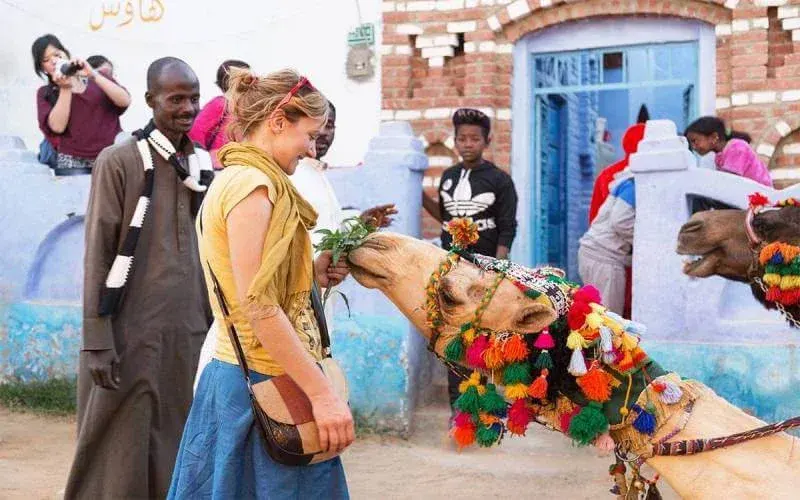
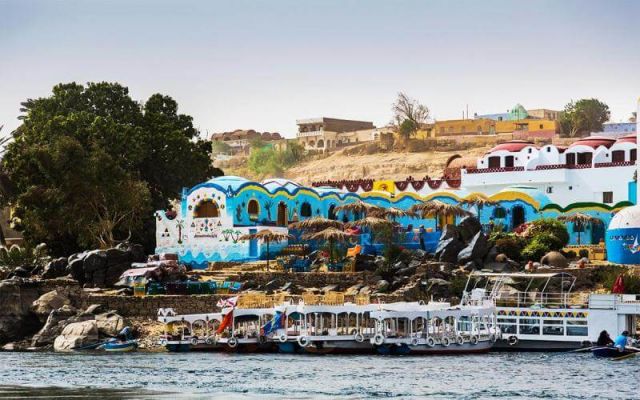
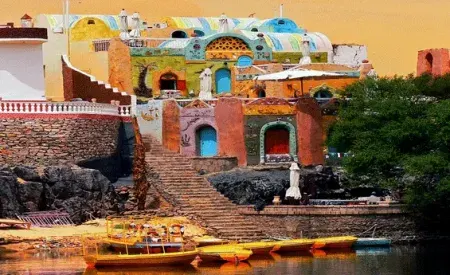
Sixty kilometres south of Aswan, the landscape changes. The desert cliffs that frame the Nile for most of its Egyptian course recede, the river widens, and the villages along its banks begin to appear in colours that have no equivalent in the rest of Egypt: deep indigo, turquoise, ochre, coral, bright white with painted crocodiles and fish and the names of the hajj pilgrimages of previous generations spelled out on the external walls in bold Arabic script. These are Nubian villages — and the culture behind those walls is one of the oldest and most extraordinary in Africa.
Who Are the Nubian People?
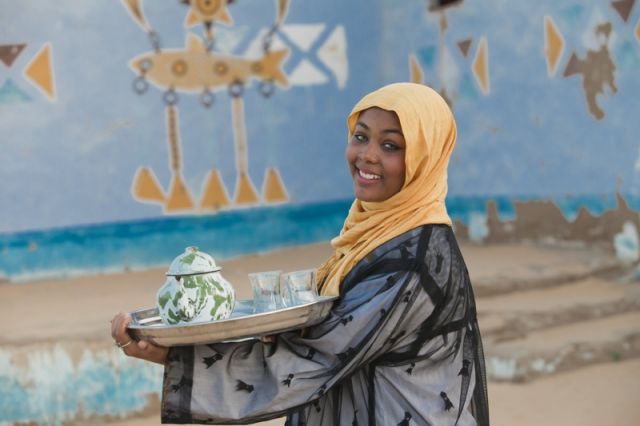
The Nubian people are the indigenous population of the Nile Valley between the first and sixth cataracts — the region stretching from Aswan in Egypt south into Sudan. Their civilisation is older than pharaonic Egypt: the Kingdom of Kush and the earlier A-Group and C-Group Nubian cultures were established along the Nile long before Narmer unified Upper and Lower Egypt in 3100 BC. Nubian pharaohs ruled all of Egypt during the 25th Dynasty (760–656 BC), building more pyramids than any other civilisation — there are over 200 Nubian pyramids in Sudan compared to Egypt’s 118. The Nubian language — Nobiin — is still spoken in Aswan-area villages and is entirely unrelated to Arabic, a linguistic survivor of one of the world’s great ancient civilisations.
The Displacement — The Story Behind the Villages
The Nubian villages near Aswan that visitors see today are not the original Nubian homeland. The construction of the Aswan High Dam between 1960 and 1970 flooded the original Nubian homeland — hundreds of villages, ancestral farmland and the historic town of Wadi Halfa — beneath Lake Nasser, the reservoir created by the dam. Approximately 100,000 Nubians were displaced. UNESCO’s response included the rescue operation that moved Philae Temple and Abu Simbel to higher ground. The Nubian people were resettled in purpose-built villages north of Aswan — and they brought their culture with them, reconstructing in their new environment the painted houses, the social structures and the traditions of a homeland that now lies beneath the lake. The coloured walls of Nubian houses today are partly an assertion of cultural identity: we are still here, and this is who we are.
Nubian Houses — The Colours and What They Mean
The most immediately striking feature of a Nubian village is the painted house facades. Unlike the mud-brick beige of most Egyptian villages, Nubian houses are painted in vivid colours — turquoise and cobalt blue being most common, but also coral pink, deep green and bright yellow. The decoration follows specific traditions:
- Crocodile paintings: Crocodiles painted on the outer walls represent the crocodile god Sobek — a protective figure for Nubians who lived alongside the Nile’s real crocodiles for millennia. Painted crocodiles bring luck and ward off misfortune.
- Hajj murals: When a family member completes the pilgrimage to Mecca (the Hajj), the house is painted with scenes of the journey — aeroplanes, the Kaaba in Mecca, the journey route — to announce the achievement and honour the pilgrim. These murals are painted by the community in celebration.
- Fish and palm trees: Traditional Nile Valley motifs representing abundance, the river and life — painted around doorways and window frames.
- Blue interiors: The interior courtyards of many Nubian homes are painted deep blue — a colour believed to keep away insects and evil spirits, a practice shared across the Egyptian-Nubian Nile Valley.
Nubian Hospitality — What to Expect as a Guest
Nubian hospitality is not a performance for tourists — it is a deeply held cultural value. Refusing tea or coffee in a Nubian home is considered impolite. Guests are expected to accept what is offered. A typical Nubian welcome includes hibiscus tea (karkadeh) served cold and very sweet, or ginger tea (zanjabil) served hot — both made from ingredients grown in the village gardens. Biscuits, dates and sometimes fresh Nile fish follow. Conversation through your Egyptologist guide covers family history, the displaced homeland, the village’s traditions and current life. Nubian visits arranged through Egypt For Travel are genuine encounters with Nubian families who open their homes voluntarily — not staged tourist experiences.
Nubian Culture — Traditions That Survive
| Tradition | What It Is | When You See It |
|---|---|---|
| Henna ceremonies | Elaborate henna body art applied at weddings · Nubian patterns distinct from North African designs | Wedding season · on request during village visits |
| Nubian music | Doumbek (goblet drum) and oud music · distinctive pentatonic scales · call-and-response singing | Evening village gatherings · weddings · cultural performances |
| Pottery | Hand-formed terracotta pots with geometric patterns · ancient Nubian pottery tradition dating to 3000 BC | Village craft markets · family workshops |
| Basket weaving | Palm frond and straw baskets in geometric designs · used daily and sold as crafts | Every village · women weaving outside homes |
| Nobiin language | Ancient Nubian language · unrelated to Arabic · still spoken at home by older generations | Conversations between Nubian elders |
| Karkadeh (hibiscus tea) | Dried hibiscus flowers steeped in cold water with cane sugar · deep red colour, tart flavour | Every Nubian home · every village tea shop · all of Aswan |
What to Eat in a Nubian Village
Nubian cuisine reflects the Nile Valley environment: fish from the Nile and Lake Nasser, vegetables grown in the narrow strip of fertile land beside the water, and spices imported from Sudan and sub-Saharan Africa. Dishes you may encounter in a Nubian village visit:
- Ful medames: Slow-cooked fava beans with garlic, lemon and cumin — the staple Egyptian and Nubian breakfast, eaten with flatbread
- Grilled Nile perch: Freshly caught from the Nile or Lake Nasser, grilled over charcoal with cumin and chilli — the finest fish dish in Egypt
- Karkadeh: Hibiscus tea — cold in summer, hot in winter — the signature Nubian beverage, rich in vitamin C and served very sweet
- Zanjabil: Fresh ginger tea — warming, spiced, ubiquitous in Nubian homes in the cooler months
- Basbousa: Semolina cake soaked in sugar syrup with shredded coconut — a common Nubian sweet shared with guests
How to Visit a Nubian Village From Aswan
The main Nubian villages accessible from Aswan are Gharb Soheil (the closest, 7km south by motorboat across the Nile) and the villages on Elephantine Island in the Nile opposite central Aswan. Egypt For Travel arranges Nubian village visits as part of the Aswan program on every multi-day tour — motorboat transfer included, Egyptologist guide translating and providing cultural context, welcome tea with a Nubian family included. The visit takes approximately 1.5–2 hours and is one of the most humanly memorable experiences in any Egypt itinerary.
| Program | Includes Nubian Village | From |
|---|---|---|
| Nubian Village Day Tour | ✅ Dedicated Nubian village tour | From Aswan |
| 7-Night Egypt from USA | ✅ Aswan Day 4 includes Nubian visit | $1,599 |
| 11 Days All-Inclusive | ✅ Aswan Day 4 includes Nubian visit | $1,799 |
| Egypt Vacation Package | ✅ Aswan program includes Nubian visit | $1,549 |
WhatsApp: +20 155 555 2466 · ETA Category A Licence No. 1947
Frequently Asked Questions
What is Nubian culture known for?
Nubian culture is known for five things above all: the extraordinary coloured painted houses (turquoise, cobalt, coral, with crocodile and hajj murals); the warmth of Nubian hospitality (tea and food offered to every guest as a matter of cultural honour); the Nobiin language (an ancient African language unrelated to Arabic, still spoken by older Nubians); distinctive music (doumbek and oud with pentatonic scales found nowhere else in Egypt); and the ancient history that predates pharaonic Egypt and produced the 25th Dynasty Nubian pharaohs who ruled all of Egypt. Visiting a Nubian village near Aswan gives access to all five dimensions of this culture in a single afternoon.
Can tourists visit Nubian villages in Egypt?
Yes — Nubian villages near Aswan are open to visitors and Nubian families genuinely welcome guests. The main accessible villages are Gharb Soheil (reached by motorboat, 7km south of Aswan) and the Nubian villages on Elephantine Island. Egypt For Travel arranges village visits as part of every Aswan program. Your Egyptologist guide handles introductions, translations and cultural context. A dedicated Nubian Village Day Tour is also available from Aswan.
What is the best way to experience Nubian culture as a tourist?
The most authentic way is a motorboat crossing to Gharb Soheil village with a licensed Egyptologist guide, tea with a Nubian family in their painted home, a walk through the village lanes, and time at the craft market. Combine this with Philae Temple (its island was sacred to Isis and its final closure in 550 AD marked the end of the ancient Egyptian religion) and the Aswan corniche at sunset for the finest single day Aswan offers any traveler.
Are Nubians Egyptian or Sudanese?
Both. The Nubian homeland straddles the Egyptian-Sudanese border along the Nile Valley. Egyptian Nubians have Egyptian nationality and live primarily around Aswan. Sudanese Nubians live primarily around Wadi Halfa and Dongola in Sudan. The Aswan High Dam’s Lake Nasser now bisects the original Nubian homeland between the two countries. Egyptian Nubians are Egyptian citizens who consider themselves both Egyptian and Nubian — a dual identity rooted in their ancient pre-pharaonic history and their post-displacement resilience.
 -.webp)