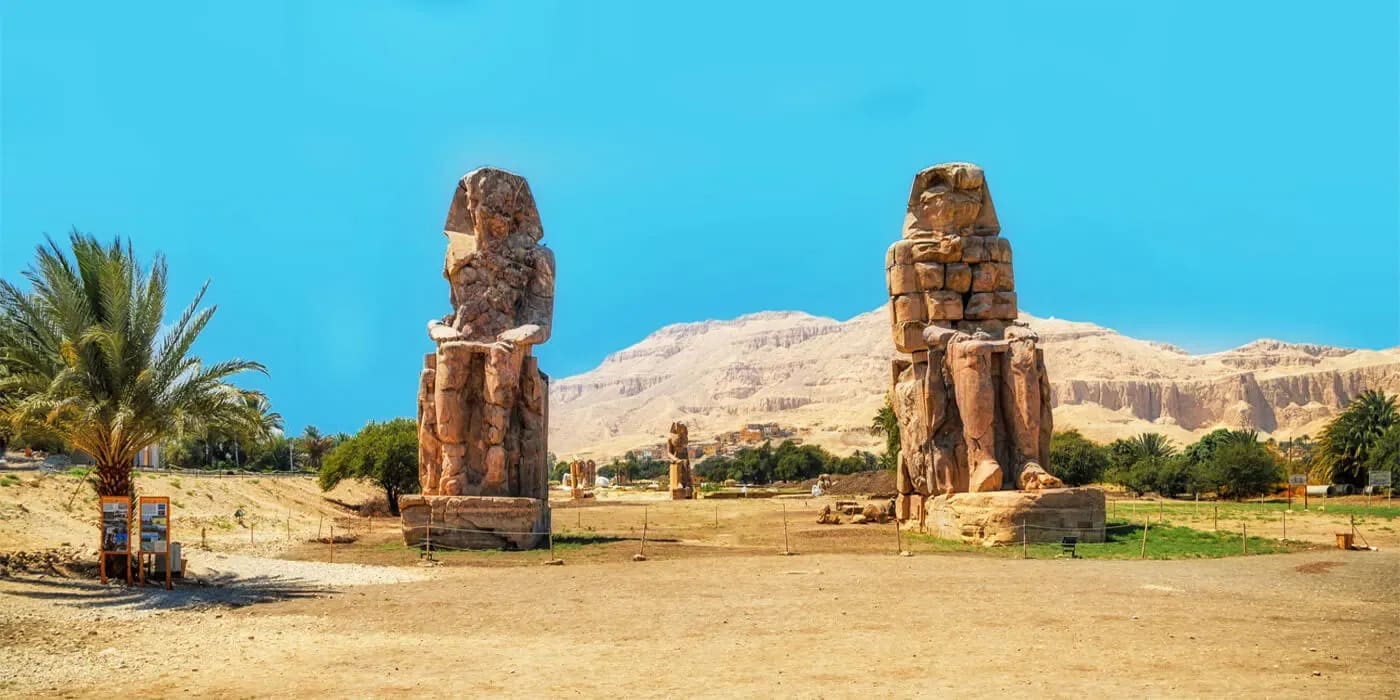
Every West Bank tour in Luxor begins here. Before the Valley of the Kings, before Hatshepsut's terraced temple, before Deir el-Medina — the first thing you see as your vehicle crosses from the East Bank and turns south along the agricultural plain is two enormous seated figures rising from the flat green fields, staring north across the Nile with the impassive authority of men who have been waiting for 3,400 years and have learned patience. The Colossi of Memnon are so familiar from photographs that they risk becoming wallpaper — another box ticked on the West Bank circuit. They deserve better than that. Behind each statue is a story about pharaonic power, Greek misidentification, Roman tourism, and one of the greatest lost temples of the ancient world — a story that most visitors never hear.
Quick Facts: Colossi of Memnon
| Who they depict | Pharaoh Amenhotep III — 18th Dynasty, c. 1388–1351 BC |
| Date built | c. 1350 BC |
| Height | 18 metres (60 feet) each — approximately the height of a 6-storey building |
| Weight | ~700 tonnes each |
| Material | Quartzite sandstone — quarried at el-Gabal el-Ahmar near Cairo and transported 675 km overland |
| Figures at the base | Queen Tiye (wife) and Mutemwiya (mother) carved beside the legs; Hapi (Nile god) on side panels |
| Original purpose | Gatekeepers of Amenhotep III's mortuary temple — the largest temple ever built in Egypt |
| The "singing" statue | The northern colossus — emitted a sound at sunrise after earthquake damage (27 BC); silenced by Roman repairs (199 AD) |
| Entrance fee | Free — no ticket required |
| Opening hours | Site is open — always accessible (exterior); best at sunrise and golden hour |
| Location | West Bank of Luxor — immediately off the main road, ~2 km from the Nile ferry landing |
Amenhotep III: The Pharaoh Behind the Statues
Amenhotep III reigned for approximately 37 years (c. 1388–1351 BC) during the height of the New Kingdom — the period of Egypt's greatest imperial power, diplomatic reach, and artistic achievement. He inherited an empire that stretched from Nubia to the Euphrates, and he spent his reign not expanding it through war (he fought very little) but consolidating and celebrating it through an unprecedented building programme. Amenhotep III built more temples, erected more statues, and produced more large-scale art than almost any pharaoh before him. He is, arguably, the greatest patron in ancient Egyptian history — and the man who commissioned the Colossi is also the man who commissioned the temple of Luxor Temple's original core, most of the Karnak complex's Third Pylon, and what was once the largest mortuary temple ever built in Egypt.
The Colossi were created not as standalone monuments but as the entrance pylons of that mortuary temple — twin guardian figures flanking the gateway through which the god Amun would process during the annual Festival of the Valley. The statues depict Amenhotep III seated on his throne, his hands resting on his thighs, wearing the double crown of Upper and Lower Egypt. The scale was deliberate: at 18 metres, they were the tallest royal statues in Egypt at the time, and the temple behind them was even more extraordinary in scale.
What no other guide tells you: The quartzite for the Colossi was quarried at el-Gabal el-Ahmar, near modern Cairo, and transported 675 kilometres overland to Thebes — not by river, because the Nile current runs northward and the blocks would need to travel south. This was one of the largest organised land-transport operations in ancient Egyptian history. Each block was moved on sledges dragged over wetted sand by teams of workers — an operation that required months of planning and thousands of man-hours before a single statue was even begun.
The Singing Statues: A Roman Tourist Attraction
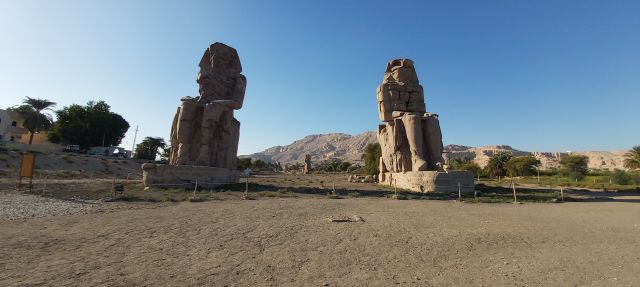
In 27 BC, a significant earthquake struck the Theban region. The northern colossus — already weakened by centuries of Nile inundation at its base — cracked across the lower torso. After the earthquake, something remarkable began to happen: in the early morning hours, as the temperature rose with the sun, the damaged statue began to emit a sound. Ancient visitors described it variously as a musical note, a ringing tone, a wail, or the sound of a plucked string. The sound occurred at or just after sunrise and was not reliably reproducible — some visitors heard it, others did not.
The Greeks and Romans who encountered the statue identified the sound with the myth of Memnon — a hero of the Trojan War, son of the goddess Eos (Dawn), killed by Achilles. According to the myth, Eos wept for her son each morning (the dew) and Memnon's shade called out to her at dawn. The identification of this particular statue with Memnon was geographically and historically completely wrong — Memnon was a Trojan War hero, not an Egyptian pharaoh, and the statues depicted Amenhotep III — but it stuck, and from the 1st century BC onward, hearing "Memnon sing" became one of the must-do experiences of ancient tourism, drawing visitors from across the Roman Empire.
The inscriptions carved by these ancient visitors — over 100 Greek and Latin graffiti covering the lower portions of both statues — include texts by Roman emperors, generals, and poets, including Hadrian and his consort Sabina, who visited in 130 AD. Sabina wrote a poem about what she heard; Hadrian came twice hoping to hear the sound. The inscriptions constitute one of the best-documented ancient tourist sites in the world.
In 199 AD, the Emperor Septimius Severus ordered the cracked statue repaired. It was rebuilt in horizontal courses of sandstone — the repair visible today as a colour difference in the upper portion of the northern colossus — and the sound was never heard again. The prevailing modern explanation is that the sound was produced by dew evaporating from the crack in the stone as the morning temperature rose, causing the stone to vibrate slightly. The repair sealed the crack and ended the phenomenon.
The Lost Temple: Amenhotep III's Mortuary Complex
The Colossi are almost all that survives above ground of what was once the largest temple ever built in ancient Egypt. Amenhotep III's mortuary temple covered an area of approximately 35 hectares — larger than Karnak's main enclosure, larger than any other temple in the Theban necropolis, larger than any temple in Egypt before or after. It contained multiple pylons, hypostyle halls, peristyle courts, sanctuaries, and auxiliary buildings, all decorated with statuary on a scale that matched the temple's footprint. The Third Pylon alone was guarded by colossi of Amenhotep III that rivalled the famous Abu Simbel statues in size.
The temple's destruction was almost total, for a simple reason: it was built too close to the Nile flood plain. Each annual inundation submerged the temple's foundations, weakening the stone and depositing silt that eventually buried the lower courses. Later pharaohs — including Merenptah and Ramesses II — dismantled the remaining stonework and reused it in their own building projects. By the Roman period, only the Colossi remained standing, everything else having been robbed, flooded, or buried.
Since 1998, an international excavation project led by German Egyptologist Hourig Sourouzian has been systematically uncovering what remains of the temple beneath the fields behind the Colossi. The excavation has recovered thousands of fragments of statuary — including several colossal quartzite figures of Amenhotep III that rank among the finest royal sculptures from the New Kingdom — and has progressively revealed the temple's layout. The ongoing excavation is visible from the site on your visit, and the finds are displayed in the Luxor Museum.
Practical Visitor Guide — Colossi of Memnon
| Detail | Information |
|---|---|
| Entrance fee | Free — no ticket required to view the statues from the road and viewing area |
| Best time to visit | Sunrise (06:00–07:30) for golden light and near-solitude; late afternoon (16:00–17:30) for warm raking light and fewer coaches |
| Time needed | 20–40 minutes at the site; the statues can be appreciated from the road or approached closely on foot |
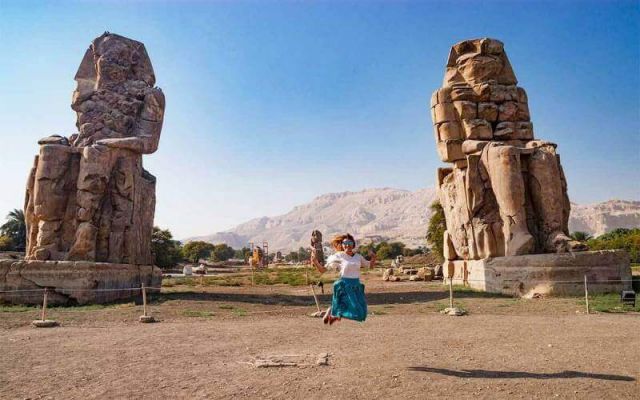
| Photography | Excellent — especially at sunrise and sunset; bring a wide-angle lens to capture both statues together |
| Combine with | Natural start/end point for the full West Bank circuit — Valley of the Kings, Hatshepsut Temple, Deir el-Medina, Medinet Habu all within 15 min |
| Accessibility | Flat ground, paved viewing area — fully accessible for visitors with mobility limitations |
| Vendors | Souvenir vendors operate around the site — polite refusal is sufficient; no obligation |
Frequently Asked Questions — Colossi of Memnon
Is there an entrance fee for the Colossi of Memnon?
No — the Colossi of Memnon are free to visit. There is no ticket booth or entrance gate. You can walk to the viewing area in front of the statues at any time. This makes them one of the few major ancient Egyptian monuments that costs nothing to see.
Why are they called the Colossi of Memnon if they depict Amenhotep III?
The name comes from a Greek misidentification. After earthquake damage in 27 BC caused the northern statue to emit a sound at sunrise, Greek and Roman visitors identified it with Memnon — a hero of the Trojan War and son of the dawn goddess Eos. The name stuck even though Memnon has no connection whatsoever to ancient Egypt or to Amenhotep III. The statues have depicted the Egyptian pharaoh Amenhotep III since 1350 BC; "Colossi of Memnon" is simply the name that 2,000 years of usage has fixed on them.
Do the Colossi of Memnon still sing?
No. The "singing" phenomenon — a sound produced by thermal expansion of the cracked northern statue at sunrise — was silenced when the Roman Emperor Septimius Severus ordered the statue repaired in 199 AD. The repair sealed the crack that produced the sound. No sounds have been reported since.
How tall are the Colossi of Memnon?
Each statue stands 18 metres (60 feet) high — approximately the height of a six-storey building. Including their bases, the total height is approximately 21 metres. Each statue weighs an estimated 700 tonnes.
What was behind the Colossi originally?
The Colossi were the gatekeepers of Amenhotep III's mortuary temple — the largest temple ever built in ancient Egypt, covering approximately 35 hectares. The temple was almost completely destroyed by Nile flooding and stone-robbing by later pharaohs. An ongoing excavation since 1998 is progressively revealing what remains beneath the agricultural fields behind the statues.
Can I visit the Colossi at sunrise?
Yes — and this is strongly recommended. The statues face east, so the morning sun lights their faces directly and the golden hour light is extraordinary. The site has no opening restrictions and you can arrive as early as you like. A sunrise visit before the Valley of the Kings opens at 06:00 is an excellent way to begin a West Bank day.
Visit the Colossi of Memnon as part of a private Luxor West Bank day tour with Egypt For Travel — browse Luxor day tours. Private Egyptologist guide · Valley of the Kings · Hatshepsut Temple · All entrance fees included. WhatsApp: +20 155 555 2466. ETA Licence No. 1947.
.webp)