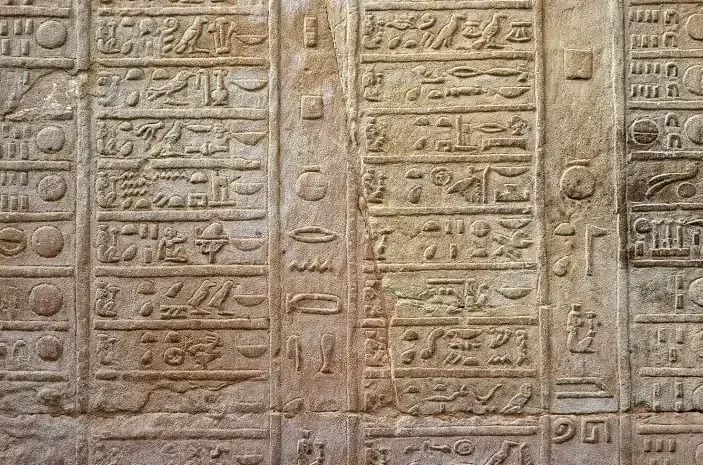
When you walk through Karnak Temple or descend into a Valley of the Kings tomb, virtually every surface is covered in hieroglyphics. Most visitors walk past them as beautiful but incomprehensible decoration. Your Egyptologist guide reads them in real time: the name of the pharaoh in the oval cartouche, the spell from the Book of the Dead on the tomb wall, the account of a military campaign on a temple pylon, the dedicatory inscription above a temple entrance. Every hieroglyphic inscription was written to be understood, to be recited, to be magically activated by being read aloud. This guide explains what hieroglyphs are, how they work, how they were deciphered, and where to see the finest examples in Egypt today.
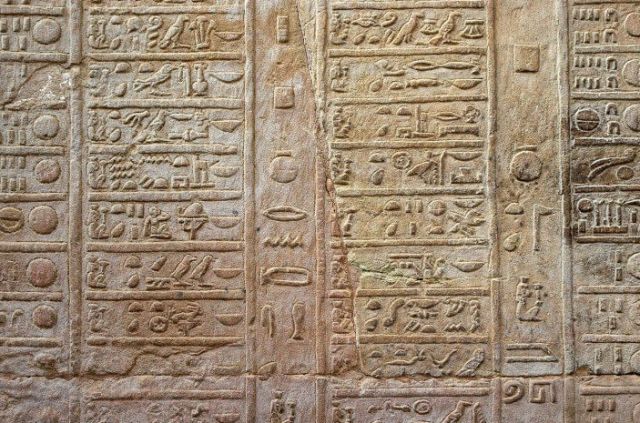
Hieroglyphs — Fast Facts
| Fact | Detail |
|---|---|
| In use | ~3200 BC to 394 AD — over 3,500 years of continuous use |
| Last inscription | August 24, 394 AD at Philae Temple — a graffito by a priest of Isis |
| Number of signs | Approximately 750 signs in Classical Middle Egyptian · over 6,000 signs by the Ptolemaic period |
| Reading direction | Right to left (most common) · or left to right · or top to bottom — the animal and human figures face the start of the text |
| Deciphered | September 27, 1822 by Jean-François Champollion, using the Rosetta Stone |
| Rosetta Stone | Found by Napoleon’s troops in 1799 at Rosetta (Rashid) · now in the British Museum · decree of Ptolemy V in 196 BC in 3 scripts |
| Language recorded | Ancient Egyptian — a language in the Afro-Asiatic family, related to Coptic (still used in Egypt’s Coptic Christian liturgy) |
How Hieroglyphs Work — The Three Types of Signs
Hieroglyphs are not an alphabet (one sign = one sound). They are a mixed system of three sign types used simultaneously, which is why they are complex to read:
| Sign Type | What It Does | Example |
|---|---|---|
| Logograms | The picture means the thing depicted | Picture of a sun = “sun” or “day” |
| Phonograms | The picture represents a sound (one consonant, two consonants, or three) | Picture of a mouth = the sound “r” |
| Determinatives | Silent signs placed at the end of words to indicate their category | Small man figure at end of a word = the word refers to a man or male activity |
Ancient Egyptian was written without vowels (only consonants were written) and without spaces between words — making reading hieroglyphs a skill requiring years of specialised training. Egypt For Travel’s Egyptologist guides hold university degrees in Egyptology and can read the inscriptions you see on temple walls and tomb passages in real time, translating directly for you as you stand before them.
How Hieroglyphs Were Deciphered — The Champollion Breakthrough
| Year | Event |
|---|---|
| 394 AD | Last hieroglyphic inscription carved at Philae · knowledge of the script dies with the last priests |
| 1,400 years | Hieroglyphs remain undeciphered · medieval scholars believe they are purely symbolic, not phonetic |
| 1799 | French soldiers find the Rosetta Stone near Rashid during Napoleon’s Egypt campaign · the stone has the same decree in Greek, Demotic and hieroglyphs |
| 1814–1819 | British polymath Thomas Young identifies that hieroglyphs in oval cartouches spell royal names phonetically · correctly identifies Ptolemy’s name |
| September 27, 1822 | Jean-François Champollion announces the complete decipherment of hieroglyphs in Paris · the key insight: hieroglyphs are a mixed phonetic-logographic system, not purely symbolic · Champollion had spent years studying Coptic (the descendant of ancient Egyptian) and could identify the sounds |
The Cartouche — How to Spot a Pharaoh’s Name
The most useful thing any visitor to Egypt can learn about hieroglyphs is how to identify a cartouche: an oval rope ring enclosing the phonetically-spelled name of a pharaoh. Every royal name in Egypt was written in a cartouche — on temple walls, tomb paintings, obelisks, statues, jewellery and papyri. When you spot an oval with hieroglyphs inside in any Egyptian site, you are reading a pharaoh’s name. The same cartouche appears on the temple walls, on the objects in the GEM, and on the workers’ graffiti inside the Great Pyramid — one of those confirms, beyond any doubt, who built it.
Where to See the Finest Hieroglyphs in Egypt 2026
| Site | Hieroglyphic Highlight | Location |
|---|---|---|
| Karnak Temple | Hypostyle Hall — 134 columns covered in cartouches of Ramesses II and Seti I | Luxor |
| Tomb of Seti I (KV17) | Finest carved and painted hieroglyphs in any royal tomb — Book of the Dead, Amduat, Litany of Ra | Valley of the Kings |
| Edfu Temple | Best-preserved wall-to-ceiling hieroglyphic reliefs in Egypt — Ptolemaic period at its finest | Nile cruise stop |
| Abu Simbel | Ramesses II’s military victory texts + divine inscriptions in the finest New Kingdom style | Aswan/Lake Nasser |
| Grand Egyptian Museum (GEM) | Book of the Dead papyri · cartouches on Tutankhamun objects · hieroglyphic labels throughout | Giza, Cairo |
| Program | Hieroglyphic Sites | From |
|---|---|---|
| 5 Days Cairo & Luxor | GEM · Karnak · Valley of Kings hieroglyphs | $749 |
| 7-Night Egypt from USA | GEM · Karnak · Edfu · Philae · Valley of Kings | $1,599 |
| 15 Days Complete Egypt | All of above + Abu Simbel hieroglyphs | $2,499 |
WhatsApp: +20 155 555 2466 · ETA Category A Licence No. 1947
Frequently Asked Questions
What are Egyptian hieroglyphs?
Egyptian hieroglyphs are the pictorial writing system used by the ancient Egyptians from approximately 3200 BC to 394 AD — over 3,500 years. They are a mixed system combining logograms (pictures meaning the thing depicted), phonograms (pictures representing sounds) and determinatives (silent category markers). They were used for religious texts, royal inscriptions, administrative records and funerary literature. The word “hieroglyph” comes from the Greek hieros (sacred) and glyphe (carving) — “sacred carved signs.” The Egyptians called their own writing medu netjer — “words of god.”
How were hieroglyphs deciphered?
The key was the Rosetta Stone, discovered in 1799 by French soldiers near Rashid (Rosetta) during Napoleon’s Egypt campaign. It contains the same decree — issued by Ptolemy V in 196 BC — in three scripts: Greek (which scholars could read), Demotic (a simplified Egyptian script) and hieroglyphs. By matching the Greek names of Ptolemy, Cleopatra and other rulers with their hieroglyphic spellings, the French scholar Jean-François Champollion cracked the phonetic system on September 27, 1822 — 1,428 years after the last hieroglyphic inscription was carved. The Rosetta Stone is now in the British Museum; a replica is displayed at the Grand Egyptian Museum (GEM).
Can you still read hieroglyphs today?
Yes — Egyptologists worldwide can read ancient Egyptian hieroglyphs as a result of Champollion’s 1822 decipherment. The language has been studied and expanded continuously since then. Egypt For Travel’s Egyptologist guides hold university degrees in Egyptology from Egyptian universities and can read the inscriptions on temple walls and tomb passages in real time, translating cartouches, ritual texts and dedicatory inscriptions directly for visitors. When you stand in Karnak’s Hypostyle Hall and your guide reads the cartouche of Ramesses II above your head — naming a man who lived 3,200 years ago — it is one of the most powerful moments Egypt offers any traveler.