.webp)
The Valley of the Kings is the reason most people come to Egypt. Not the Pyramids — although they are extraordinary. Not the GEM — although it is unmissable. The Valley of the Kings is where you stand inside a tomb carved 3,300 years ago, look up at a ceiling painted with the same cosmological texts that guided a pharaoh through the afterlife, and feel the full weight of ancient Egypt’s civilisation fall upon your shoulders. No photograph prepares you for it. No description adequately conveys what it is like to be inside KV9, looking up at the astronomical ceiling of Ramesses VI’s burial chamber, and understanding that you are looking at something painted before Homer wrote the Iliad. This guide covers everything you need to make the most of the Valley of the Kings in 2026.

Valley of the Kings 2026 — Complete Guide
Key Facts
| Location | West Bank, Luxor — across the Nile from Luxor city |
| Period | New Kingdom — approximately 1550 to 1070 BC |
| Total Tombs | 63 known tombs (numbered KV1–KV63) + ongoing excavations |
| Tombs Currently Open | Approximately 18–20 open to visitors (varies by season) |
| Entrance Fee 2026 | 750 EGP (~$15) includes 3 tombs — additional tombs: 200–600 EGP extra |
| Tutankhamun’s Tomb | Extra ticket: 700 EGP (~$14) on top of standard entry |
| Best Time to Visit | 6:00–9:00 AM for coolest temperatures and fewest visitors |
| Photography | Prohibited inside tombs (permitted outside). No flash photography. |
| UNESCO Status | UNESCO World Heritage Site (part of Ancient Thebes) |
The History of the Valley of the Kings
For nearly 500 years, from approximately 1550 BC to 1070 BC, the pharaohs of the New Kingdom chose this remote valley on Luxor’s West Bank as their burial ground. The pyramid form — which had defined royal burial for a thousand years before — was abandoned for practical reasons: pyramids advertised their riches to robbers. The Valley of the Kings was a calculated attempt at secrecy: a wadi carved deep into the limestone cliffs, with a naturally pyramid-shaped peak (known as “the Peak” or Meretseger after the serpent goddess who was believed to guard it) visible from the Nile as a natural marker. The strategy failed. Every tomb was robbed in antiquity — except one. The tomb of the boy king Tutankhamun (KV62), whose unimportant position had caused it to be buried by rubble from later construction, remained virtually intact until Howard Carter discovered it on 4 November 1922. What he found inside became the greatest archaeological discovery in history.
The Best Tombs to Visit in 2026
Your standard entrance ticket includes 3 tombs from the general rotation. These are the tombs we recommend prioritising:
⭐ KV9 — Tomb of Ramesses VI (Most Impressive)
The single most visually stunning tomb in the Valley. The astronomical ceiling of the burial chamber depicts the Book of the Night and Book of the Day in extraordinary detail — the sky goddess Nut swallowing the sun at dusk and giving birth to it at dawn, flanked by thousands of stars and deities. The scale and preservation of the paintings in KV9 exceed every other tomb open to visitors. This is the tomb that stops everyone who enters it. Always include KV9 in your visit.
⭐ KV11 — Tomb of Ramesses III (Most Complete)
One of the longest tombs in the Valley at 125 metres, KV11 is remarkable for its side chambers depicting everyday life — bakeries, food storage, musicians — alongside the standard religious texts. The corridor paintings are exceptionally well-preserved. The tomb was partially used by Ramesses III after Ramesses II’s original plans were altered. The famous “harper’s tomb” scenes are here.
KV2 — Tomb of Ramesses IV (Good Overview)
One of the easier tombs to navigate — wide corridors, excellent preservation, and a magnificent sarcophagus still in situ. Known for having Greek and Coptic graffiti from ancient tourists who visited thousands of years ago. The ceiling of the burial chamber is painted with the goddess Nut in spectacular fashion.
KV14 — Tomb of Tausert/Setnakht (Large Scale)
One of the largest tombs in the Valley, originally constructed for Queen Tausert and usurped by Pharaoh Setnakht. The double-use history gives it an unusual double set of decorations in some sections. Impressive scale with good preservation.
KV62 — Tomb of Tutankhamun (Extra Ticket Required)
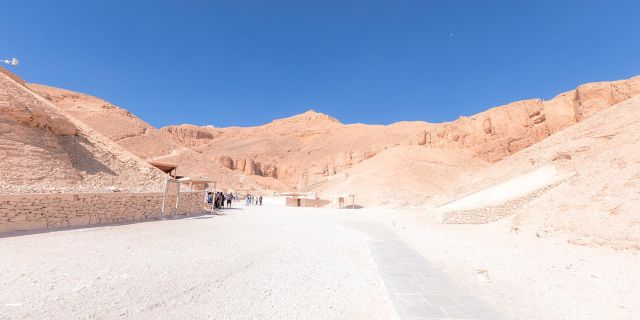
Tutankhamun’s tomb requires a separate ticket (600 EGP, ~$12). It is the smallest royal tomb in the Valley — probably because Tutankhamun died unexpectedly young and was buried hastily in a tomb originally intended for a non-royal. The famous treasures have been moved to the Grand Egyptian Museum. What remains in the tomb: the decorated burial chamber walls (including the famous scene of Ay performing the Opening of the Mouth ceremony), and Tutankhamun’s mummy, which remains in the tomb in its outer sarcophagus, visible beneath a glass panel. Visiting the tomb where one of history’s most famous discoveries was made is worth the extra ticket — but manage your expectations: the room is small and the treasures are at the GEM.
Practical Tips for Visiting in 2026
- Arrive early: The Valley opens at 6:00 AM. Visiting between 6:00 and 9:00 AM means cooler temperatures, fewer visitors, and better photography light. After 10:00 AM in peak season, the Valley fills significantly.
- Bring water: There is shade in the tombs but the walk between them is exposed. Carry at least 1 litre. Egypt For Travel provides bottled water on all excursions.
- Wear a hat and sunscreen: Essential from March onwards. The Valley is a bowl of pale limestone that reflects heat intensely.
- No photography inside tombs: Flash photography is strictly prohibited and can permanently damage pigments that have survived 3,000 years. Phone cameras without flash are also prohibited inside most tombs. Photograph outside only.
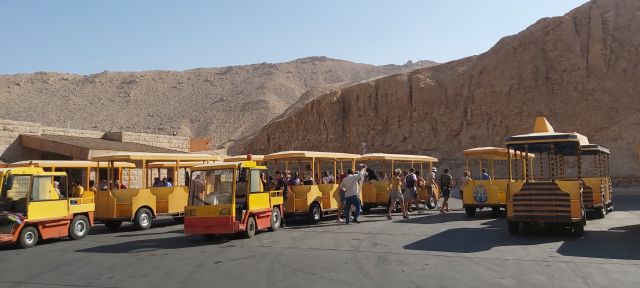
- Use the tourist train (Taf-Taf): A small electric train runs from the entrance gate to the start of the tomb area. Worth taking in the heat to conserve energy for the tombs. Egypt For Travel includes Taf-Taf in all itineraries.
- Hire a licensed guide: The decoding of what you are looking at inside the tombs transforms the experience completely. Without a guide, you see extraordinary paintings but cannot understand their narrative. With an Egyptologist, you read the story of the afterlife carved by people 3,300 years ago. That is a completely different experience.
Valley of the Kings and the Nile Cruise
The Valley of the Kings is visited on Day 1 or Day 2 of every Nile cruise that departs from Luxor. This is one of the major advantages of the cruise format: you arrive by boat on the Nile at Luxor, and your guide takes you directly to the Valley of the Kings the following morning before the heat builds. The combination of waking on the Nile, crossing the river by ferry in the early morning light, and entering the Valley before the day-trippers from Hurghada arrive is an experience that independent hotel-based travelers cannot replicate. See Egypt For Travel’s full Nile cruise fleet from $499 per person.
Frequently Asked Questions
How many tombs are in the Valley of the Kings?
There are 63 known tombs in the Valley of the Kings, numbered KV1 through KV63. New discoveries continue: KV63 was found in 2006. Not all are royal tombs — some belong to nobles, priests, and royal family members. Of the 63, approximately 18–20 are open to visitors at any given time, with openings rotating to allow preservation work. Your standard ticket includes 3 tombs from the open rotation. Ask your guide which specific tombs are currently accessible on your visit date for the best combination.
Is Tutankhamun’s tomb worth the extra ticket?
It depends on your motivation. If you want to stand in the specific physical space where Howard Carter made his 1922 discovery, or to see Tutankhamun’s actual mummy in its sarcophagus — yes, the extra 600 EGP (~$12) is worth it. If you are expecting to see his treasures, note that the golden mask, throne, chariots and all artefacts are now at the Grand Egyptian Museum (GEM) in Giza. The tomb itself is the smallest royal burial in the Valley and the paintings are less impressive than KV9 or KV11. Verdict: worth visiting on a first trip — less essential on a repeat visit when you have already seen KV9 and KV11.
What is the best time of day to visit the Valley of the Kings?
Without question, 6:00–9:00 AM. This is when temperatures are manageable (even in summer), when visitors are fewest, and when the morning light on the limestone cliffs is most beautiful for photography outside the tombs. Egypt For Travel’s Nile cruise itineraries are specifically designed to arrive at the Valley of the Kings at opening time, before the large group coaches from the Red Sea resorts arrive later in the morning. In October and November, the Valley at 7:00 AM can have barely 20 other visitors. In December and January at 11:00 AM, the same Valley has hundreds.
The Valley of the Kings is included in all Egypt For Travel Nile cruises — from $499 per person, with private licensed Egyptologist guide and all entrance fees. Browse Nile cruise options or WhatsApp us to build your Egypt itinerary: +20 155 555 2466.