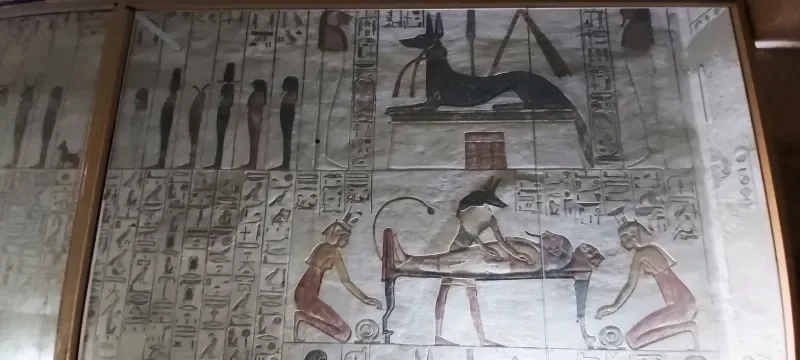
Ancient Egypt’s most distinctive contribution to human thought is not the Pyramids or the temples — it is the idea that death is not an ending. For the ancient Egyptians, death was a transition: the beginning of a journey through the underworld to a paradise called the Field of Reeds, where the deceased would live in eternal happiness, farming fertile land beside an eternal Nile, in the company of the gods. Every ritual, every tomb painting, every amulet, every funerary text was designed to help the dead make that journey safely. The Valley of the Kings — 63 royal tombs cut deep into the Luxor limestone — is the most visible expression of this belief system, and walking through its painted corridors is walking through a 3,300-year-old map of what the Egyptians believed the universe to be.
The Egyptian Concept of the Soul — Five Parts
Ancient Egyptians did not have one concept of the soul. They had five, each playing a different role in life and in death:
| Name | What It Is | Role After Death |
|---|---|---|
| Ka | The life force — created at birth, doubled the individual | Remained in the tomb · needed food offerings left by the living |
| Ba | The personality — depicted as a human-headed bird | Flew between the tomb and the underworld · returned to the body at night |
| Akh | The transformed spirit — created when Ka and Ba united after successful judgment | Lived in the Field of Reeds · could interact with the living as a protective spirit |
| Ren | The name — the most sacred element of identity | As long as the name was spoken or written, the person lived on — hence the cartouches in every tomb |
| Sheut | The shadow — inseparable from the person | Followed the deceased into the underworld as a protective presence |
Mummification — Why and How
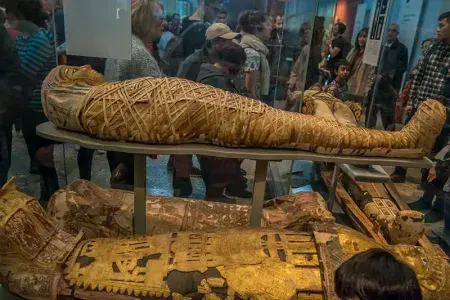
The Ka required the physical body to survive. This is why mummification existed: the body had to be preserved indefinitely so the Ka could continue to inhabit it. The mummification process in the New Kingdom (the period when the Valley of the Kings was in use) took 70 days and involved:
| Stage | Days | Process |
|---|---|---|
| Organ removal | 1–4 | Brain removed via nostril with a hook · organs (liver, lungs, stomach, intestines) removed and placed in 4 canopic jars · heart left in body |
| Desiccation | 5–44 | Body packed in natron (naturally-occurring salt) for 40 days · removes all moisture |
| Wrapping | 45–68 | Wrapped in hundreds of metres of linen bandages · amulets placed between layers · spells recited at each stage |
| Funeral rites | 69–70 | Opening of the Mouth ceremony · restores senses to the mummy · burial in the prepared tomb |
The heart was left in the body because it was needed for the Judgment of the Soul: the most dramatic and consequential moment in any Egyptian’s afterlife journey.
The Book of the Dead
The Book of the Dead (more accurately translated as “The Book of Coming Forth by Day”) was a personalised collection of spells, illustrations and instructions commissioned by the deceased before death and placed in the tomb. It contained:
- Spell 125 — the most important: the Declaration of Innocence, in which the deceased recites 42 negative confessions before 42 gods (“I have not stolen, I have not lied, I have not murdered”). Success in this declaration was required to pass through to judgment.
- Navigation spells — for passing through the 12 gates of the underworld, defeating the snake Apophis, and crossing the Lake of Fire
- Transformation spells — allowing the deceased to transform into different creatures (falcon, lotus flower, heron) to navigate different underworld regions
- Protective amulets — illustrated and named, to be included in the mummy wrapping
Papyrus copies of the Book of the Dead are among the finest examples of ancient Egyptian art. The finest surviving example — the Papyrus of Ani (c.1275 BC) — is in the British Museum. Illustrated Book of the Dead papyri are also displayed in the Grand Egyptian Museum (GEM), opened November 2025.
The Judgment of the Soul — Weighing the Heart Against the Feather
The culminating moment of every Egyptian’s afterlife journey was the Weighing of the Heart in the Hall of Two Truths. The deceased’s heart was placed on one side of a golden scale. On the other side was the Feather of Maat — the feather of the goddess of truth, justice and cosmic order. If the heart was lighter than or equal to the feather — meaning the deceased had lived a just, truthful life — they were declared maat kheru (true of voice) and allowed to proceed to the Field of Reeds. If the heart was heavier — weighed down by sin and wrongdoing — it was fed to Ammit: a composite monster with the head of a crocodile, the body of a leopard and the hindquarters of a hippopotamus. The soul was destroyed. This scene is depicted on the walls of many Valley of the Kings tombs and in Book of the Dead papyri, with the god Anubis conducting the weighing and Thoth recording the result.
The Field of Reeds — Egyptian Paradise
Those who passed the judgment entered the Aaru — the Field of Reeds — a paradise structured as an idealised version of Egypt: fertile farmland, abundant grain, eternal sunshine, the Nile in full flood, and the company of the gods. The deceased would live here forever, farming their land, worshipping Ra as he crossed the sky, and existing in a state of eternal contentment. The Field of Reeds scenes depicted in royal tombs show the deceased ploughing, harvesting and sailing on the eternal waters — the Egyptian vision of paradise as a continuation and perfection of their earthly life.
Where to See Egyptian Afterlife Beliefs in 2026
| Site | What You See | Location |
|---|---|---|
| Valley of the Kings | Book of the Dead scenes · Amduat · Book of Gates · Weighing of the Heart · Field of Reeds | Luxor West Bank |
| Grand Egyptian Museum (GEM) | Tutankhamun canopic jars · Book of the Dead papyri · mummification equipment · shabtis | Giza Plateau, Cairo |
| Karnak Temple | Osiris shrines · Osirian resurrection mythology in relief · Sacred Lake purification rituals | Luxor East Bank |
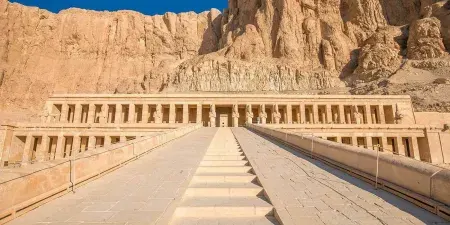
| Hatshepsut Temple | Osirian pillars · mummification scenes · divine birth sequence | Luxor West Bank |
Experience the Afterlife Journey With Egypt For Travel
Egypt For Travel’s licensed Egyptologist guides explain the complete afterlife belief system — the soul components, mummification, the Book of the Dead, the Weighing of the Heart — as you stand in the tombs where these beliefs are painted on the walls. Understanding why the Valley of the Kings was built transforms the experience of walking through it.
| Program | Afterlife Sites | From |
|---|---|---|
| 5 Days Cairo & Luxor | GEM · Valley of Kings · Karnak · Hatshepsut | $749 |
| 7-Night Egypt from USA | GEM · Nile cruise · Valley of Kings · Karnak | $1,599 |
| Egypt Vacation Package | GEM · Nile cruise · Valley of Kings · Abu Simbel | $1,549 |
WhatsApp: +20 155 555 2466 · ETA Category A Licence No. 1947
Frequently Asked Questions
What did ancient Egyptians believe happened after death?
Ancient Egyptians believed that after death, the soul underwent a journey through the underworld (Duat), guided by spells from the Book of the Dead. The journey culminated in the Weighing of the Heart in the Hall of Two Truths, where the deceased’s heart was weighed against the Feather of Maat by the god Anubis. If the heart was light (meaning the person had lived justly), they were admitted to the Field of Reeds — the Egyptian paradise. If the heart was heavy, it was consumed by the monster Ammit and the soul was destroyed. The entire belief system is painted on the walls of the Valley of the Kings tombs.
Why did ancient Egyptians mummify their dead?
Mummification preserved the physical body so the Ka (the life force) could continue to inhabit it. The Egyptians believed that the soul required a physical anchor in the tomb — either the mummy itself or a statue of the deceased — to return to between its journeys through the underworld. The 70-day mummification process removed moisture to prevent decay, ensuring the body remained intact for eternity. The Grand Egyptian Museum (GEM) displays the complete mummification equipment found in Tutankhamun’s tomb.
What is the Book of the Dead?
The Book of the Dead is a personalised collection of magical spells, illustrations and instructions buried with the deceased to guide them through the underworld. It is not a single book but a selection of spells chosen from a corpus of approximately 200, compiled specifically for each individual. The most important spell — Spell 125 — contains the Declaration of Innocence, in which the deceased recites 42 negative confessions before 42 gods. The Book of the Dead was in use from approximately 1550 BC to 50 BC — 1,500 years of continuous production. Fine examples are displayed at the GEM and the Egyptian Museum in Tahrir Square.