From the outside, the Pyramids of Giza are overwhelming in scale. From the inside, they are something else entirely: a narrow stone corridor cut 4,500 years ago into the heart of 5.75 million tonnes of limestone, leading to a red granite chamber where a pharaoh lay sealed in silence for thousands of years. What is inside the pyramids is not what most visitors expect — there are no painted walls, no gold, no hieroglyphics (those are in the Valley of the Kings). Instead there is something more powerful: the absolute geometry of a space built to last eternity, precisely as its architects intended.
Which Pyramids Can You Go Inside?
| Pyramid | Can You Enter? | Interior | Extra Ticket |
|---|---|---|---|
| Great Pyramid (Khufu) | ✅ Yes — daily | King’s Chamber · Grand Gallery · Queen’s Chamber passage | ~600 EGP (~$12) |
| Pyramid of Khafre | ✅ Yes — daily | Burial chamber · granite-lined walls · original corbelled ceiling | ~300 EGP (~$6) |
| Pyramid of Menkaure | ⚠️ Periodically | Descending passage · burial chamber | Check on site |
Inside the Great Pyramid of Khufu — Room by Room
The Entrance and Descending Passage
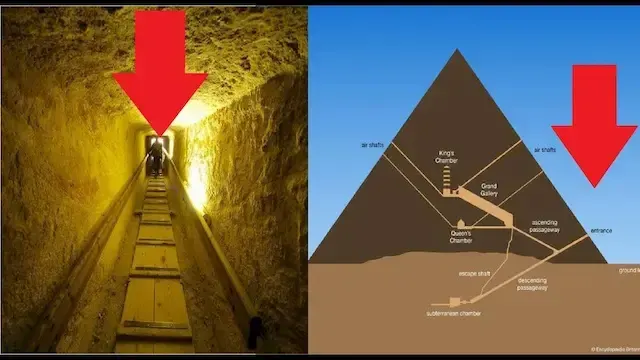
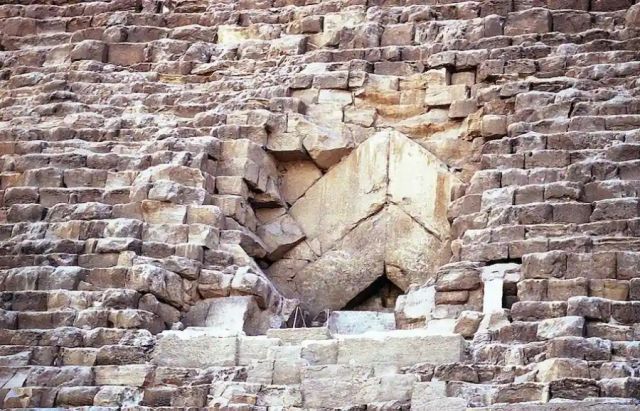
The current tourist entrance is on the north face, approximately 17 metres above ground level. You stoop through a low corridor cut through the limestone — the passage is approximately 1.2 metres high, requiring most adults to duck — then descend steeply before the passage levels out and begins to ascend. The original entrance was sealed with three granite plugs after the burial; robbers broke through the masonry alongside the plugs in antiquity, and this breach is now the tourist entrance.
The Ascending Passage
The ascending passage rises at a 26-degree angle for 39 metres. It is narrow — approximately 1.05 metres wide and 1.2 metres high — requiring visitors to crouch and climb. It is physically demanding but entirely manageable for most adults in good health. The walls are precisely cut limestone with almost no gap between the blocks — the precision of the stonework visible at close range inside the passage is one of the most astonishing things you will see in Egypt.
The Grand Gallery
The Grand Gallery is the most dramatic interior space in any pyramid: 47 metres long, 8.5 metres high, with corbelled limestone walls rising in seven stepped tiers to a ceiling just 1.04 metres wide. It ascends at the same 26-degree angle as the passage below it. Ramps with notches on both sides suggest some kind of counterweight or restraining system was used to move the massive granite plugs that sealed the passage after the burial. Standing in the Grand Gallery — in a space engineered 4,500 years ago with mathematical precision — is one of the most powerful moments available to any traveler anywhere on earth.
The King’s Chamber
At the top of the Grand Gallery, a low antechamber passage leads to the King’s Chamber: a room measuring 10.47 × 5.23 metres, lined entirely with red Aswan granite brought from 900km south by barge. The ceiling consists of nine flat granite slabs, each weighing approximately 25–40 tonnes. In the western end of the chamber stands the red granite sarcophagus of Khufu — too large to have been brought in through the passage, it was placed during construction, before the chamber was sealed. The sarcophagus is lidless and empty — the mummy of Khufu has never been found. Five relieving chambers above the King’s Chamber distribute the weight of the 140+ metres of pyramid above it; the top chamber has a pointed (gabled) ceiling, the finest solution the ancient engineers found to the problem of roof load.
The Queen’s Chamber
A horizontal passage off the Grand Gallery leads to the Queen’s Chamber — a misnomer given by early Arab explorers (no queen was buried here). This limestone-lined room measures 5.75 × 5.23 metres with a pointed ceiling rising to 6.26 metres. It contains a corbelled niche in the east wall whose original purpose remains debated. Two narrow shafts lead north and south from the chamber — their function is unknown; robotic exploration in 2002 found small stone doors with copper handles at the ends of both shafts, beyond which further chambers may exist.
The 2017 Discovery — The Big Void
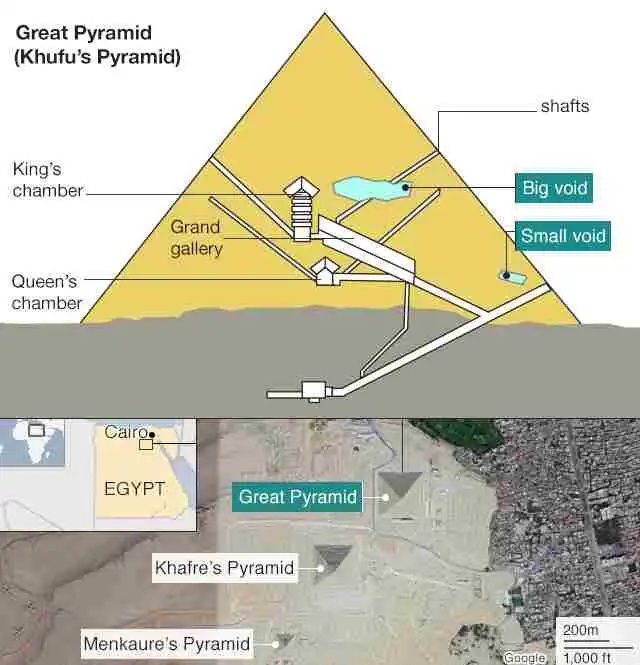
In 2017, the ScanPyramids project used muon particle scanning technology to peer through the stone of the Great Pyramid without any excavation. They found a previously unknown large void above the Grand Gallery — at least 30 metres long, with a cross-section similar to the Grand Gallery itself. Its purpose is unknown. It may be a construction void, a relieving space, or an undiscovered chamber. It has not yet been accessed. This discovery confirmed that the interior of the Great Pyramid — after 4,500 years of study — still holds secrets. For how all of this was built, see our companion guide: How Were the Pyramids Built?
Practical Tips for Visiting Inside the Pyramids
- Arrive at 7:00 AM (site opening) — the interior ticket queue forms quickly after 9:00 AM. Early arrival means shorter wait and cooler internal temperature.
- Physical requirement: The ascending passage requires sustained crouching for approximately 50 metres. Anyone with claustrophobia, severe back problems or mobility issues should consider visiting the exterior only. Healthy adults in normal fitness manage it without difficulty.
- Temperature: The interior is noticeably cooler than the plateau outside — a relief in summer, chilly in December–February. A light layer is useful.
- Photography: Photography is generally permitted in the passages and chambers; check the current policy with your Egyptologist guide as rules occasionally change.
- Egypt For Travel’s 5-Day program includes complimentary Khufu interior entry — see the 5-Day Cairo & Luxor program from $749.
Book a Cairo Tour Including Pyramid Interior Entry
| Program | Pyramid Interior | From |
|---|---|---|
| 5 Days Cairo & Luxor | ✅ Khufu entry complimentary | $749 |
| Cairo 3 Days From USA | Add-on available | $349 |
| 7-Night Egypt From USA | Add-on available | $1,599 |
| Egypt Vacation Package | Add-on available | $1,549 |
???? WhatsApp: +20 155 555 2466 · ETA Category A Licence No. 1947
Frequently Asked Questions
What is inside the Great Pyramid of Giza?
The Great Pyramid of Khufu contains three main chambers connected by passages: the King’s Chamber (lined in red Aswan granite, containing the original granite sarcophagus), the Queen’s Chamber (limestone, purpose still debated) and the unfinished Subterranean Chamber cut into the bedrock below the pyramid. The 47-metre Grand Gallery connects them. In 2017, muon scanning discovered an additional large void above the Grand Gallery — at least 30 metres long — that has not yet been accessed or explained.
Is there treasure inside the Pyramids?
No treasure remains. The pyramids were robbed in antiquity — likely within a few centuries of construction — by people who had detailed knowledge of the internal layout. The sarcophagus of Khufu in the King’s Chamber was found empty by the first modern explorers. The mummy of Khufu has never been found. The extraordinary treasure associated with Egyptian royal burial — golden masks, jewellery, chariots, canopic jars — was discovered intact only in the tomb of Tutankhamun in the Valley of the Kings in 1922, and is now displayed at the Grand Egyptian Museum (GEM).
How long does it take to visit inside the Great Pyramid?
The interior visit takes approximately 30–45 minutes for most visitors. The route in and out follows the same passages — there is no circular route. Egypt For Travel allocates time for the interior visit within the Pyramids plateau schedule, which is typically 2–2.5 hours total including the Sphinx, Valley Temple and exterior photography. The interior visit is most rewarding with your Egyptologist guide explaining what you are seeing at each point — the King’s Chamber especially benefits from expert commentary.
Are there hieroglyphics inside the pyramids?
Almost none in the interior chambers and passages — this surprises most visitors. The Pyramid Texts (religious inscriptions) appear in some Old Kingdom pyramids at Saqqara (including the Pyramid of Unas) but the Giza pyramids have almost no decoration. The interior workers’ graffiti — gang names painted in red on the blocks in the relieving chambers above the King’s Chamber — are the only written marks inside, and they include the cartouche of Khufu, confirming authorship. The elaborately painted royal tombs are in the Valley of the Kings at Luxor, built 1,000 years after the Giza pyramids.