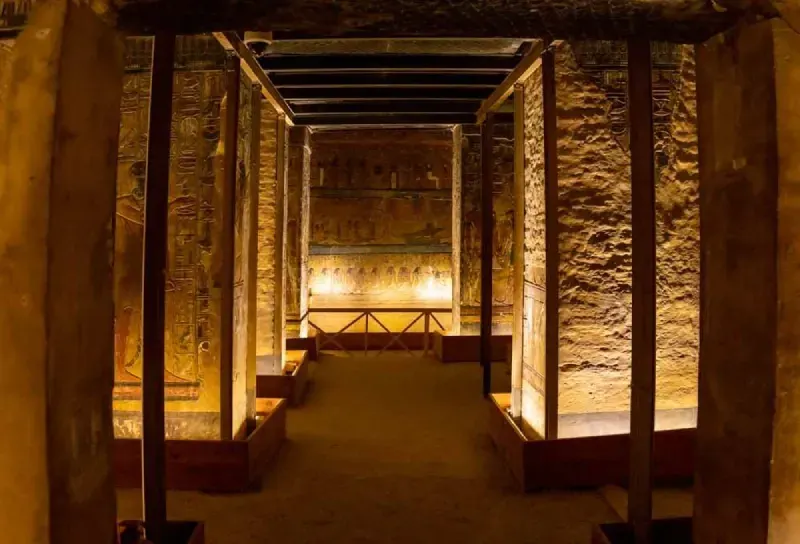
In the Valley of the Kings, where 63 royal tombs compete for the description “finest,” there is a clear answer among Egyptologists: KV17, the Tomb of Seti I. At 137 metres in length and 30+ metres below the valley floor, it is the longest and deepest tomb in the Valley. Its painted reliefs — covering every wall, every ceiling, every pillar of its 11 chambers and corridors — represent a technical and artistic achievement that surpasses every other royal tomb in Egypt, including the more famous Tutankhamun’s KV62. Seti I was the father of Ramesses II, and his tomb was the construction project that established the technical standards his son would try to replicate across Egypt for the next 67 years.
Pharaoh Seti I — Fast Facts
| Fact | Detail |
|---|---|
| Full name | Menmaatre Seti I — meaning “He of the god Set, Eternal is the Justice of Ra” |
| Dynasty | 19th Dynasty, New Kingdom — second pharaoh after Ramesses I founded the dynasty |
| Reign | ~1290–1279 BC — approximately 11 years |
| Son | Ramesses II — the greatest builder-pharaoh in Egyptian history, who ruled for 67 years |
| His greatest temple | Temple of Seti I at Abydos — with the famous King List of 76 pharaohs |
| Tomb discovered | October 16, 1817 by Giovanni Belzoni — one of the greatest archaeological discoveries of the 19th century |
| Mummy | Removed in antiquity by priests to protect from robbers · discovered in the Deir el-Bahri royal cache (DB320) in 1881 · now at the Egyptian Museum Tahrir |
The Tomb of Seti I — Dimensions and Layout
| Feature | KV17 — Tomb of Seti I |
|---|---|
| Total length | 137 metres — longest tomb in the Valley of the Kings |
| Depth below valley floor | 30+ metres — deepest major tomb in the Valley |
| Corridors | 7 descending corridors + stairways |
| Chambers | 3 antechambers + pillared burial hall + side chambers + crypt extension |
| Decorated surfaces | Every wall, ceiling and pillar — sunk relief carvings with original painted colour largely intact |
| Funerary texts | Amduat · Book of Gates · Book of Caverns · Book of the Dead · Litany of Ra · Opening of the Mouth |
What Makes KV17 the Most Beautiful Tomb in Egypt
Three qualities distinguish KV17 from every other royal tomb in the Valley of the Kings. First, the technical quality: the sunk relief carvings in Seti I’s tomb are executed with a delicacy and precision not found in any other Valley tomb — the hieroglyphs are finer, the figures more graceful, the proportions more carefully calculated. Second, the painted colour: unlike most Valley tombs where colour has faded or been destroyed, much of KV17’s original painted surface is intact, giving the walls a luminous blue, gold and ochre that appears almost freshly painted. Third, the astronomical ceiling of the burial hall: the first astronomical ceiling ever painted in a royal tomb, showing the constellations, the decan stars and the northern circumpolar stars in a map of the night sky as it appeared in 1290 BC.
How to Visit Tomb of Seti I in 2026
| Detail | Information |
|---|---|
| Location | Valley of the Kings, Luxor West Bank |
| Opening status | Periodically open — check at Valley of Kings ticket office on the day |
| Entry ticket | Requires a separate premium ticket (~1,400 EGP / ~$28) in addition to Valley of Kings entry |
| Opening hours | 6:00 AM – 5:00 PM daily (when open) |
| Best time to visit | 6:00–7:00 AM — before crowds arrive · cooler inside in early morning |
Egypt For Travel’s Egyptologist guides know KV17’s opening schedule and can advise at booking which days it is expected to be available. If KV17 is closed on your visit day, your guide will prioritise KV9 (Ramesses VI), KV11 (Ramesses III) and KV62 (Tutankhamun) — three of the finest tombs in the Valley. See our Tomb of Ramses VI (KV9) guide for comparison.
Visit the Valley of the Kings With Egypt For Travel
| Program | Valley of Kings | From |
|---|---|---|
| 5 Days Cairo & Luxor | ✅ Day 4 West Bank | $749 |
| 7-Night Egypt from USA | ✅ Cruise Day 4 West Bank | $1,599 |
| Egypt Vacation Package | ✅ Nile cruise West Bank day | $1,549 |
WhatsApp: +20 155 555 2466 · ETA Category A Licence No. 1947

Frequently Asked Questions
Is the Tomb of Seti I open to visitors in 2026?
KV17 opens and closes periodically for conservation work. When open, it requires a separate premium ticket (~1,400 EGP / ~$28) beyond the standard Valley of Kings entry. Egypt For Travel’s Egyptologist guides monitor opening schedules and advise clients on availability. If KV17 is closed, the guide selects the finest currently-open tombs — KV9, KV11 and KV62 are consistently available. Arrive at the Valley of the Kings at 6:00 AM to check the day’s availability before the crowds arrive.
What is the difference between KV17 (Seti I) and KV9 (Ramses VI)?
KV17 (Seti I) is longer, deeper and more elaborately decorated — the finest tomb art in the Valley, with intact painted colour and an astronomical ceiling from 1290 BC. It requires a premium ticket and is not always open. KV9 (Ramesses VI) is consistently open, included in the standard ticket, and has the most spectacular double astronomical ceiling in the Valley — a complete map of the sky in brilliant colour across two massive ceiling panels. Both are extraordinary; if only one is available, KV9 is a complete experience in itself.
Who discovered the Tomb of Seti I?
The Tomb of Seti I was discovered on October 16, 1817 by the Italian adventurer and archaeologist Giovanni Belzoni, who had been excavating in the Valley of the Kings for the British Consul General Henry Salt. Belzoni spent several days inside the tomb mapping and describing its chambers, and created a full-scale replica of the burial hall for exhibition in London. The discovery caused a sensation across Europe. The French linguist and Egyptologist Jean-François Champollion, who deciphered hieroglyphics in 1822, described KV17 as “the most beautiful thing in Egypt.”

.webp)