Luxor East & West Bank Full-Day Private Tour — The Complete Theban Experience
.webp)
.webp)
 -.webp)
.webp)
.webp)
.webp)
 -.webp)
.webp)
Overview
Ancient Thebes — the city the Greeks called the "city of a hundred gates," the capital of Egypt during the New Kingdom and the most magnificent city in the ancient world — spreads across both banks of the Nile at modern Luxor. The East Bank holds the great cult temples of the living: Karnak and Luxor Temple. The West Bank holds the monuments of eternity: the Valley of the Kings, Hatshepsut's temple, and the colossal statues of Amenhotep III known as the Colossi of Memnon. Egypt For Travel's Luxor East & West Bank Full-Day Tour is the most comprehensive single-day Luxor programme available — covering all six essential sites with a private licensed Egyptologist guide, all entrance fees included, and lunch at a recommended Luxor restaurant, from $65 per person.
West Bank Morning — The World of the Dead
The Valley of the Kings
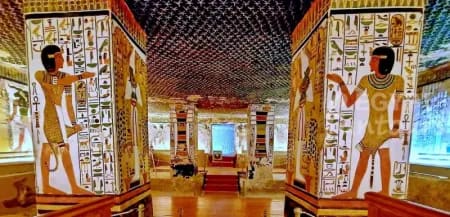
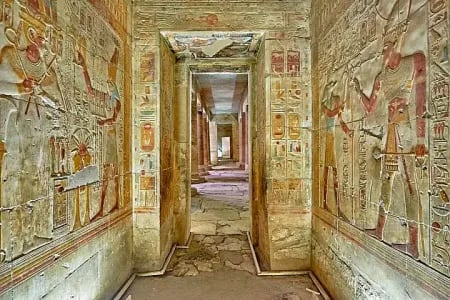
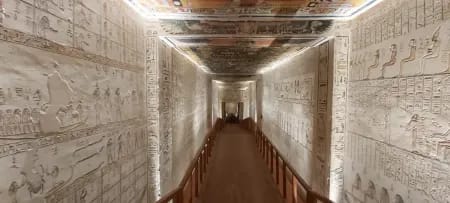
The royal burial ground of the New Kingdom pharaohs is a destination unlike any other in Egypt. Sixty-three tombs cut into the limestone cliffs of a natural valley behind the West Bank cliffs — their interiors painted from floor to ceiling with scenes from the Book of the Dead, the Book of Gates, and the Amduat — the theological narratives that described the pharaoh's journey through the underworld and his resurrection at dawn. Your Egyptologist guide is the most important resource here: the guide selects which three tombs to visit from those currently open (the combination changes depending on crowd levels and restoration work), ensuring you see the finest paintings available on the day. Do not make the mistake of choosing your own tombs based on name recognition — Tutankhamun's tomb (KV62) is famous but artistically modest; KV9 (Ramesses VI) has the most spectacular astronomical ceiling in the valley, and KV17 (Seti I, when open) has the finest painting in any royal tomb in Egypt.
Entrance fees: Standard ticket 750 EGP (3 tombs, included) · Tutankhamun KV62: 700EGP additional (optional) · Seti I KV17 when open: additional fee
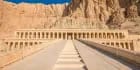
The Temple of Hatshepsut (Deir el-Bahari)
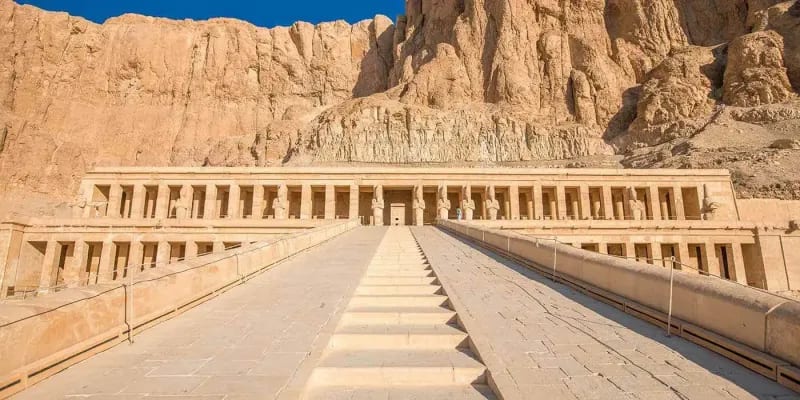
Built by the female pharaoh who ruled Egypt for 20 years and created the most prosperous reign of the 18th Dynasty, the mortuary temple of Hatshepsut rises in three colonnaded terraces against the dramatic limestone cliffs of the West Bank amphitheatre. The temple's design — by the royal architect Senenmut — is the most architecturally sophisticated building of the New Kingdom, its proportions calculated with mathematical precision and its reliefs narrating the queen's divine birth, her expedition to Punt, and her coronation before the gods. Your guide will explain the story of the temple's systematic defacement by Thutmose III (Hatshepsut's stepson, who chiselled her image and name from every surface he could reach) and the painstaking 20th-century reconstruction that revealed what was hidden.
Entrance: 440 EGP (included)
The Colossi of Memnon
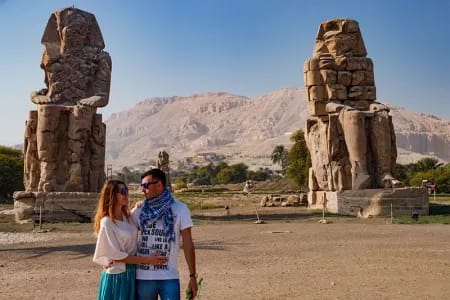
Two enormous quartzite statues of Amenhotep III — 18 metres high, the largest freestanding statues in ancient Egypt — stand in an open field at the entrance to the West Bank, the only surviving surface remnant of what was once the largest mortuary temple ever built in Egypt. The temple behind them was systematically demolished in antiquity for its stone; the colossi were left because they were too massive to move. The northern statue was famous in classical antiquity for producing a musical sound at dawn — the result of a crack caused by an earthquake that expanded in the morning dew. The Romans repaired the crack in 199 AD and the sound stopped. Your guide will explain the complex ongoing excavation of the vanished temple behind the statues.
East Bank Afternoon — The World of the Living
Karnak Temple Complex
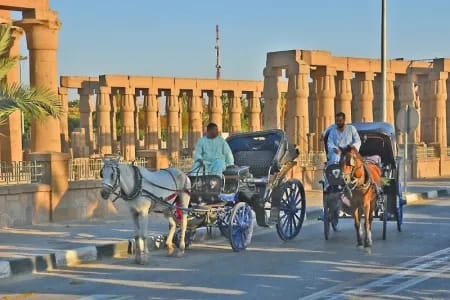
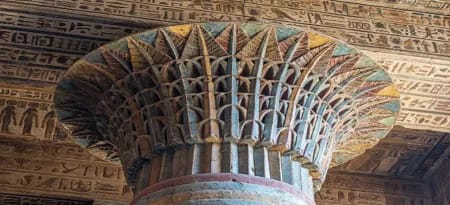
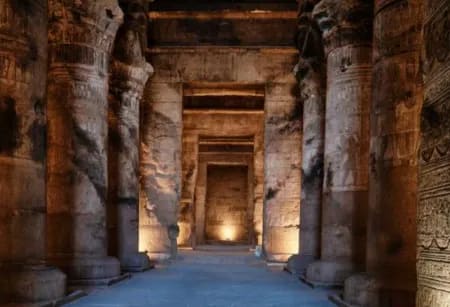
The largest religious complex ever built by human beings, Karnak was under continuous construction for over 1,500 years — each pharaoh adding pylons, obelisks, halls, sanctuaries, and colossal statues, the complex growing outward from its 12th-Dynasty core into a 200-acre city of temples. The centrepiece — the Great Hypostyle Hall, built by Seti I and completed by Ramesses II — contains 134 columns, the largest of which are 23 metres high and 10 metres in circumference, their surfaces covered in painted reliefs so dense that every square centimetre of stone carries meaning. Your guide will navigate the complex with purpose, explaining the theological and political significance of each pharaoh's contribution.
Entrance: 600 EGP (included) · Evening Sound & Light show: separate ticket (see our Karnak Sound & Light tour)
Luxor Temple
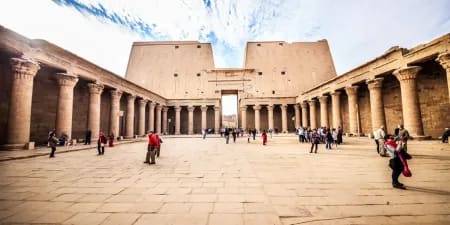
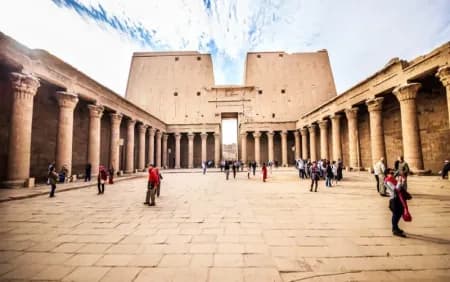
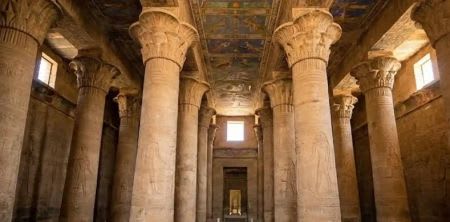
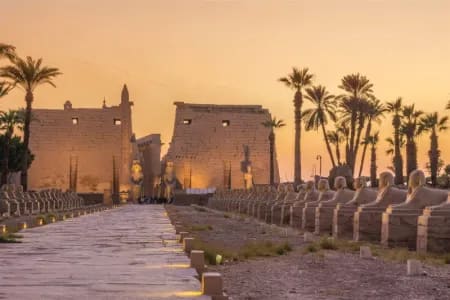
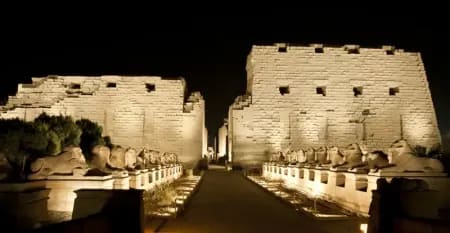
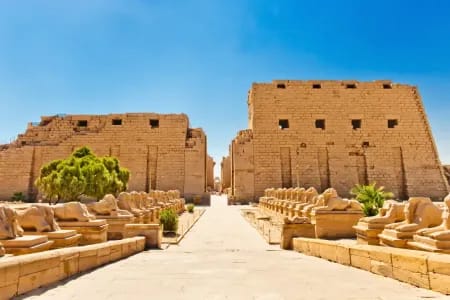
Luxor Temple — built primarily by Amenhotep III (c. 1390 BC) and completed by Ramesses II — is one of the most beautiful ancient monuments in Egypt, its proportions more harmonious and its state of preservation more complete than almost any other New Kingdom temple. Unlike Karnak, Luxor Temple was not a cult temple for daily worship — it was specifically built for the Opet Festival, the annual renewal of the pharaoh's divine power, when the sacred barque of Amun was carried from Karnak along the sphinx avenue to Luxor. The Avenue of Sphinxes connecting the two temples — restored and reopened in 2021 — is part of your visit: the only time since antiquity that the complete processional route of the Opet Festival has been walkable.
What no other guide tells you: Inside Luxor Temple, in the innermost sanctuary of the Opet chamber, a series of Christian frescoes from the 4th century AD are painted directly over the ancient Egyptian reliefs — the face of a Byzantine saint superimposed on a pharaonic scene. And in the court of Ramesses II at the temple entrance, a 13th-century mosque (the Mosque of Abu el-Haggag) has been built directly inside the temple precinct on the accumulated sediment of centuries — its floor level a metre above the ancient temple floor. Three civilisations — pharaonic, Christian, and Islamic — occupy the same structure simultaneously. No other building in Egypt makes this as visible.
Entrance: 500 EGP (included) · Best visited late afternoon / evening when the light is dramatic on the great pylon
| Site | Bank | Entrance Fee | Time Allocated |
|---|---|---|---|
| Valley of the Kings (3 tombs) | West | 750 EGP — included | 2 hours |
| Tutankhamun KV62 (optional) | West | 700 EGP extra | Within Valley visit |
| Hatshepsut Temple | West | 440 EGP — included | 1 hour |
| Colossi of Memnon | West | Free — included | 20 minutes |
| Karnak Temple | East | 600 EGP — included | 1.5 hours |
| Luxor Temple | East | 500 EGP — included | 1 hour |
Visitor Type Guide
| Visitor Type | This Tour Is | Consider Instead |
|---|---|---|
| First-time Luxor visitor | ✅ Perfect — covers all essential sites | — |
| Nile cruise passenger (1 day in port) | ✅ Ideal — maximum coverage in one day | — |
| Wants only the West Bank | Too much — consider West Bank only tour | Luxor West Bank Tour |
| Wants deep-dive West Bank | Too fast — not enough time at each site | Nobles, Deir el-Medina & Medinet Habu |
| Returns to Luxor / second visit | Consider adding Nefertari's Tomb or balloon | Nefertari's Tomb Tour |
| Duration: Full Day (8–9 hours) | Type: Private Tour | Run: Everyday |
Included
- Private licensed Egyptologist guide throughout
- Private air-conditioned vehicle — hotel or cruise ship pickup and drop-off
- All entrance fees: Valley of the Kings (3 tombs) · Hatshepsut Temple · Colossi of Memnon · Karnak Temple · Luxor Temple
- Lunch at a recommended Luxor restaurant
- Bottled water throughout the day
- All government taxes and service charges
Excluded
- Optional: Tutankhamun's Tomb KV62 (300 EGP extra — payable locally)
- Optional: Nefertari's Tomb QV66 (1,200 EGP extra — advance arrangement required; see our Nefertari's Tomb tour)
- Optional: Karnak Sound & Light Show at the end of the day (separate ticket — see our Sound & Light tour)
- Alcoholic beverages at lunch
- Personal spending and tips
Itinerary:
07:00 — Hotel or cruise ship pickup
07:30–09:30 — Valley of the Kings: guide selects optimal 3 tombs · explanation of Book of the Dead
09:30–10:30 — Hatshepsut Temple: three terraces · Punt expedition reliefs · divine birth narrative
10:30–10:50 — Colossi of Memnon: guide explains vanished temple and classical "singing statue"
10:50–12:00 — Cross Nile to East Bank · transfer to Karnak
12:00–13:30 — Karnak Temple: hypostyle hall · sacred lake · avenue of ram-headed sphinxes · obelisks
13:30–14:15 — Lunch at recommended Luxor restaurant
14:15–15:15 — Luxor Temple: great pylon · Ramesses II court · colonnade of Amenhotep III · inner sanctuary
15:30 — Return to hotel or cruise ship
Prices:
Prices
Notes:
Prices Policy
All prices per person. Private available at a premium for groups wanting exclusive use — contact Egypt For Travel for pricing. Weather cancellations receive a full rescheduling without penalty.
Departure Tips
Pickup is at 07:00 — the earliest of any Egypt For Travel tour. Set two alarms. Bring warm clothing — the desert at pre-dawn is significantly cooler than during the day (can be 12–15°C in winter). A fully charged phone or camera is essential. Wear closed-toe shoes.
Payment Policy
25% deposit to confirm booking. Peak season (October–April): 50% deposit. The slot must be confirmed well in advance during peak season.
Installment Policy
Installments available for groups. Contact Egypt For Travel via WhatsApp (+20 155 555 2466).
Tipping Guide
Customary $5–10 per person, paid directly to the crew after the post-landing celebration. Boat captain: 20–50 EGP. Driver: $5–8 per day.
Cancellation Policy
61+ days: 10% · 31–60 days: 20% · 15–30 days: 50% · 1–14 days: 100%. Weather cancellations are rescheduled without charge — this is not a standard cancellation.
 -.webp)