Edfu Temple Private Day Tour from Luxor — The Best-Preserved Temple in Egypt
Overview
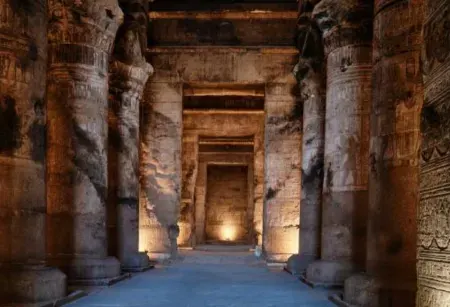
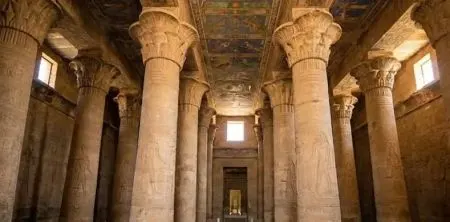
There is a question every serious Egypt visitor eventually asks: which temple is the most completely preserved? The answer, without hesitation, is the Temple of Horus at Edfu — 115 kilometres south of Luxor, built between 237 and 57 BC, and the only major ancient Egyptian temple whose massive stone roof is still largely in place over the hypostyle hall and inner sanctuary. As a result, entering Edfu is the closest thing available to experiencing an ancient Egyptian temple as its ancient worshippers did: cool, dim, the light entering through narrow clerestory openings, the air smelling of old stone and incense residue, the carved reliefs surrounding you on every wall from floor to ceiling. Egypt For Travel's Edfu Temple Private Day Tour from Luxor takes you there in a private air-conditioned vehicle, with a private Egyptologist guide and all entrance fees included — plus the traditional horse-drawn carriage ride through Edfu town to the temple entrance.
The Temple of Horus — The Complete Experience
The Approach: Horse Carriage Through Edfu Town
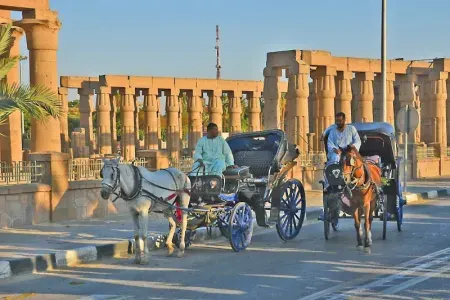
From the car park on the edge of Edfu, the traditional approach to the temple is by horse-drawn carriage — a 5-minute ride through the streets of this busy Upper Egyptian town, the horses moving at a steady clip between the market stalls and the ordinary life of a Nile Valley town, arriving at the temple entrance through a gate in the town wall. Your guide arranges the carriage, confirms the price before departure, and accompanies you — ensuring the experience is smooth and the carriage operators know they are dealing with a professional operation. The carriage approach is part of the experience: Edfu is not a site that sits in empty desert like Karnak or Abu Simbel — it is embedded in a living town, and arriving by carriage acknowledges this.
The First Pylon
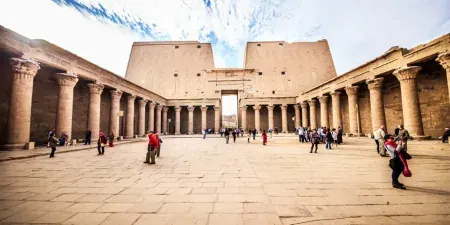
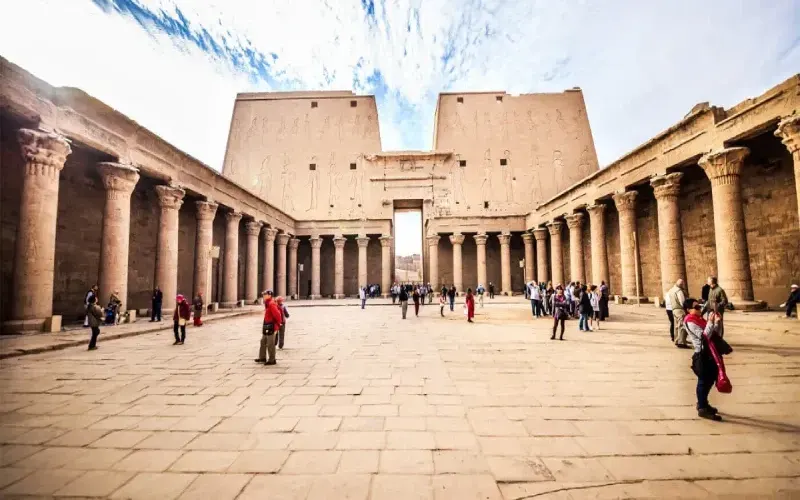
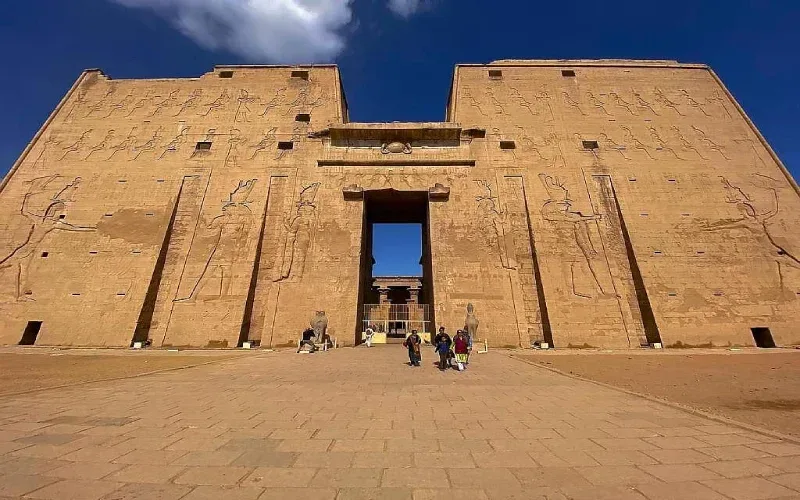
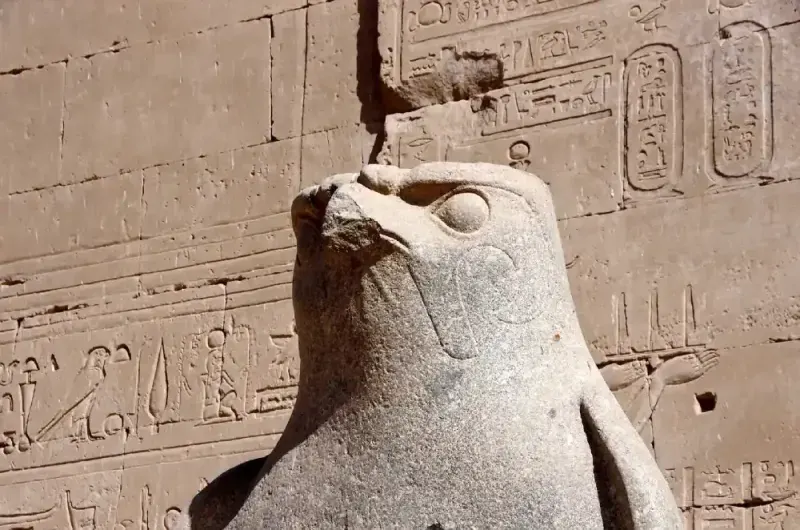
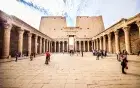
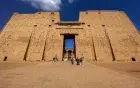
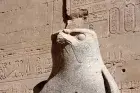
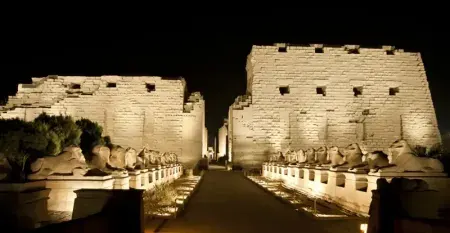
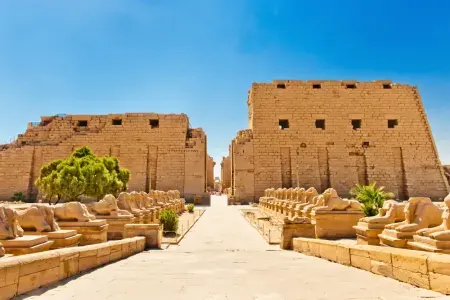
The first pylon of Edfu Temple stands 36 metres high — one of the tallest in Egypt — its faces carved with towering relief figures of Ptolemy XII smiting enemies before Horus. The scale is immediately overwhelming, the more so because the pylon is not standing in isolation but rising from the edge of the town, its towers visible from the Nile and from the surrounding farmland for miles. The entrance between the towers leads into a large open court enclosed by a colonnade — and at the far end of the court, the granite cult statue of Horus as a falcon wearing the double crown of Egypt, 3.45 metres high, the best-preserved cult statue in any Egyptian temple.
The Hypostyle Hall — Under the Original Roof
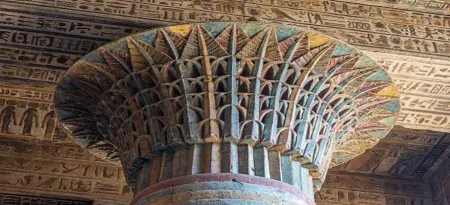
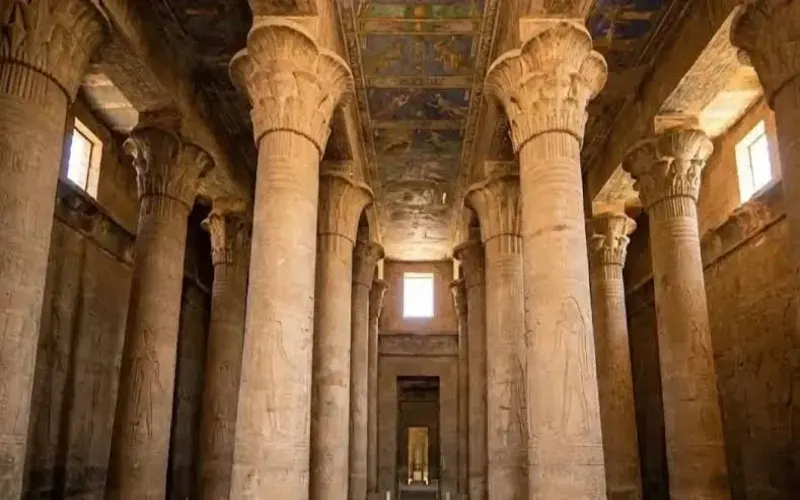
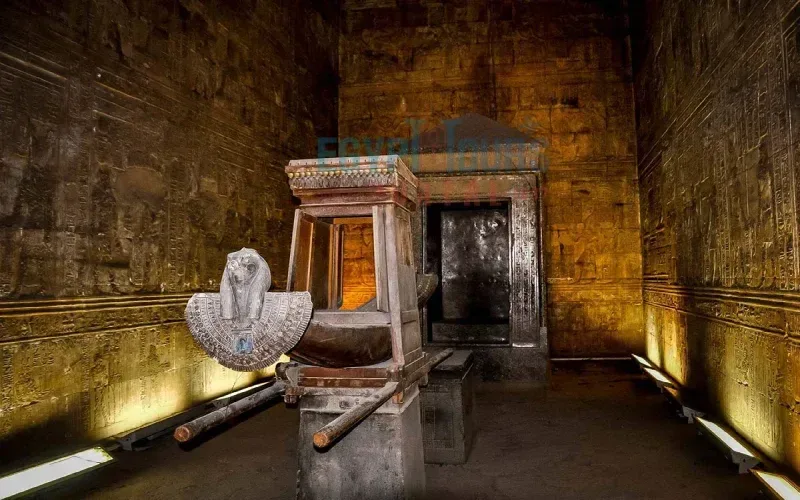
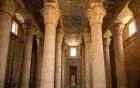
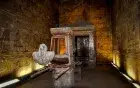
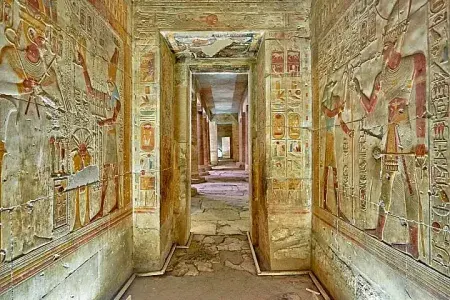
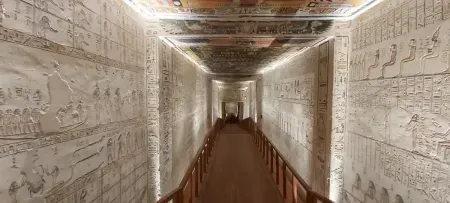
Entering the hypostyle hall through the carved sandstone doorway, you move from bright Upper Egyptian sunlight into a different world: cool, shadowed, the ceiling above you the original stone of 2,000 years ago, the columns surrounding you on all sides, their surfaces covered in texts and relief scenes at a density that would require weeks to read completely. Your Egyptologist guide will identify the most significant sections: the representation of the Festival of the Beautiful Meeting (the annual reunion of Hathor from Dendera with Horus at Edfu), the naos sanctuary — a massive granite shrine in the innermost sanctuary, the oldest surviving ancient Egyptian naos still in its original position, containing a smaller granite statue of Horus inside.
The Festival of the Beautiful Meeting
The reliefs of Edfu record one of the most romantic narratives in ancient Egyptian religion: the annual Nile journey of Hathor from her temple at Dendera to Edfu, travelling upriver by sacred barque for the annual divine marriage with Horus. The journey took several weeks, with stops at temples along the way. At Edfu, the two barques — Horus's and Hathor's — were brought together in the outer court for the sacred marriage ceremony. The texts describing this event, carved on the walls of the outer enclosure, are the most detailed surviving description of any ancient Egyptian festival. Your guide will read the key passages.
What no other guide tells you: The Temple of Edfu's construction timeline is inscribed on its walls in unprecedented detail — the foundation date, the dates of each building phase, the completion date, and the names of the builders. From this information, Egyptologists have determined that the temple was under construction for exactly 180 years. During this period, at least three different generations of craftsmen worked on the same building, the later workers able to read and continue the inscriptions begun by their great-grandfathers. No other ancient building project has a more detailed surviving construction record.
| Detail | Information |
|---|---|
| Distance from Luxor | 115 km south — approximately 2 hours by private car |
| Temple period | Ptolemaic — built 237–57 BC · 180 years of construction |
| Dedicated to | Horus the Elder (Haroeris) — hawk-headed son of Osiris, divine embodiment of the living pharaoh |
| Distinguishing feature | Original stone roof still in place — the most completely preserved ancient Egyptian temple in the world |
| Entrance fee | ~550 EGP — included |
| Horse carriage | Included from car park to temple (5-min ride) · arranged and priced by guide before departure |
| Best combined with | Esna Temple (45 min north of Edfu) or Esna + Edfu + Kom Ombo full day |
| Duration: Full Day (7 hours including drives) | Type: Privet Tour | Run: Everyday |
Included
- Private licensed Egyptologist guide throughout
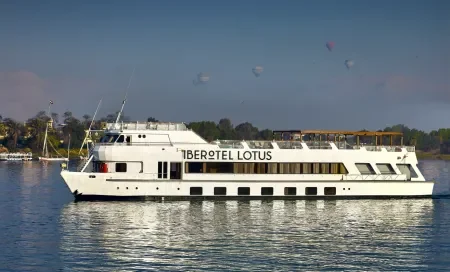
- Private air-conditioned vehicle — Luxor hotel or cruise ship pickup and drop-off
- Horse carriage from Edfu car park to temple and back
- Edfu Temple entrance (~550 EGP)
- Lunch at a recommended restaurant en route or in Edfu (included in full-day option)
- Bottled water throughout · all taxes and service charges
Excluded
- Optional: extend to Kom Ombo (45 min south of Edfu) — see Luxor to Aswan day trip
- Personal spending and tips
Itinerary:
07:00 — Hotel or cruise pickup in Luxor
09:00 — Arrive Edfu car park · board horse carriage
09:10–11:30 — Edfu Temple: first pylon · open court · Horus falcon statue · hypostyle hall · naos sanctuary · Festival reliefs · construction timeline inscriptions
11:30–12:00 — Lunch (local Edfu restaurant — included in full-day option)
12:00 — Depart Edfu
14:00 — Return to Luxor hotel or cruise ship
Prices:
Prices
Notes:
Prices Policy
All prices per person. Private available at a premium for groups wanting exclusive use — contact Egypt For Travel for pricing. Weather cancellations receive a full rescheduling without penalty.
Departure Tips
Horse carriage tip for driver: 20–30 EGP per person — pay after, not before. The temple interior is cool — a pleasant contrast to the summer heat outside. Photography of the reliefs is permitted throughout.
Payment Policy
25% deposit to confirm booking. Peak season (October–April): 50% deposit. The slot must be confirmed well in advance during peak season.
Installment Policy
Installments available for groups. Contact Egypt For Travel via WhatsApp (+20 155 555 2466).
Tipping Guide
Customary $5–10 per person, paid directly to the crew after the post-landing celebration. Boat captain: 20–50 EGP. Driver: $5–8 per day.
Cancellation Policy
61+ days: 10% · 31–60 days: 20% · 15–30 days: 50% · 1–14 days: 100%. Weather cancellations are rescheduled without charge — this is not a standard cancellation.

.webp)
 -.webp)