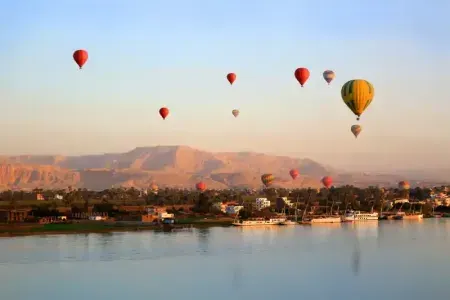
At approximately 5:30 in the morning, before any temple opens and before any tour group boards its bus, a flotilla of enormous balloons quietly inflates on the West Bank of the Nile opposite Luxor. As they fill, the eastern sky begins to pale. By the time the first gondolas lift from the desert floor and begin to rise — carrying their passengers above the date palms, above the West Bank cliffs, above the Valley of the Kings — the sun is just breaking the horizon over the eastern desert. And from 300–500 metres above the ground, the most extraordinary view in Egyptology unfolds below: the entire 500-square-kilometre landscape of ancient Thebes — every temple, every necropolis, every royal tomb, every causeway and avenue — laid out in the golden light of dawn like a map of civilisation itself.
This is what a sunrise hot air balloon flight over Luxor looks like — and it is consistently rated the single most memorable experience in Egypt by visitors who have done both the balloon and the ground monuments. Egypt For Travel's Luxor Hot Air Balloon Ride arranges everything from your hotel pickup and Nile crossing to your post-landing folkloric celebration, ensuring that one of the world's great dawn experiences is also completely hassle-free.
What You Will See from the Air
The balloon's flight path over the West Bank varies by wind direction — no two flights are identical, which is part of the experience's magic. On most mornings, the balloon crosses some combination of the following:
The Valley of the Kings
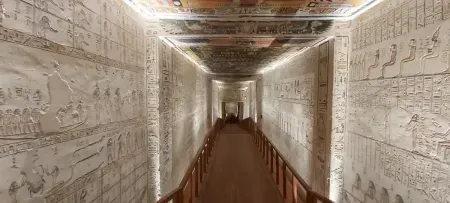
From the air, the Valley of the Kings reveals itself as what it is: a natural amphitheatre of limestone cliffs, a bowl in the desert ridgeline selected by New Kingdom architects precisely because its shape mimicked the sacred akhet (horizon) hieroglyph — the sun disc between two mountains. The 63 tombs cut into these cliffs are invisible from the air, but the contours of the valley, the causeway scars, and the distant pyramid shape of the dominant peak (el-Qurn — "the horn") that watches over all the royal tombs are clearly visible. Your pilot will identify each landmark as you pass over.
The Temple of Hatshepsut (Deir el-Bahari)
The three-tiered terraced temple of Hatshepsut — built into and against the dramatic limestone cliff of the West Bank — is one of the most architecturally precise buildings in ancient Egypt when seen from the ground. From the air, its perfection becomes even more apparent: the colonnades aligned with absolute mathematical precision, the causeway leading from the valley temple (now mostly gone) across the flood plain to the Nile visible as a faint scar in the soil. The cliff immediately behind the temple towers overhead even from balloon altitude — a reminder of the extraordinary decision to build here.
Medinet Habu (Temple of Ramesses III)
The largest intact temple on the West Bank — Medinet Habu — is often better appreciated from the air than from the ground, where its scale is difficult to comprehend. From the balloon, the full extent of the complex is visible: the fortified gateway, the pylons, the hypostyle hall, the inner sanctuary, and the palace to the south. The reliefs carved on the outer walls — depicting Ramesses III's victory over the Sea Peoples invasion — cover more surface area than any battle scene in any Egyptian temple.
The Nile Valley in Full
Perhaps the most affecting view from the balloon is simply the Nile Valley itself: the narrow band of green on both sides of the river — the black land (Kemet) that sustained ancient Egyptian civilisation — surrounded on all sides by the red-gold desert. From 500 metres, the line between fertile land and desert is as sharp as a knife's edge. The river runs silver through the middle. The East Bank city of Luxor glows in the early morning light. And beyond the desert to the west, the horizon stretches uninterrupted to Libya. The ancient Egyptians called this landscape the gift of the Nile — and from this altitude, you understand exactly what they meant.
|
Detail |
Information |
|
Flight duration |
45–60 minutes in the air (weather and wind dependent) |
|
Maximum altitude |
300–500 metres above the West Bank (approximately 1,000–1,500 feet) |
|
Departure time |
Hotel pickup approximately 04:30–05:00 · launch at sunrise |
|
Nile crossing |
By private motorboat from the East Bank dock · tea, coffee and cake served on board during crossing |
|
Balloon capacity |
Typically 12–20 passengers per balloon · private balloon available on request (premium) |
|
Post-landing |
Traditional folkloric celebration with balloon crew · medal/certificate presentation |
|
Weather cancellation |
Flights cancelled in strong winds or poor visibility · rescheduled without charge · Egypt's clear sky record means cancellations are rare |
|
Safety certification |
Egypt For Travel uses ECAA-certified balloon operators · pilots hold international balloon pilot licences |
|
Best combined with |
Balloon + West Bank full day tour — balloon at dawn, monuments all morning |
The Complete Morning Sequence
Here is exactly what happens, step by step — because understanding the logistics makes the experience even more enjoyable:
04:30 — Your Egypt For Travel driver arrives at your hotel or Nile cruise ship. The early start is non-negotiable — the balloon must launch at sunrise when the morning air is stable. You will be tired. You will not regret it.
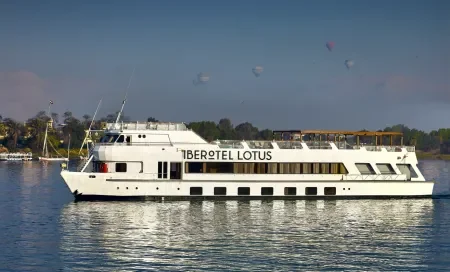
05:00 — You arrive at the East Bank dock and board a private motorboat. As the boat crosses the Nile in the pre-dawn darkness, the crew serves tea or coffee and small cakes. The balloon launch site glows across the water.
05:15 — You arrive on the West Bank and board a minibus that takes you to the inflation area — a flat desert field among the date palms where the balloon crews are already working. Watching the enormous envelopes fill with hot air, the burners roaring, the gondola gradually rising to vertical, is itself a spectacular sight.
05:30–06:00 — Launch. The gondola lifts from the ground and the noise of the city disappears. Below you, the West Bank spreads out in all directions as you rise. The sun breaks the horizon. The Nile catches the light. The temples appear, one by one.
06:30 — Landing. The pilot brings the balloon down on a flat desert area — landings are gentle but occasionally bumpy, depending on wind. The balloon crew chases the landing site by vehicle and arrives within minutes. The post-landing folkloric show (singing, drumming, the crew celebrating another successful flight) is a joyful, unexpected conclusion.
07:15 — Return transfer to your hotel or cruise ship. You will be back before most guests have finished breakfast — with photographs that will define your Egypt trip.
What no other guide tells you: The best photography position in the gondola is on the side that faces east as you ascend — the rising sun behind the eastern desert creates a backlit silhouette of the West Bank cliffs that is unlike any other photographic opportunity in Egypt. Tell your guide you want this position when you board. Bring your longest lens for the Valley of the Kings, and your widest angle for the Nile valley panorama. A polarising filter dramatically improves the colour of the desert and the river.
Combine the balloon with a full West Bank ground tour after landing — Egypt For Travel's Balloon + West Bank Full Day package is available at a combined discount. Contact us via WhatsApp: +20 155 555 2466.