• +201555552466
  • [email protected]
USD ($)
  • USD ($)
  • EUR (€)
  • GBP (£)
English
  • English
  • Español
Egypt For Travel
USD ($)
  • USD ($)
  • EUR (€)
  • GBP (£)
Egypt
  • English
  • Español
  • Home
  • Egypt Tours 2026
    • Egypt Travel Packages
    • Nile Cruises
    • Egypt Multi-Country Trips
    • Egypt Day Tours
  • Jordan
    • Trips to Jordan
    • Jordan Day Tours
    • Jordan Combined Tours
  • Saudi Tours
    • Saudi Tours
    • Saudi Day Tours
    • Saudi Combined Tours
  • Morocco
    • Morocco Tours
    • Morocco Day Tours
    • Morocco Combined Tours
  • Blog
    • Jordan Tourist
    • Morocco Tourist
    • Saudi Tourist
    • Egypt Tourist
  • About
    • WHY US
    • Terms and Conditions
    • Responsible Travel
    • About Us
Inquire
  • Home
  • Egypt Tours 2026
  • Egypt Day Tours 2026 — Private Guided Tours from $55
  • Philae Temple Sound & Light Show — Aswan Evening Private Tour
Philae Temple Sound & Light Show — Aswan Evening Private Tour
Aswan

(1,186 Reviews)
Night crossing to Philae Temple Aswan — motorboat to the illuminated Isis temple
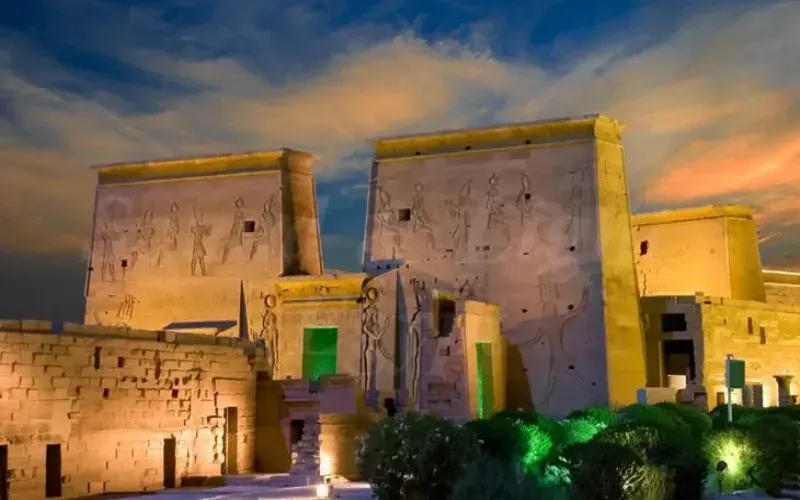
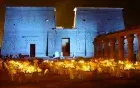
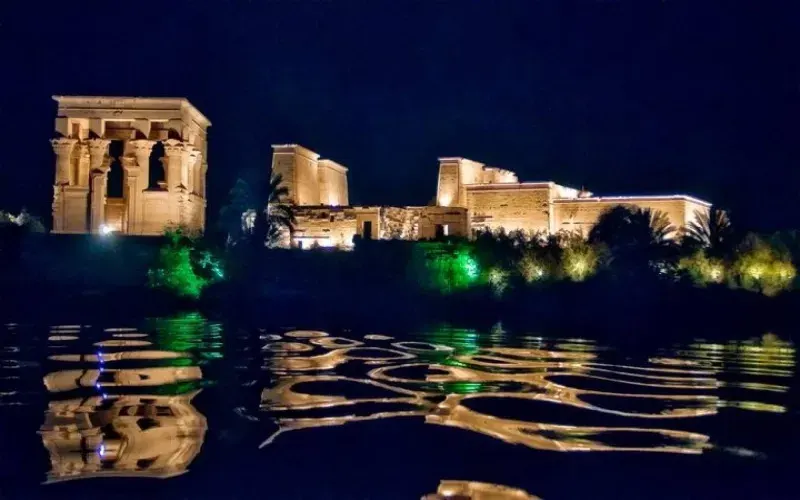
Philae Temple Sound and Light Show Aswan — illuminated pylon at night, Isis temple
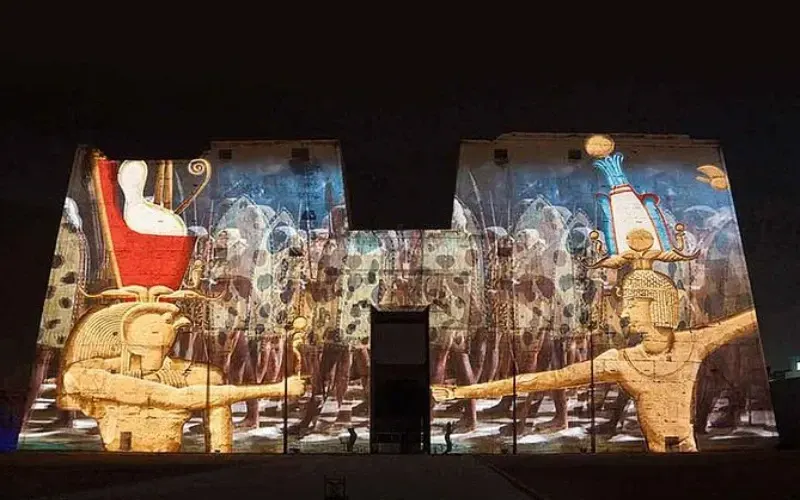
Philae Temple carved reliefs illuminated at night — Isis and Osiris myth depicted in stone
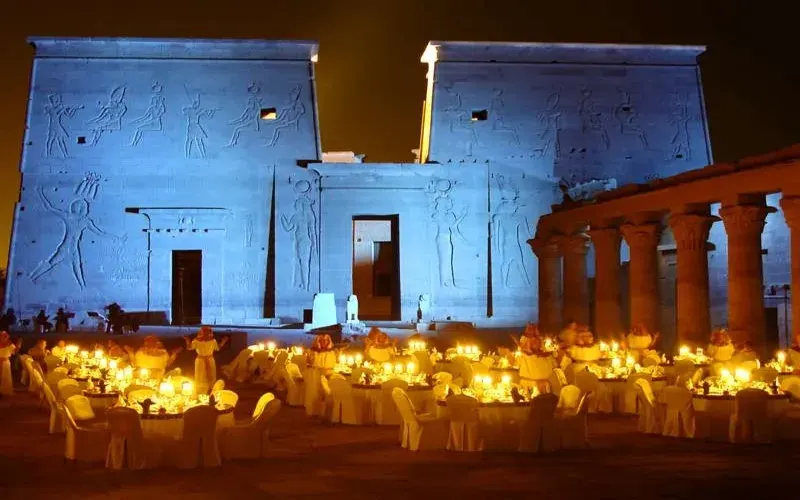
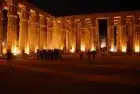
Philae Sound and Light Show audience — seated viewing area within the illuminated temple
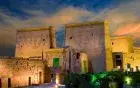
Philae Temple at night Aswan — the complete illuminated temple complex on Agilkia Island
Night crossing to Philae Temple Aswan — motorboat to the illuminated Isis temple
Philae Temple Sound and Light Show Aswan — illuminated pylon at night, Isis temple
Philae Temple carved reliefs illuminated at night — Isis and Osiris myth depicted in stone
Philae Sound and Light Show audience — seated viewing area within the illuminated temple
Philae Temple at night Aswan — the complete illuminated temple complex on Agilkia Island

Overview

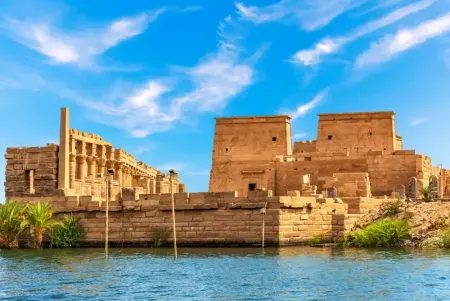
By day, Philae Temple — the island sanctuary of the goddess Isis, relocated stone by stone to save it from the rising waters of Lake Nasser — is one of the most beautifully situated monuments in Egypt. By night, illuminated against the dark water and the silhouettes of the surrounding granite islands, narrated by a dramatic sound and light programme recounting the myth of Isis and Osiris and the temple's own extraordinary history of survival, it becomes something else entirely. Egypt For Travel's Philae Temple Sound & Light Show tour arranges the complete evening experience — private motorboat crossing to the island, your show tickets, and a guide who provides context before and after the performance — for one of Aswan's most memorable evening outings.

The Show

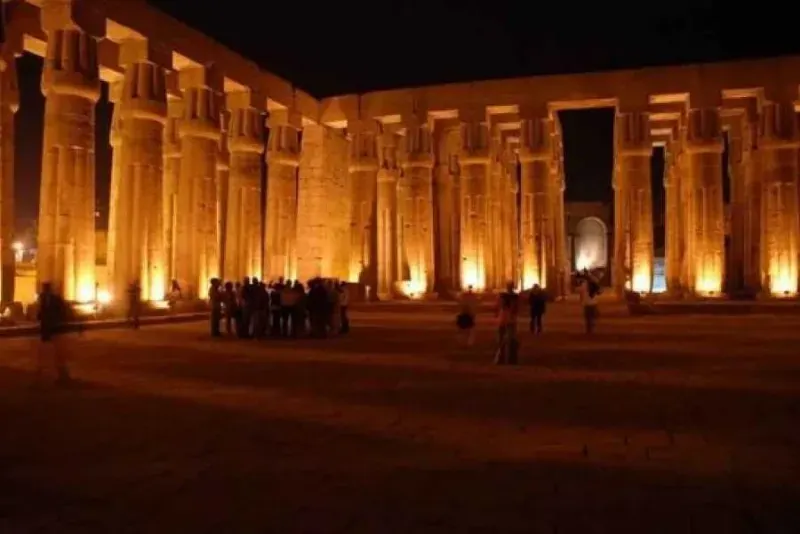
The Philae Sound and Light Show follows a walking route through the illuminated temple complex — beginning at the quay where the boat docks, proceeding through the outer pylon, into the great court, and finally to a seated viewing area within the temple precinct for the final dramatic sequence. Coloured floodlighting picks out the carved reliefs and column capitals in sequence as the narration unfolds, the temple's sandstone glowing amber, gold, and blue against the black water of Lake Nasser surrounding the island.

The narration tells two interwoven stories: the ancient Egyptian myth of Isis and Osiris — the murder of Osiris by his brother Set, the search and reassembly of his body by the grieving Isis, and the conception of their son Horus, who would avenge his father and inherit the throne of Egypt — and the more recent, equally dramatic story of the temple's 20th-century rescue: how Philae was threatened first by the original Aswan Dam in 1902 (which left it partially submerged for half the year for over six decades) and then by complete inundation following the Aswan High Dam, and how UNESCO's Nubia Campaign carried out one of the most technically demanding monument relocations in history between 1972 and 1980, moving the entire temple complex, block by numbered block, to its current home on Agilkia Island.

Detail Information
Show duration Approximately 60 minutes
Show days Daily, with shows in different languages on a rotating schedule — confirm at booking
Show times Typically two shows per evening — first show approximately 18:00, second show approximately 19:30, varying seasonally
Languages Each show is presented in a specific language; English is among the most frequently scheduled — confirm your preferred language at booking
Access By private motorboat from the Shellal quay — included
Ticket price ~1100 EGP — included in Egypt For Travel package, along with the boat transfer

What no other guide tells you: Philae's stone has a unique sensitivity that makes the temple's lighting design especially significant: because the temple was partially submerged in Nile water for roughly six decades following the original 1902 Aswan Dam (before the larger High Dam was built and the temple relocated entirely), the lower portions of many columns and walls absorbed mineral salts that, over time, caused surface erosion and discolouration distinct from the unaffected upper sections. The show's lighting designers deliberately use warmer, more saturated colours on these lower, water-damaged sections specifically to disguise the visible difference in stone condition — a subtle technical solution that most visitors never consciously notice but that is part of why the temple appears so uniformly beautiful at night, in a way it does not always appear in plain daylight.

Duration: Evening (2–2.5 hours with transfers) Type: Day Tour / Evening Run: Daily (language schedule varies — confirm at booking)

Included

  • Private vehicle — hotel or cruise ship pickup and drop-off in Aswan
  • Private motorboat crossing to and from Philae/Agilkia Island
  • Philae Temple Sound & Light Show ticket (~1000 EGP)
  • Private guide accompanies you before and after the show with historical context and commentary
  • Bottled water
  • All government taxes and service charges

Excluded

  • Dinner (can be arranged at a recommended Aswan restaurant before or after the show, on request)
  • Personal spending and tips

Itinerary:

First show option — 17:15 — Hotel or cruise ship pickup · 17:30 arrive Shellal quay and board motorboat · 17:45 arrive Philae Island, guide briefing · 18:00 Sound & Light Show · 19:00 return motorboat crossing · 19:30 return to hotel or cruise ship
Second show option — 18:45 — Hotel or cruise ship pickup · 19:00 motorboat crossing · 19:15 guide briefing · 19:30 Sound & Light Show · 20:30 return crossing · 21:00 return to hotel or cruise ship
Combine the early show with a sunset felucca ride beforehand for a complete Aswan evening — see our Felucca Ride on the Nile tour

Prices:


Prices
2-3 Persons
$ 70 Per Person
4-6 Persons
$ 60 Per Person
7-9 Persons
$ 50 Per Person
10+
$ 40 Per Person

Notes:

Prices Policy

All prices are quoted per person and include the show ticket, the boat transfer, your guide, and hotel or cruise ship transfers as detailed in the Inclusions section above. Single travellers pay the same per-person rate. Children aged 2 to 11 receive a discounted rate — please contact Egypt For Travel for current pricing. The show language schedule changes by day; Egypt For Travel will confirm the specific language available on your chosen date at the time of booking, and will recommend the most suitable showing time accordingly.

Departure Tips

Bring a light jacket or wrap, as the evening air at Philae on the water can be noticeably cooler than during the day, particularly between November and February. The walking route through the temple during the show is over ancient stone surfaces that can be uneven in places, so flat, comfortable, closed shoes are strongly recommended over sandals. Photography without flash is generally permitted during the show, though flash photography may be restricted to avoid disrupting the lighting sequence for other visitors; your guide will confirm current site policy on the day. Arrive at the agreed pickup time promptly, as the motorboat crossing operates on a fixed schedule tied to the show start time.

Children Policy

Children aged 0–1 travel free of charge. Children aged 2–11 receive a discounted rate — please contact Egypt For Travel for current pricing. The evening show, narration, and night-time setting are generally very well received by children, though very young children may find the 60-minute seated portion of the show requires some patience. The motorboat crossing is short, calm, and well-suited to families; life jackets for children are available on request.

Payment Policy

A deposit of 25% of the total tour cost is required to confirm your booking. The remaining 75% balance is due before or on the day of the show. During peak season, from October through April, and for group bookings of 6 or more people, a 50% deposit is required at the time of booking, as show tickets for popular language slots can sell out in advance during busy periods. Egypt For Travel accepts payment by bank transfer, credit card, or cash in USD, EUR, or EGP.

Installment Policy

Flexible payment installments are available on request, particularly when this evening tour is combined with a broader Aswan day tour package or a multi-day Egypt itinerary booked through Egypt For Travel. Please contact us via WhatsApp at +20 155 552 466 [sic — use +20 155 555 2466] or by email to discuss installment arrangements before your booking is confirmed.

Tipping Guide

Tipping is customary in Egypt but entirely at your discretion, and Egypt For Travel never adds automatic gratuities to your invoice or applies any pressure to tip. As a general guideline, your guide typically receives $10–15 per day (pro-rated for this evening experience, typically $5–8), and the boat captain typically receives $5–10 for the crossing. These amounts are paid directly and in cash at the end of the evening, in USD, EUR, or EGP as you prefer.

Cancellation Policy

Cancellations made 61 days or more before the scheduled show date incur a 10% cancellation fee. Cancellations made between 31 and 60 days before the show incur a 20% cancellation fee. Cancellations made between 15 and 30 days before the show incur a 50% cancellation fee. Cancellations made within 1 to 14 days of the show are non-refundable, representing a 100% cancellation fee, as show tickets are purchased in advance and are generally non-transferable. All cancellation requests must be submitted to Egypt For Travel in writing. In the rare event that the show itself is cancelled by the site authority due to technical issues or adverse weather, Egypt For Travel will arrange a full refund or rebooking at no additional cost to you.
Check Availability

Related Tours

09 Hours

Abu Simbel Day Tour from Aswan — By Flight or Road, Private Guide

(198)

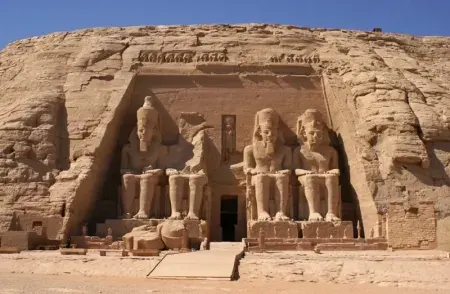
On the western bank of Lake Nasser, 280 kilometres south of Aswan, two temples carved into a sandstone cliff by Ramesses II around 1264 BC have stood for 3,300 years as the most impressive rock-cut monuments in the world. The Great Temple of Abu Simbel — guarded by four 20-metre seated colossi of Ramesses II, its interior penetrating 63 metres into the cliff — and the Small Temple dedicated to his queen Nefertari and the goddess Hathor, together form the greatest monument to royal power and divine self-identification in ancient Egyptian history. Egypt For Travel's Abu Simbel Day Tour from Aswan makes this extraordinary site accessible as a day trip — by 45-minute flight or by road convoy — with a private licensed guide and all entrance fees included.

The Two Temples of Abu Simbel

The Great Temple (Temple of Ramesses II)

Four colossal seated statues of Ramesses II — each 20 metres high, carved directly from the cliff face — flank the entrance to the Great Temple, their scale and authority undiminished by 33 centuries of desert sun. Inside, the hypostyle hall is lined with eight 10-metre statues of Ramesses as Osiris; the walls carry the most detailed battle reliefs in any Egyptian temple — scenes from the Battle of Kadesh (1274 BC, one of the earliest documented major battles in history) depicted in vivid, propagandistic detail. The innermost sanctuary contains four seated statues of Ramesses II and the three great gods — Amun, Ra-Horakhty, and Ptah — arranged so that on 22 October and 22 February each year, the rising sun penetrates the entire 63-metre length of the temple and illuminates the three seated gods (but not Ptah, god of darkness) in the innermost sanctuary: an astronomical engineering achievement of extraordinary precision.

The Small Temple (Temple of Nefertari)

Immediately to the north of the Great Temple, the Small Temple is dedicated jointly to Queen Nefertari (Ramesses II's most beloved wife) and the goddess Hathor. It is one of only two occasions in ancient Egyptian history where a pharaoh dedicated a major temple to his wife; and the facade — six standing colossal figures (four of Ramesses, two of Nefertari) all at the same scale — is a unique statement of royal equality and devotion. The interior reliefs show Nefertari in ritual roles normally reserved for the pharaoh himself, identified with Hathor as a divine being in her own right.

The UNESCO Relocation — An Engineering Miracle

Both temples were originally carved into cliffs that would have been submerged by the rising waters of Lake Nasser after the construction of the Aswan High Dam. Between 1964 and 1968, in one of the greatest cultural rescue operations in history, UNESCO coordinated the careful cutting of both temples into over 1,000 numbered blocks, their transport to a storage area, and their precise reassembly 65 metres higher and 200 metres further back from the original site — maintaining the original cardinal orientation so that the solar alignment events of 22 October and 22 February still occur as Ramesses II's architects intended. The operation cost approximately $40 million (equivalent to over $350 million today) and involved engineers and archaeologists from 50 countries.

The Solar Alignment Events: 22 October & 22 February

The most spectacular times to visit Abu Simbel are the twice-yearly solar alignment events on 22 October and 22 February — when the rising sun penetrates the full 63-metre depth of the Great Temple and illuminates the statues in the innermost sanctuary. These dates correspond (with a one-day margin introduced by the relocation) to the pharaoh's coronation and birthday according to some Egyptologists. The events attract thousands of visitors and require advance booking 6+ months ahead. Egypt For Travel arranges priority access and preferred positioning for the alignment viewing. Contact us immediately via WhatsApp if you wish to visit on these dates.

How to Get There: Flight vs Road

Option Journey Time Pros Cons
By flight (recommended) 45 min each way Much more time at the temples · less tiring · aerial view of Lake Nasser Higher cost · flight times fixed · booking needed in advance
By road 3 hours each way (convoy) Lower cost · desert landscape driving · no flight booking needed 6 hours driving total · tiring · limited temple time · convoy schedule required

Egypt For Travel strongly recommends the flight option. The 90 minutes saved in each direction translates directly into more time at the temples — and Abu Simbel rewards a slow, unhurried visit. The flight from Aswan Airport takes approximately 45 minutes and provides an extraordinary aerial view of Lake Nasser and the surrounding desert landscape. Contact us via WhatsApp: +20 155 555 2466 for current flight availability and pricing.

$ 99 | Per person

03 hours

Nubian Village Tour Aswan — Soheil Island by Felucca

(78)

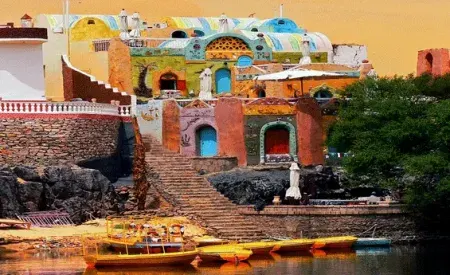
Aswan sits at the historical boundary between Egypt and Nubia — the ancient land that stretched south along the Nile into modern Sudan, home to one of Africa's oldest civilisations and a culture, language, and architectural tradition entirely distinct from mainstream Egyptian Arab culture. Soheil Island, a small island in the Nile a short distance south of Aswan, is one of the most accessible and authentic places to encounter living Nubian culture — its painted houses, its warm hospitality, and its community life largely unchanged by the tourism that surrounds Aswan's ancient monuments. Egypt For Travel's Nubian Village Tour sails to Soheil Island by traditional felucca, with a guide who has personal relationships with island families, ensuring a visit that feels like an invitation rather than a transaction.

Why Soheil Island

Soheil Island is one of several Nubian-settled islands and West Bank communities around Aswan, but it holds particular significance: it was an important boundary marker in antiquity, with ancient inscriptions carved into its granite boulders recording Nile flood levels and royal expeditions dating back over 3,000 years. The island today is a quiet farming and fishing community of a few hundred Nubian residents, its narrow lanes lined with houses painted in the distinctive Nubian palette — bright blues, ochres, and whites, decorated with geometric patterns and, in many cases, painted murals commemorating a family member's pilgrimage to Mecca.

The Felucca Crossing

The journey to Soheil Island is itself part of the experience: a 15–20 minute felucca sail from the Aswan Corniche, the wind filling the lateen sail as the boat threads between the granite boulders and small islands of the First Cataract. This stretch of the Nile is the most visually striking anywhere in Egypt — the pink and grey granite outcrops rising directly from the water, smoothed by millennia of river flow, creating a landscape unlike any other point on the Nile's 6,650-kilometre length. Your guide will point out Elephantine Island and the Aga Khan Mausoleum on the West Bank cliffs as you pass.

On the Island — Genuine Hospitality

Upon arrival, your guide — who has built relationships with specific island families over years of bringing visitors — leads you through the village to a family home. This is not a staged demonstration: it is a genuine visit, with the family offering tea, sometimes fresh-baked bread, and conversation about island life, farming, fishing, and Nubian traditions. Many families keep a small crocodile in a courtyard enclosure — a tradition referencing the historical reverence for the crocodile god Sobek among riverine Nubian communities, now maintained more as a curiosity and minor tourist attraction than a living religious practice. You will have the opportunity to see traditional Nubian handicrafts — basketry, beadwork, and textiles — available for purchase directly from the families who make them, with proceeds going straight to the community rather than through a bazaar middleman.

What no other guide tells you: The Nubian language spoken on Soheil Island — Kenuzi, one of several Nubian language varieties spoken in southern Egypt and northern Sudan — predates Arabic in the Nile Valley by thousands of years and is unrelated to it; it belongs to the Nilo-Saharan language family, the same broad group as several languages of South Sudan and Chad. UNESCO classifies it as a vulnerable language. Visiting Soheil Island and hearing it spoken in daily conversation is an encounter with one of the oldest continuously spoken languages in the Nile Valley — older than the arrival of Islam, older than Christianity, older than the Greek and Roman periods of Egyptian history.

Detail Information
Duration 3–4 hours including felucca crossing both ways
Felucca crossing 15–20 minutes each way · private felucca, your group only
On the island 1.5–2 hours · family visit · village walk · craft purchase opportunity
Best time Late afternoon — combines naturally with sunset on the return crossing
Language spoken Kenuzi Nubian (UNESCO-classified vulnerable language) and Arabic

$ 39 | Per person

06 Hours

Kalabsha Temple & Nubian Museum Private Tour from Aswan

(118)

Within sight of the Aswan High Dam, on a peninsula overlooking Lake Nasser, stands one of the largest free-standing temples ever rescued by the UNESCO Nubia Campaign: the Temple of Kalabsha, dedicated to the Nubian solar god Mandulis. Combined with a visit to the award-winning Nubian Museum — the finest regional museum in Egypt — Egypt For Travel's half-day private tour from Aswan covers the two essential sites for understanding Nubian civilisation: its ancient religious architecture and its broader cultural and archaeological legacy, told through one of the best-curated museum collections in the country.

Kalabsha Temple — A Temple Twice Saved

The Temple of Kalabsha was originally built during the reign of the Roman emperor Augustus (around 30 BC – 14 AD), on the site of an earlier and smaller temple structure, approximately 50 kilometres south of Aswan in the heart of Lower Nubia. Dedicated principally to Mandulis — a Nubian solar deity worshipped alongside the Egyptian gods Isis and Osiris — Kalabsha was the largest freestanding (non-rock-cut) temple in Nubia, second in scale only to Abu Simbel among the entire Nubian temple group threatened by the rising waters of Lake Nasser after the construction of the Aswan High Dam.

Between 1962 and 1963, in an operation funded substantially by the West German government as part of the broader UNESCO Nubia Campaign, the temple was dismantled into more than 13,000 numbered stone blocks and reconstructed on a new site on the western shore of Lake Nasser, immediately south of the High Dam — close enough to Aswan to be visited as part of a half-day private tour, unlike Abu Simbel, which requires a full-day excursion. The reconstructed temple preserves the original pylon, forecourt, hypostyle hall, and sanctuary, along with a wealth of carved relief decoration showing Roman emperors depicted in full pharaonic regalia making offerings to Mandulis, Isis, and other deities of the Egyptian-Nubian religious synthesis.

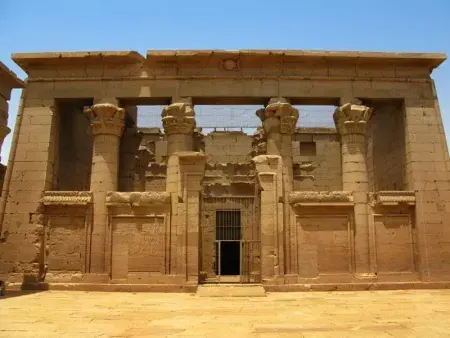
The Kiosk of Qertassi

Adjacent to the main temple, the elegant Kiosk of Qertassi — a small but architecturally refined structure with two Hathor-headed columns supporting an ornate roof — was relocated to the same site from its original location further south. Though modest in scale compared to the main Kalabsha Temple, the kiosk is one of the most photogenic structures in the entire relocated Nubian monument group, its slender proportions and floral column capitals making it a favourite subject for photographers.

The Nubian Museum

Established in 1997 specifically to preserve and present the cultural heritage of Nubia — much of which was permanently submerged or fundamentally altered by the creation of Lake Nasser — the Nubian Museum is widely regarded by art historians and museum professionals as one of the best-designed regional museums in Egypt, winning the Aga Khan Award for Architecture in 2001. Its collection spans the full chronological range of Nubian civilisation: prehistoric artefacts, objects from the powerful Kingdom of Kush (which at one point conquered and ruled all of Egypt as the 25th Dynasty), Christian-era Nubian art and manuscripts, and a rich ethnographic collection documenting Nubian village life, architecture, and customs before the displacement caused by the High Dam's construction.

What no other guide tells you: The Nubian Museum holds one of the most important and least-known archives of Egyptology: thousands of photographs, architectural drawings, and salvage records produced during the UNESCO Nubia Campaign of the 1960s — the largest coordinated international archaeological rescue operation in history, involving over 50 countries and resulting in the relocation of more than 20 temples and monuments, including both Kalabsha and Abu Simbel. Walking through the museum's lower galleries, where this rescue effort is documented in detail with original campaign photographs, gives a completely different understanding of how the monuments you have just visited at Kalabsha came to stand where they do today — and the magnitude of the cultural sacrifice made when ancient Nubia itself was flooded beneath Lake Nasser.

Site Entrance Fee (2026) Highlight
Kalabsha Temple + Kiosk of Qertassi ~200 EGP — included Largest freestanding temple relocated from Nubia, after Abu Simbel
Nubian Museum ~400 EGP — included Aga Khan Award-winning architecture, 3,000+ years of Nubian history

$ 59 | Per person

02 Hours

Felucca Ride on the Nile at Aswan — Private Sunset Sailing Tour

(50)

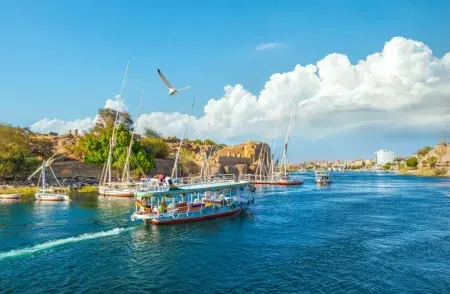
Aswan is, by general consensus among travellers and Egyptologists alike, the most beautiful stretch of the Nile in Egypt — the river narrowing between pink and grey granite outcrops at the First Cataract, palm-fringed islands rising from the water, and the desert cliffs of the West Bank glowing rose and gold in the late afternoon light. There is no better way to experience this landscape than from the deck of a felucca — the traditional, engineless, wind-powered wooden sailboat that has carried Egyptians and travellers along this stretch of the Nile for thousands of years. Egypt For Travel's Felucca Ride on the Nile is a private sailing experience, timed for sunset, sailing past Elephantine Island, the Aga Khan Mausoleum, and the colourful Nubian villages on the West Bank.

The Aswan Felucca Experience

Unlike a powered motorboat, a felucca has no engine and depends entirely on the wind and the skill of its captain to navigate — which means every felucca journey on the Nile at Aswan has a quality of unhurried, almost meditative calm that no motorised alternative can replicate. The boat moves silently, the only sounds the lapping of water against the hull, the occasional creak of the rigging, and the wind in the sail. Aswan's local felucca captains, many from families who have sailed these waters for generations, read the wind and the channels between the granite islands with an intuitive skill built from a lifetime on the river.

What You Will See

Sailing south or north from the Aswan Corniche (your guide and captain will choose the best route based on the day's wind direction), the felucca passes some of the most scenic points on the entire Nile:

Elephantine Island — the large island in the middle of the river opposite central Aswan, continuously inhabited for over 5,000 years, with its ancient Nilometer (used since pharaonic times to measure the annual flood level), the ruins of the Temple of Khnum, and a small but excellent on-site museum. Kitchener's Island (also called the Island of Plants) — a smaller island just south of Elephantine, transformed into a botanical garden in the early 20th century by Lord Kitchener, planted with exotic species from around the British Empire and now a lush, shaded retreat visible from the water. The Aga Khan Mausoleum — a striking domed structure on the West Bank cliffs above the river, the resting place of Aga Khan III, spiritual leader of the Ismaili Muslim community, who fell in love with the view of Aswan from this hillside and asked to be buried there. Nubian villages on the West Bank — their houses painted in vivid colours, visible along the riverbank as the felucca sails past.

Sunset on the Nile

The felucca ride is timed to place you on the water during the final hour before sunset, when the light over the First Cataract turns from white to gold to deep orange, the granite islands silhouetted against the colour, and the call to prayer occasionally drifting across the water from a riverside mosque. This is consistently rated by visitors as one of the most peaceful and memorable experiences available anywhere in Egypt — a complete contrast to the intensity of the ancient monuments, and a chance to simply absorb the beauty of the Nile itself.

What no other guide tells you: The felucca's distinctive triangular sail is called a lateen sail — a design that originated in the eastern Mediterranean and Red Sea region over a thousand years ago and that allows the boat to sail effectively even when the wind is not blowing directly from behind, a critical advantage on a river like the Nile where the wind frequently blows from the north (against the current) while boats need to travel both upstream and downstream. The felucca exploits this northerly wind to sail upstream (south) while relying on the river's natural current to carry it back downstream (north) without needing to fight the wind at all — meaning a skilled captain plans the entire day's sailing route around this elegant natural balance between wind and current, a system of navigation essentially unchanged since antiquity.

Detail Information
Duration 1.5–2 hours on the water
Best time 1 hour before sunset, departing the Corniche dock
Route Elephantine Island · Kitchener's Island · Aga Khan Mausoleum · Nubian villages
Capacity Private felucca, your group only — typically up to 8 passengers
On board Cushioned seating, shaded canopy section, Egyptian mint tea

$ 25 | Per person

06 Hours

Aswan Private Day Tour — Philae Temple, High Dam, Obelisk & Nubian Museum

(110)

Aswan is Egypt's most beautiful city — and one of its most historically significant. Sitting at the First Cataract of the Nile, where the ancient border between Egypt and Nubia ran for most of pharaonic history, Aswan offers a completely different Egypt from Cairo or Luxor: granite outcrops rising from the river, feluccas on the water, the warmth of Nubian culture, and monuments that range from the UNESCO-rescued Philae Temple on its island to the Aswan High Dam — one of the greatest engineering achievements of the 20th century. Egypt For Travel's Aswan Private Day Tour covers the essential highlights with a licensed Egyptologist guide and all entrance fees included.

What You Will See

Philae Temple — Island of Isis

The Temple of Philae — dedicated to Isis, goddess of magic and motherhood — is one of the most beautifully situated temples in Egypt: approached by motorboat across the waters of Lake Nasser, its pylons and colonnades rising directly from the water's surface on its own island. Originally located on the island of Philae, the temple was dismantled and relocated to the adjacent island of Agilkia between 1972 and 1980 as part of the UNESCO Nubia Campaign — the only temple in the Nubia rescue operation to be moved to a new island rather than reassembled on higher ground. The result is a temple setting of extraordinary beauty, the columns reflecting in the calm water, the pink granite outcrops of the First Cataract framing the scene on all sides. Entrance: 300 EGP (included) + motorboat transfer (~100–150 EGP, included).

The Unfinished Obelisk

In the ancient granite quarries on the southern edge of Aswan, a partially carved obelisk lies abandoned in the rock — 42 metres long, it would have been the largest obelisk ever erected if it had been completed. A crack appeared in the granite during carving and the project was abandoned, leaving the obelisk in a state that reveals exactly how ancient Egyptians quarried and shaped granite: the marks of the dolerite-ball pounders used to pound the granite surface are still visible, the channels of separation still clearly cut. This site is the best surviving evidence of ancient Egyptian quarrying technique in existence. Entrance: ~200 EGP (included).

The Aswan High Dam

The Aswan High Dam — 111 metres high, 3,830 metres long, completed in 1970 with Soviet technical assistance — is the engineering achievement that transformed modern Egypt: it controls the Nile flood, provides hydroelectric power, and created Lake Nasser (500 km long, one of the world's largest man-made lakes). Standing on the dam and looking south at the blue expanse of the lake and north at the controlled flow through the generators gives a vivid sense of the scale of the intervention. The Soviet-Egyptian Friendship Monument beside the dam commemorates the USSR's contribution. Entrance: ~100 EGP (included).

The Nubian Museum

Winner of the Aga Khan Award for Architecture 2001, the Nubian Museum is the finest museum in Egypt outside Cairo — a purpose-built collection of over 3,000 artefacts covering Nubian civilisation from prehistoric times through the pharaonic, Meroitic, Christian, and Islamic periods. Its beautifully designed galleries provide the essential context for understanding the temples of Lake Nasser and the living Nubian culture around Aswan. Entrance: ~150 EGP (included).

Optional Add-Ons

Felucca ride at sunset (after the main tour, ~1–2 hours on the Nile between Elephantine Island and the west bank — additional ~$20–30 per boat, not included) · Nubian village visit (by motorboat to the west bank — additional ~$20 per person for boat + guide time) · Elephantine Island (ancient site + Nilometer + small museum — additional entrance fee).

Site Entrance Fee (2026) Highlight
Philae Temple + motorboat 550 EGP + ~700 EGP boat — included Island temple of Isis · UNESCO relocated 1972–1980
Unfinished Obelisk ~220 EGP — included 42m obelisk abandoned in quarry · ancient carving technique
Aswan High Dam ~300 EGP — included 111m dam · Lake Nasser views · Soviet monument
Nubian Museum ~220 EGP — included Aga Khan Award winner · 3,000 Nubian artefacts

$ 55 | Per person

Full Day (8.5 hours)

Kom Ombo & Edfu Temples Private Day Tour from Aswan

(150)

North of Aswan, the Nile passes two of the most architecturally distinctive Ptolemaic temples in Egypt: the Temple of Sobek and Haroeris at Kom Ombo — the only completely symmetrical double temple in the country, dedicated simultaneously to two gods along parallel axes — and the Temple of Horus at Edfu, the single best-preserved ancient Egyptian temple anywhere in the world, its original stone roof still largely intact 2,000 years after construction. Both temples lie directly on the route that every Nile cruise ship travels between Luxor and Aswan, but for travellers based in Aswan who are not cruising — staying at a hotel, arriving by flight, or beginning their Egypt journey in the south — Egypt For Travel's private day tour makes both temples accessible without needing to join a cruise itinerary.

Kom Ombo — The Double Temple

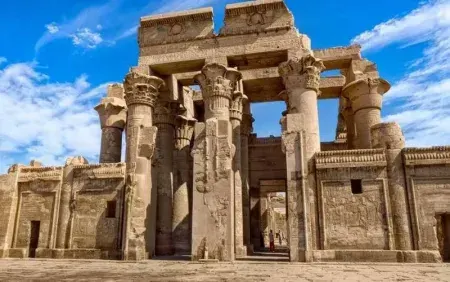
The Temple of Kom Ombo, approximately 45 kilometres north of Aswan, is unique among Egyptian temples for its rigorously symmetrical double dedication. Every architectural element of the temple is duplicated and mirrored along a central axis: two entrances, two forecourts, two hypostyle halls, and two inner sanctuaries, one half dedicated to Sobek, the crocodile-headed god of fertility and the life-giving power of the Nile, and the other to Haroeris (Horus the Elder), the falcon-headed god of the sky and kingship. Nowhere else in Egyptian religious architecture is this kind of perfect dual symmetry attempted on this scale.

The temple's position is as remarkable as its design: it stands directly on a bend of the Nile, its ruined outer walls falling away almost to the water's edge, offering one of the most photogenic river views of any temple on the Nile cruise route. Sacred crocodiles, associated with Sobek, were once kept and ceremonially fed within the temple precinct; after death they were mummified, and the adjoining Crocodile Museum displays 22 mummified crocodiles in varying states of preservation, from fully grown adults to tiny hatchlings, alongside crocodile sarcophagi and ritual equipment associated with their cult.

The outer corridor walls of Kom Ombo carry one of ancient Egypt's most studied relief scenes: a depiction of surgical and medical instruments — forceps, scalpels, bone saws, and other tools — laid out in a votive offering scene that has been interpreted by medical historians as evidence of the sophistication of ancient Egyptian medical and surgical practice, possibly connected to a healing cult associated with the temple.

Edfu — The Best-Preserved Temple in Egypt

Continuing north approximately 60 kilometres from Kom Ombo, the Temple of Horus at Edfu represents the opposite architectural philosophy from Kom Ombo's symmetry: a single, vast, conventional temple plan, built between 237 and 57 BC and preserved with a completeness unmatched anywhere else in Egypt because its massive stone roof remains largely intact over the hypostyle hall and inner sanctuary. Entering Edfu means experiencing an ancient Egyptian temple interior as it was originally designed to be experienced: dim, cool, mysterious, lit only by narrow clerestory openings high in the walls, the carved reliefs surrounding you on every surface from floor to ceiling.

The approach to the temple from the car park is traditionally made by horse-drawn carriage through the streets of Edfu town — a short, characterful ride that is included as part of this tour. Inside, the temple's first pylon rises 36 metres, among the tallest in Egypt; the open court beyond contains the original granite statue of Horus as a falcon wearing the double crown, one of the best-preserved cult statues from any Egyptian temple; and the hypostyle hall beyond demonstrates, in the differing carving styles visible on its walls, the temple's 180-year construction history across multiple generations of craftsmen.

Temple Distance from Aswan Entrance Fee Key Feature
Kom Ombo ~45 km north (45 min) ~450 EGP — included Perfectly symmetrical double temple, Nile bank setting, mummified crocodiles
Edfu ~105 km north (1.5 hrs) ~550 EGP — included Best-preserved temple in Egypt, intact stone roof, granite falcon statue

$ 75 | Per person

Follow on Instagram
insta
insta
insta
insta
insta
insta
insta
insta
insta
insta
Egypt For Travel

Egypt For Travel Is A Young Innovative Travel Company Yet Matured And Experienced. Founded In 2005, Egypt For Travel Has Made A Considerable Impact On The Egyptian Tourism Sector By Promoting Egypt As One Of The Fascinating Destinations In The World.

Quick link
  • WHY US
  • Terms and Conditions
  • Responsible Travel
  • About Us
Categories
  • Egypt Travel Packages 2026 & 2027 — Private Tours from $599
  • Nile Cruises 2026 — Luxor to Aswan
  • Egypt Multi-Country Tours 2026 — Jordan, Morocco, Saudi & Dubai
  • Egypt Day Tours 2026 — Private Guided Tours from $55
Newsletter

join the newsletter to receive our best monthly deals

  • We Kindly Accept:
  • Visa
  • MasterCard
  • NBE
  • Bank Transfer

© 2026 Egypt For Travel. All rights reserved.