.webp)
Since the Grand Egyptian Museum (GEM) opened its doors on 1 November 2025, travelers to Cairo face a question that didn’t exist before: do you visit the GEM, the old Egyptian Museum in Tahrir Square, or both? This guide gives you the honest, specific answer — which artefacts are where, the real difference in the experience, the entrance fees, and exactly how Egypt For Travel schedules both if you want to see them.
The Headline Answer
If you can only visit one: the GEM. It now holds the complete Tutankhamun treasure — all 5,398 artefacts — and the experience of seeing them in purpose-built, climate-controlled galleries with proper lighting and English-language explanations is genuinely incomparable to how they were displayed before.
If you have two Cairo days: GEM on Day 1 (combined with the Pyramids), old Egyptian Museum on Day 2 for the Royal Mummies Hall — which remains exclusively in the Tahrir building and is not duplicated anywhere at the GEM.
If you visited the old museum before November 2025: you have not seen what the GEM now contains. The transfer of Tutankhamun’s collection from Tahrir to GEM is the single most significant change in the Egyptian museum landscape in decades.
What’s at the GEM That Wasn’t at the Old Museum
The Grand Egyptian Museum is not simply an upgrade of the Egyptian Museum — it is a completely new institution with a different collection philosophy, different building, and different experience. Here is what you will find exclusively at the GEM:
The Complete Tutankhamun Collection — All 5,398 Pieces
This is the transformative change. The old Egyptian Museum displayed Tutankhamun’s treasures across two floors in crowded cases with limited lighting and minimal explanatory text. The GEM dedicates twelve purpose-built galleries specifically to Tutankhamun, displaying all 5,398 objects from his tomb in sequence — the objects Howard Carter found in the Antechamber, the Treasury, the Annexe, and the Burial Chamber over three years of excavation beginning in 1922. Many objects that were in storage at the old museum and never publicly displayed are now exhibited here for the first time. The golden death mask, the four gilded shrine coffins, the golden throne, the chariots, the model boats, the calcite canopic jars, the shabtis, his board games, his sandals, his childhood toys — the complete picture of one royal burial, 3,300 years after it was sealed.
The Khufu Boat Museum
The Khufu Solar Boat — a 43-metre cedar vessel buried beside the Great Pyramid around 2500 BC, reassembled piece by piece after its discovery in 1954 — is now displayed in a dedicated museum within the GEM complex, adjacent to the main building. The boat is one of the oldest and best-preserved wooden vessels on earth, and the new display provides access and context that the original converted shed beside the Pyramid could not.
The Grand Staircase
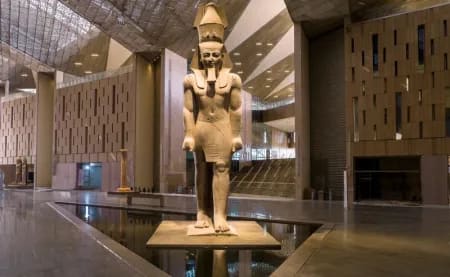
The GEM’s Grand Staircase features 87 colossal royal statues — pharaohs and gods removed from sites across Egypt — displayed in a monumental processional arrangement lit by natural light through the building’s translucent stone facade, with the Pyramids visible in the background. It is one of the most extraordinary museum interiors in the world, and it has no equivalent at the old Tahrir museum.
Conservation Labs
The GEM includes visible conservation laboratories where visitors can watch Egyptologists restoring ancient artefacts in real time through glass partitions — an educational experience unique to this museum globally.
What’s at the Egyptian Museum (Tahrir) That Is NOT at the GEM
The Egyptian Museum in Tahrir Square has not closed, and it has not been emptied. It still holds approximately 120,000 artefacts — including pieces that did not transfer to the GEM and that remain exclusively at Tahrir. The most significant:
The Royal Mummies Hall — Exclusively at Tahrir
The Royal Mummies Hall at the Egyptian Museum in Tahrir is the only place on earth where you can stand in front of the preserved remains of Egypt’s greatest pharaohs. The hall houses 11 royal mummies including:
- Ramesses II (the Great) — 67-year reign, 90+ years old at death, the most recognisable royal mummy in existence. His face is extraordinarily well preserved.
- Seti I — whose mummy is considered the finest preserved royal mummy in the world, with facial features intact after 3,200 years.
- Thutmose III — the Napoleon of ancient Egypt, who extended the empire to its greatest extent.
- Hatshepsut — identified in 2007 from DNA and dental records as one of the Deir el-Bahari cache mummies.
- Ramesses III, Ramesses IV, Merenptah, and several queens and princes of the New Kingdom.
The Royal Mummies Hall requires a separate ticket supplement (~300 EGP) above the general museum entrance fee. It cannot be visited at the GEM — these mummies were not transferred and remain exclusively at Tahrir Square.
The Predynastic and Early Dynastic Collections
The Egyptian Museum in Tahrir still holds the most significant collection of predynastic and early dynastic artefacts in Egypt — objects from before the pyramid age, when Egyptian writing, art, and statecraft were first being developed. For specialists and serious students of early Egyptian history, the Tahrir collection retains unique value.
The Narmer Palette
The Narmer Palette — the most important single artefact in Egyptian history, a cosmetic palette dating to approximately 3100 BC that depicts the unification of Upper and Lower Egypt by the first pharaoh — remains at the Egyptian Museum in Tahrir Square. It is the founding document of Egyptian civilization.
Entrance Fees: GEM vs Egyptian Museum 2026
| Museum | General Admission | Extra Tickets | Location |
|---|---|---|---|
| Grand Egyptian Museum (GEM) | 1,590 EGP (~$32) | Khufu Boat Museum (separate ticket, ~100 EGP). Timed-entry booking required online. | Giza Plateau — 2km from the Pyramids, 20 min drive from central Cairo |
| Egyptian Museum, Tahrir | ~450 EGP (~$9) | Royal Mummies Hall: +300 EGP (~$6). Tutankhamun Jewellery Room: +100 EGP (~$2). | Tahrir Square — central Cairo, 30 min drive from the GEM |
Important note on the GEM ticket: As of 2026, timed-entry booking is strongly recommended (and at peak periods, required) through the official GEM portal at visit-gem.com. Egypt For Travel handles this booking for all guests at no extra charge as part of the Cairo day tour.
The Experience Difference — What No One Tells You
The GEM is larger than you expect — plan accordingly
The GEM covers 45,000 square metres of gallery space. A visit covering the Tutankhamun galleries, the Grand Staircase, and the main permanent collection takes 4–6 hours minimum. Egypt For Travel’s full-day GEM + Pyramids program allows 3 hours at the Pyramids and Sphinx in the morning and 3–4 hours at the GEM in the afternoon — the correct ratio for a first-time visit that doesn’t rush either experience. Do not attempt the GEM in under 2 hours.
The old Egyptian Museum is chaotic in a way the GEM is not
The Egyptian Museum in Tahrir Square opened in 1902 and has not fundamentally changed its display system since. Cases are packed, lighting is variable, labelling is inconsistent, and on busy days (which is most days) the crowds in the Tutankhamun galleries were oppressive. That pressure is now released — the Tutankhamun crowds have moved to the GEM — making the old museum quieter and more contemplative than it has been in decades. For the Royal Mummies Hall specifically, this actually improves the experience: fewer visitors, more space, more time with each mummy.
The GEM’s building is an experience in itself
The GEM was designed by Heneghan Peng Architects with a translucent stone facade through which the Giza Pyramids are visible from inside the atrium. Walking into the Grand Staircase — 87 colossal pharaonic statues, natural light filtering through the stone facade, the Pyramids framed in the background — is one of the most extraordinary museum arrivals in the world. The architecture is inseparable from the collection.
Should You Visit Both in One Cairo Trip?
Our recommendation by trip length:
| Cairo Days | Recommendation |
|---|---|
| 1 day only | GEM only (combined with Pyramids). Do not try to fit both museums in one day. |
| 2 days | Day 1: Pyramids + GEM. Day 2: Egyptian Museum (Tahrir) + Coptic Cairo + Khan El-Khalili. This is the Egypt For Travel standard 2-day Cairo program. |
| 3+ days | Add Saqqara, Memphis, or Islamic Cairo on Day 3. Return to whichever museum you want more time in on Day 3 afternoon. |
| Returning visitor (visited before Nov 2025) | GEM is entirely new to you — the Tutankhamun collection you saw at Tahrir has been transformed. Visit GEM first, then decide if the old museum adds anything. |
Frequently Asked Questions
Has Tutankhamun’s mummy moved to the GEM?
No — Tutankhamun’s mummy remains in his tomb in the Valley of the Kings (KV62) in Luxor, where it was found in 1922 and where it will remain. His treasures (artefacts and grave goods) have transferred to the GEM. His mummy is a separate visit entirely — KV62 requires a special supplement ticket at the Valley of the Kings. The GEM displays the contents of his tomb, not the king himself.
Is the old Egyptian Museum in Tahrir still worth visiting?
Yes — specifically for the Royal Mummies Hall, the Narmer Palette, and the predynastic collection. For travelers on their second or third Egypt trip who saw the old Tutankhamun display before 2025, the old museum now has a quieter, more focused character that rewards a half-day visit. For first-time visitors with limited time, the GEM is the priority.
Do I need to pre-book GEM tickets?
Yes — timed-entry is strongly recommended and at peak periods required. Egypt For Travel handles GEM ticket booking for all guests as part of the day tour package. The entrance fee of 1,590 EGP (~$32) is included in all Egypt For Travel Cairo programs. See our complete GEM visitor guide for opening hours, practical tips, and what to prioritise.
Can I visit the GEM and the Pyramids in the same day?
Yes — this is Egypt For Travel’s standard Day 2 Cairo schedule for all programs. The Pyramids, Sphinx, and Valley Temple in the morning (3 hours), lunch at a quality local restaurant, then the GEM in the afternoon (3–4 hours). The two sites are 2km apart. This is the most efficient way to see both the monuments and the museum that houses their most significant contents.
Visit both Cairo museums with an expert Egyptologist guide. Egypt For Travel’s licensed guides know the GEM from opening day and the old Egyptian Museum from decades of daily visits. WhatsApp +20 155 555 2466 or [email protected] — ETA Licence Category A No. 1947.