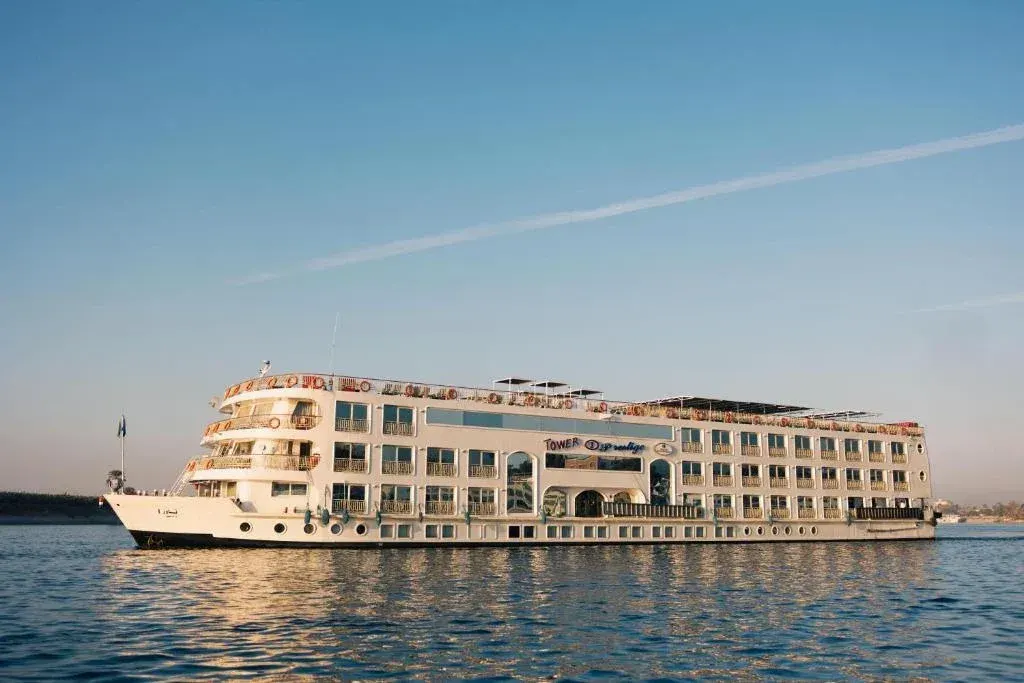
The single most common question Egypt For Travel receives from travelers planning their first trip is not about the Pyramids or the cost or the weather. It is this: “Do I need the Nile cruise, or can I see everything on a land tour?” The honest answer is nuanced — and this guide gives it to you completely, with the specific sites that are only accessible by cruise, the sites that are actually better on a land tour, the cost difference, and the decision framework that Egypt For Travel’s guides use when clients ask.
The Quick Answer
- Do the Nile cruise if you have 8+ days and visiting the Nile Valley temples (Karnak, Valley of the Kings, Edfu, Kom Ombo, Philae) is important to you. The cruise is not just transport — it changes how you experience these sites.
- Skip the Nile cruise if you have 6 days or fewer, if Egypt is the secondary destination in a multi-country trip, if you have mobility limitations, or if Abu Simbel (which is better visited from Aswan on land) is your priority over the Karnak-to-Philae circuit.
- Consider both if you have 14+ days and can add a Red Sea beach stay after the cruise — Hurghada is 3.5 hours from Luxor and gives the complete Egypt experience: monuments, river, and beach.
What the Nile Cruise Adds That a Land Tour Cannot
1. You approach the temples the way they were designed to be approached
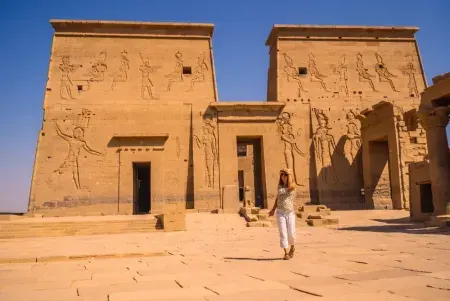
Every major temple on the Luxor–Aswan cruise route was built with a river entrance — the processional pylon and forecourt face the Nile, not a road. Edfu’s Horus Temple, the most complete ancient Egyptian temple in existence, was designed to be seen from the Nile first — the river perspective reveals the full scale of the pylon towers in a way the land approach (arriving by horse carriage from the car park behind the temple) does not. Kom Ombo sits on a promontory above the river so that its twin facades face the water at sunset. On a cruise, you arrive at these sites by water, at the angle the pharaoh who built them intended. No land tour can replicate this.
2. The Nile itself is an experience
The Nile between Luxor and Aswan looks very similar today to how it looked when Cleopatra sailed it 2,000 years ago: sugar cane fields, date palms, mud-brick villages, felucca sailboats, herons fishing at the water’s edge, and the desert escarpment rising sharply beyond the thin green strip of cultivated land on each bank. There is no road equivalent to an afternoon on the upper deck of a cruise ship watching this landscape. The cruise is not just transport between temples — for most travelers, the time on the river is itself one of the most distinctive memories of their Egypt trip.
3. Daily unpacking: zero
On a Nile cruise, you unpack once on Day 1 of the cruise and your cabin is your home for 3 or 4 nights while the ship moves. You wake up at a temple, visit it, return to lunch on board, and sail to the next site while you have dinner. On a land tour covering the same temples, you check in and out of a different hotel in Luxor, then Edfu, then Aswan — three check-ins and check-outs in three days. For travelers who find the constant movement of land tours exhausting, the cruise removes this entirely.
4. Karnak at 6:00 AM, Valley of the Kings at 7:00 AM
Cruise ships dock in Luxor overnight, giving Egyptologist guides the ability to arrive at Karnak Temple at 6:00 AM when it opens — typically with fewer than 20 other visitors in the entire complex. The same applies to the Valley of the Kings at dawn. Land-tour visitors arriving by day bus from Cairo or Hurghada typically arrive after 9:00 AM. The difference between Karnak at 6:00 AM (cool, quiet, the sound of the muezzin from the village, golden light on the columns) and Karnak at 10:00 AM (35°C, tour groups, competing commentary) is not a small difference.
What a Land Tour Does Better
Abu Simbel is easier from Aswan on land
Abu Simbel — the twin temples of Ramesses II and Queen Nefertari on Lake Nasser, 280km south of Aswan — is one of Egypt’s most extraordinary sites and the one most tour itineraries treat as optional. On a cruise itinerary, Abu Simbel is typically visited as an early-morning road trip from Aswan (depart 03:30 AM, return by 12:00 PM) before the cruise sails north. It is entirely possible — Egypt For Travel includes it as a standard Day 7 option on the cruise programs — but the departure time is taxing for some travelers. On a purely land-based Aswan stay, you can depart at a more reasonable hour, spend more time at the temples, and return at leisure. If Abu Simbel is your priority over the Karnak–Edfu–Kom Ombo circuit, a land tour based in Aswan gives you the better version of it.
Flexibility
On a land tour, your guide can adapt the day in real time — if you want to spend three hours at a single tomb in the Valley of the Kings rather than covering all three tombs on your ticket, that is a conversation between you and your guide. Cruise itineraries follow the ship’s docking schedule — you have a specific window at each site before the ship sails on. Egypt For Travel’s private Nile cruises (both Standard and Deluxe) allow considerably more flexibility than group-ship schedules, but some constraint still exists.
Dahshur and Saqqara — land only
The Step Pyramid of Djoser at Saqqara (the oldest pyramid in Egypt, built 300 years before Giza) and the Bent and Red Pyramids at Dahshur are accessible only from Cairo on land programs. Cruise itineraries leave Cairo after 2 days and don’t return until the cruise ends — meaning these sites require a dedicated Cairo day. Egypt For Travel’s 8-day land program includes both Saqqara and a free day in Cairo that cruise programs cannot offer.
Side by Side: What You See on Each
| Site | Nile Cruise | Land Tour |
|---|---|---|
| Pyramids of Giza + GEM | ✅ Both programs | ✅ Both programs |
| Saqqara Step Pyramid | ❌ No time in Cairo | ✅ 8-day Cairo program |
| Karnak Temple | ✅ At 6:00 AM from ship | ✅ Day trip from Luxor hotel |
| Valley of the Kings | ✅ At 7:00 AM from ship | ✅ Day trip from Luxor hotel |
| Edfu Horus Temple | ✅ Arrived by river | ⚠️ Possible but not standard |
| Kom Ombo Temple | ✅ Arrived by river at sunset | ⚠️ Possible but not standard |
| Philae Temple | ✅ Via motorboat from Aswan | ✅ Via motorboat from Aswan |
| Abu Simbel | ⚠️ 03:30 AM road trip (optional) | ✅ Better from Aswan land stay |
| Dahshur Red + Bent Pyramids | ❌ Not included | ✅ Day trip from Cairo |
| Nubian Village, Aswan | ✅ Motorboat from ship | ✅ From Aswan hotel |
| Hot air balloon, Luxor | ✅ Pre-dawn from ship | ✅ From Luxor hotel |
Cost Comparison 2026
| Program | Duration | Includes Cruise? | From (triple, May–Sep) |
|---|---|---|---|
| Cairo + Nile Cruise | 8 days | ✅ 4-night cruise | $1,249 |
| Cairo + Luxor land tour | 5 days | ❌ Hotels only | From $599 |
| All-Inclusive Egypt (USA) | 11 days | ✅ 3-night cruise + Hurghada | $1,799 |
| Dahabiya private sailing | 5–8 nights sailing | ✅ Entire experience is the cruise | From $699/night (2 pax) |
The cruise itself costs approximately $200–400 extra per person compared to equivalent hotel nights at the same standard — the price difference covers full board on the ship (all meals), the guide coordination across multiple sites without inter-hotel transfers, and the ship as a moving hotel. For most travelers, the premium is worth it. For shorter trips where the cruise takes up most of the budget, a land tour with a 1-night Luxor hotel is a legitimate alternative.
Nile Cruise Ship Options — Standard vs Deluxe vs Dahabiya
Not all Nile cruises are equal. Egypt For Travel offers three distinct cruise experiences:
Standard Cruise Ships
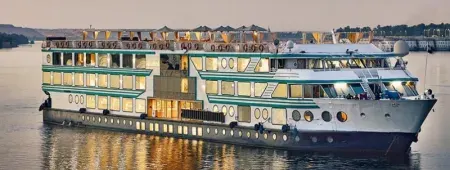
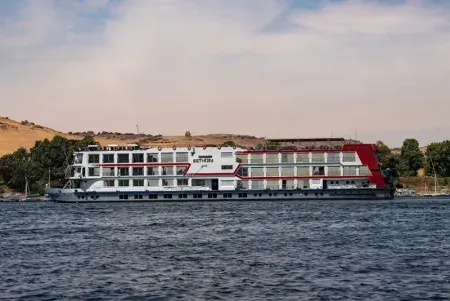
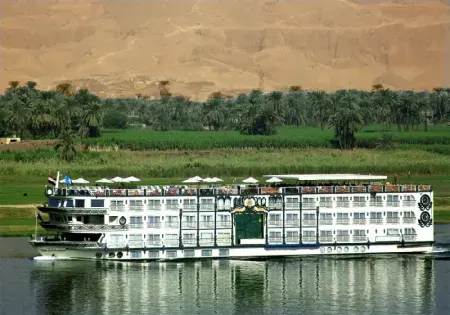
Ships like the Radamis II Princess Du Nil operate full-board, 4-night Luxor–Aswan cruises with comfortable cabins, pool deck, restaurant, and standard excursions. They carry 30–60 cabins and are the best value Egypt Nile cruise experience available. From $499 per person (May–Sep).
Deluxe Cruise Ships
Ships like the MS Nile Premium offer 5-star superior cabins with larger balconies, upgraded dining, and smaller passenger numbers. The quality of sleep and the evening experience on the top deck are meaningfully better than standard ships. From $699 per person.
Dahabiya Private Sailing
A dahabiya is a traditional Egyptian sailing boat carrying 4–16 passengers in private cabins, sailing the Nile at a slower pace over 5–8 nights. No engine noise, no shared dining room with strangers, docking spots away from the main cruise fleet — the private Nile experience for couples, small groups, and honeymoon travelers. From $699 per person per night (all-inclusive, 2 passengers).
Honest Verdict: When to Choose Each
| Your Situation | Choose |
|---|---|
| First Egypt trip, 8+ days, Nile Valley temples are a priority | Nile cruise — the standard 8-day or 10-day program |
| Honeymoon or anniversary, any duration | Dahabiya — the most romantic version of the Nile |
| 6 days or fewer | Land tour — Cairo + Luxor by domestic flight; don’t compress the cruise |
| Egypt as add-on to Jordan, Morocco, or Dubai | Land tour — Cairo only; save the cruise for a future Egypt-primary trip |
| Abu Simbel is the primary goal | Land tour with Aswan base — better Abu Simbel logistics than cruise add-on |
| Saqqara, Dahshur, and the older pyramids matter to you | Land tour — extended Cairo program covers these; cruise programs don’t |
| Family with young children, first-time travelers | Cruise — one base, daily guided excursions, meals handled, afternoon pool |
| Senior travelers, mobility considerations | Cruise — unpack once, ship accessible, pace flexible with private guide |
Frequently Asked Questions
Can I do both — a land section in Cairo and a cruise for the Nile Valley?
Yes — this is exactly what Egypt For Travel’s standard 8-day Cairo and Nile Cruise program is structured around: 2 days in Cairo (Pyramids, GEM), fly to Luxor, board the cruise ship, sail to Aswan over 4 nights covering Karnak, Valley of the Kings, Edfu, Kom Ombo, and Philae, then fly back to Cairo. You get the Cairo land experience and the cruise experience in one trip.
Is a 3-night cruise long enough or do I need 4 nights?
A 3-night cruise covers Luxor to Aswan in the reverse direction (Aswan to Luxor), visiting all the major sites at a slightly faster pace. A 4-night cruise gives one full extra morning — typically used for the Karnak pre-dawn visit, which is one of the best early-morning experiences in Egypt. Egypt For Travel generally recommends 4 nights for first-time visitors. For repeat visitors who have seen the temples before and want the river experience at a more relaxed pace, a 3-night cruise is sufficient.
What happens if I get seasick on a Nile cruise?
The Nile between Luxor and Aswan is a calm river — the current is gentle, the ship moves slowly, and there are no waves. Motion sickness on a Nile cruise is extremely rare. Travelers who are badly affected by ocean cruises almost never experience problems on the Nile. If you have concerns, pack basic motion sickness tablets as a precaution — but it is almost certain you won’t need them.
Can I upgrade or downgrade the cruise ship after booking?
Yes — Egypt For Travel can adjust the cruise ship tier from Standard to Deluxe (or vice versa) before the departure date, subject to cabin availability. Contact our team via WhatsApp (+20 155 555 2466) or email [email protected] to modify your booking.
What is a dahabiya and how does it differ from a standard cruise?
A dahabiya is a traditional Egyptian flat-bottomed sailing vessel carrying 4–16 passengers in private en-suite cabins, sailing under canvas sails between Aswan and Luxor over 5–8 nights. The pace is slower, the docking spots quieter (away from the main cruise fleet and their generators), and the experience intimate. A dahabiya costs more than a standard cruise but is the choice of honeymooners, small private groups, and photographers who want sunrise and sunset on the Nile without sharing it with 40 strangers on an upper deck.
Not sure which Egypt program is right for you? Egypt For Travel has operated private Nile cruises and land tours under ETA Licence Category A No. 1947 since 2010. Tell us your dates, group size, and what matters most and we will build the right itinerary for you within 24 hours.
WhatsApp: +20 155 555 2466 · [email protected]