There are moments in a lifetime when the universe offers you something so rare, so overwhelming, and so brief that missing it would be a permanent regret. The total solar eclipse of 2 August 2027 is one of those moments. For six minutes and twenty-three seconds — the longest totality on easily accessible land since 1991, and the longest until 2114 — the moon will completely cover the sun above the ancient city of Luxor, Egypt. The day will go dark. The temperature will drop several degrees in seconds. Stars will appear in a sky that was sunlit a moment before. And the corona of the sun — the blazing outer atmosphere that is otherwise invisible to the naked eye — will blaze in a ring of white fire above the columns of Karnak Temple.
This is not hyperbole. The eclipse of 2 August 2027 is genuinely exceptional by every measurable criterion. The totality duration. The near-perfect weather probability. The location — directly above the greatest concentration of ancient monuments on Earth. The visibility — an estimated 89 million people live within the path of totality. Eclipse chasers who have seen dozens of total solar eclipses are already calling this the one they have been waiting for. Egypt For Travel is ready to help you be there.
Key Eclipse Facts — 2 August 2027
| Date | Monday, 2 August 2027 |
| Maximum duration of totality | 6 minutes 23 seconds — near Luxor, Egypt |
| Totality duration in Luxor city | Approximately 6 minutes 20 seconds |
| Start of totality in Luxor | Approximately 13:04 local time (EEST) |
| Sun altitude during totality | 82° above the horizon — nearly overhead, ideal for viewing |
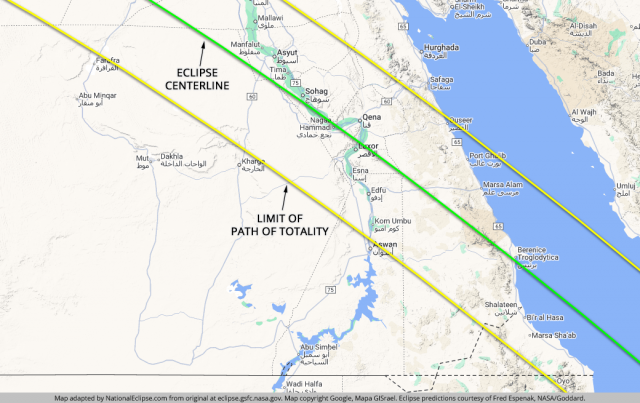
| Width of path of totality over Egypt | Approximately 250 km — a wide band from Qena south through the New Valley |
| Cloud cover probability in Luxor (August) | Less than 5% — near-guaranteed clear sky |
| Path of totality crosses | Spain · Gibraltar · Morocco · Algeria · Tunisia · Libya · Egypt · Saudi Arabia · Yemen · Somalia |
| Eclipse ranking | Second longest total solar eclipse of the 21st century · Longest on easily accessible land until 2114 |
| Saros series | Saros 136 — the same series that produced the exceptional 1973 and 1991 eclipses |
| Visible planets during totality | Venus (very bright, near the sun) · Mercury · Jupiter · Saturn · Mars visible in the darkened sky |
| Population within path of totality | Approximately 89 million people |
Why Egypt — and Why Luxor — Is the Best Place on Earth to See This Eclipse
The path of totality on 2 August 2027 crosses multiple countries — Spain, Morocco, Libya, Saudi Arabia — and in theory you could watch the eclipse from any of them. But Egypt, and specifically Luxor, offers a combination of factors that no other location on the path can match.
1. Near-guaranteed clear skies. Luxor in August has a cloud cover probability of less than 5%. This is not luck — it is geography. Luxor sits in one of the world's most reliably sunny climates, in a desert where August clouds are an extraordinary rarity. Compare this to Spain (where Atlantic weather systems bring meaningful cloud risk) or even Morocco (coastal humidity). When it comes to the single most important variable in eclipse viewing — will I actually see it? — Luxor is the safest bet on the entire path of totality.
2. The longest totality on accessible land. While the theoretical maximum duration of 6 minutes 23 seconds occurs slightly southeast of Luxor (in the New Valley desert), Luxor city itself offers approximately 6 minutes 20 seconds — more than enough to experience the full eclipse spectacle including the diamond ring effect, Baily's Beads, the appearance of stars and planets, the drop in temperature, and the solar corona in all its glory. No other major accessible city on the path comes close to this duration.
3. The monuments. This is what makes the Egypt eclipse truly singular. Watching totality from the Karnak Temple hypostyle hall — 134 columns rising 23 metres, built by the pharaohs of the New Kingdom — or from the rooftop of a Nile cruise ship moored beside Luxor Temple, or from the desert plateau above the Valley of the Kings — is an experience with no parallel anywhere else in the eclipse path. The combination of astronomical phenomenon and ancient monument creates a moment that is both scientifically extraordinary and historically overwhelming.
What no other guide tells you: The ancient Egyptians experienced and recorded total solar eclipses. In the Papyrus Carlsberg and other astronomical texts, Egyptian scribes tracked celestial events including solar eclipses, interpreting them within the framework of their solar theology — a temporary defeat of the sun god Ra by the chaos serpent Apophis. To watch a total solar eclipse above the temples of Karnak — built by a civilisation whose entire religious system was organised around the sun — is to participate in an astronomical event that would have held profound theological significance for the people who built what you are standing among.
Best Viewing Locations in Egypt
| Location | Totality Duration | Why Choose It | Accommodation |
|---|---|---|---|
| Luxor city | ~6 min 20 sec | Best combination of totality duration + monuments + hotels + infrastructure. The #1 choice. | Winter Palace · Sofitel · Steigenberger Achti · Sonesta St George — all filling fast |
| Karnak Temple site | ~6 min 20 sec | Most dramatic backdrop — 3,400-year-old hypostyle hall goes dark during totality. Limited capacity. | Luxor hotels (15 min drive) |
| New Valley (Kharga Oasis) | ~6 min 22–23 sec | Closest to maximum totality point — remote desert, minimal crowds, extraordinary dark sky | Limited lodging — best as day trip from Luxor |
| Bahariya Oasis | ~6 min 22 sec | Desert oasis setting — dark sky, away from Luxor crowds, spectacular landscape | Ecolodge accommodation available; book far in advance |
| Aswan | ~5 min 30 sec | Slightly south of optimum path but still spectacular — combines with Abu Simbel and Philae | Old Cataract Hotel · Movenpick · Sofitel Legend |
| Red Sea coast (Marsa Alam area) | ~5–6 min 20 sec | Combines eclipse with Red Sea diving / snorkelling — appeals to beach travellers | Red Sea resort hotels — more availability than Luxor |
| Nile cruise between Luxor and Aswan | ~5–6 min (depending on position) | Floating hotel moored at the optimal location — unobstructed views, no crowds, temples as backdrop | Nile cruise ships — heavily booked; contact Egypt For Travel now |
Planning Your Egypt Eclipse Trip: What You Need to Know NOW
The eclipse is on 2 August 2027 — and the planning window is already closing faster than most travellers realise. Eclipse tourism operates on a different timeline from normal travel: serious eclipse chasers book 2–5 years in advance, and the 2027 event is being called the most anticipated eclipse of the 21st century. Here is what the situation looks like as of mid-2026:
Hotels: Luxor's top hotels — the Winter Palace, Sofitel Winter Palace, Steigenberger Achti, and Sonesta St George — were already reporting significant bookings for the eclipse period (late July to early August 2027) as early as December 2025. By mid-2026, the best rooms at the most iconic properties are either sold out or available only through specialist tour operators who hold allocations. If you want to watch the eclipse from a room at the Winter Palace — one of the most storied hotels in Africa, where Agatha Christie wrote Death on the Nile — you need to book now.
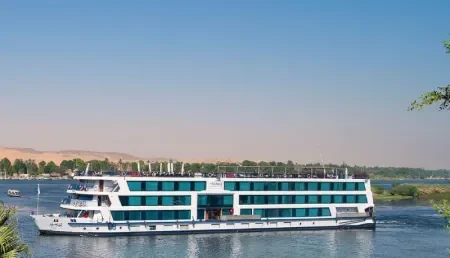
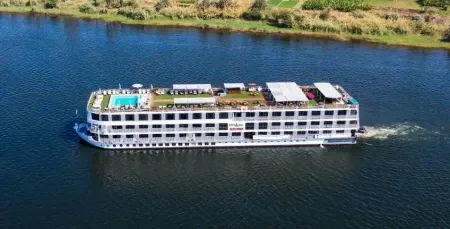
Nile cruise ships: Cruise ships positioned between Luxor and Aswan during the eclipse offer a unique experience — watching totality from the deck of a ship moored beside an ancient temple, with the river below and the darkening sky above. Egypt For Travel holds cruise cabin allocations for the eclipse period. Contact us immediately via WhatsApp to check availability.
Flights: Direct and indirect flights to Luxor are filling. Most eclipse visitors will fly into Cairo and connect to Luxor (1-hour domestic flight), or fly directly to Luxor International Airport if their carrier serves it. Cairo to Luxor flights on 31 July and 1 August 2027 will be at a premium — book early.
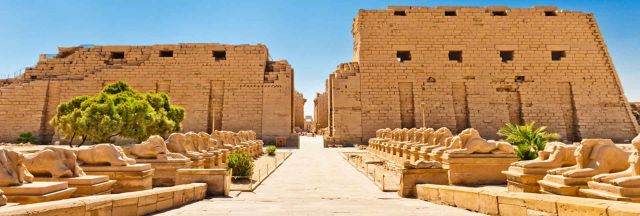 Karnak Temple Luxor — one of the world's most dramatic eclipse viewing locations. On 2 August 2027, its 3,400-year-old columns will stand in midday darkness for over 6 minutes.
Eclipse Day: What to Expect Hour by Hour
| Time (Luxor local, EEST) | Event | What You Will Experience |
|---|---|---|
| ~11:19 AM | First Contact — partial eclipse begins | Moon takes its first "bite" from the sun's edge — visible only through certified eclipse glasses |
| ~12:30 PM | 80%+ coverage — light begins to change | Shadows become sharp-edged; colours flatten; animals may become confused; temperature begins to drop |
| ~13:00 PM | 95%+ coverage — pre-totality phenomena | Shadow bands visible on white surfaces; Baily's Beads appear at sun's edge; Diamond Ring effect begins |
| ~13:04 PM | SECOND CONTACT — TOTALITY BEGINS | Remove eclipse glasses. Day becomes night. Corona blazes. Stars and Venus appear. Temperature drops 5–10°C. 6 minutes 20 seconds of the most extraordinary natural spectacle on Earth. |
| ~13:10 PM | THIRD CONTACT — TOTALITY ENDS | Diamond Ring reappears — immediately replace eclipse glasses. Day returns. Partial phase continues. |
| ~14:39 PM | Fourth Contact — eclipse ends | Moon completely clears the sun. Full daylight restored. The eclipse of the century is complete. |
Eclipse Safety: Critical Information
Looking at a partial solar eclipse without proper eye protection causes permanent, irreversible retinal damage. There is no pain — the retina has no pain receptors — which makes the damage all the more dangerous because you will not realise it is happening. Standard sunglasses provide zero protection.
The only safe options during the partial phases are ISO 12312-2 certified eclipse glasses or a proper solar filter on any telescope or camera. During the brief period of totality only — when the sun is completely covered — it is safe to look with the naked eye. You will know totality has begun because the last sliver of sun disappears in the Diamond Ring effect. The moment any sliver of sunlight reappears, replace your eclipse glasses immediately.
Egypt For Travel includes certified eclipse glasses in all our 2027 eclipse packages.
Egypt For Travel's 2027 Eclipse Packages
Egypt For Travel is building a range of eclipse packages for 2027 combining the astronomical event with the best of Egypt's ancient monuments. Options include:
Eclipse + Luxor Only (3–5 nights) — Based in Luxor with guided visits to Karnak, the Valley of the Kings, Luxor Temple, and the West Bank, with eclipse viewing from a prime Luxor location. Ideal for those who want maximum flexibility and minimum travel time.
Eclipse + Nile Cruise (7–10 nights) — A Nile cruise from Cairo to Luxor or Luxor to Aswan, arriving in Luxor for the eclipse. Watch totality from the cruise ship deck moored beside an ancient temple. Includes Karnak, Valley of the Kings, Abu Simbel.
Eclipse + Full Egypt (12–15 nights) — The complete Egypt experience: Cairo and the Pyramids, Nile cruise, eclipse in Luxor, and extension to Aswan. The trip of a lifetime built around the astronomical event of the century.
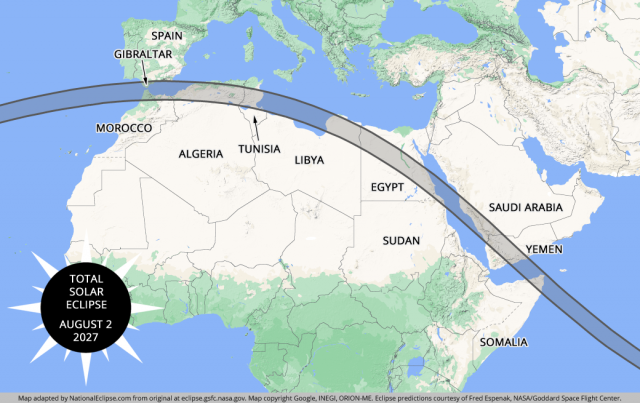 Path of totality for the 2 August 2027 solar eclipse — the 250km-wide band crosses directly over Luxor, Egypt, delivering 6 minutes 23 seconds of totality.
Frequently Asked Questions — Egypt Eclipse 2027
When exactly is the 2027 solar eclipse?
The total solar eclipse occurs on Monday, 2 August 2027. Totality begins in Luxor at approximately 13:04 local time (EEST — Egypt Standard Time + 1 hour summer) and lasts approximately 6 minutes 20 seconds. The partial eclipse begins around 11:19 AM and ends around 14:39 PM.
How long is totality over Luxor?
Approximately 6 minutes and 20 seconds in Luxor city. The absolute maximum of 6 minutes 23 seconds occurs slightly southeast of Luxor in the New Valley desert — but the difference is negligible and Luxor's infrastructure and monuments make it the clear choice for most visitors.
Why is the 2027 eclipse called the "Eclipse of the Century"?
The 2027 eclipse offers the longest total solar eclipse on easily accessible land in the 21st century — longer than the previous record and not surpassed until 3 June 2114. Combined with near-guaranteed clear skies (less than 5% cloud probability in Luxor in August), location directly above the world's greatest ancient monuments, and the astronomical rarity of such extended totality, it deserves the designation.
Is it safe to travel to Egypt in August?
Yes — Egypt is safe for international visitors. August is hot in Luxor (daytime temperatures 40–45°C), but Egypt For Travel's eclipse packages include air-conditioned accommodation, shaded viewing areas, cold water, and private transport. The heat is manageable with proper preparation and is a small price for the most extraordinary eclipse of the century.
Will I need eclipse glasses?
Yes — ISO 12312-2 certified eclipse glasses are essential during the partial phases. You may look at the sun with the naked eye only during the minutes of totality. Egypt For Travel provides certified eclipse glasses as standard in all 2027 eclipse packages.
Are Luxor hotels really selling out?
Yes — eclipse tourism operates on a multi-year booking timeline. Top Luxor hotels were already reporting significant bookings for the eclipse period (late July to early August 2027) by December 2025. Egypt For Travel holds allocations at key properties. Contact us via WhatsApp immediately to check availability — early booking is not just recommended, it is essential.
Book your Egypt Eclipse 2027 package now — before hotels sell out. Egypt For Travel holds accommodation allocations and can build your complete eclipse experience around the astronomical event of the century. WhatsApp: +20 155 555 2466. ETA Licence No. 1947. Browse Egypt tour packages · Private Egyptologist guide · All monuments · Eclipse viewing logistics handled.