When you stand in a tomb in the Valley of the Kings and look at walls covered in hieroglyphic text — columns of signs running from floor to ceiling in every direction, each sign precisely carved and coloured, every word meaningful — the question that strikes most thoughtful visitors is not "what does it say?" but "who made this?" The answer, invariably, is a scribe: a professional writer, draughtsman, and specialist of the written word who spent years in training and who represented the educated elite of ancient Egyptian society. Understanding how that education worked — who received it, what it consisted of, where it happened, and what it produced — illuminates everything else about how ancient Egypt functioned.
Quick Facts: Education in Ancient Egypt
| Primary school type | Per medjat — "House of Books" — scribal school attached to temples or royal administration |
| Advanced institution | Per ankh — "House of Life" — temple library, scriptorium, and centre of higher learning |
| Who received formal education | Sons of scribes, officials, priests, and craftsmen · some royal children · girls very rarely |
| Starting age | Approximately 5 years old (after weaning, which lasted until age 3) |
| Training duration | Approximately 12 years for a fully trained scribe |
| Scripts taught | Hieratic (everyday cursive) first · then hieroglyphs · advanced scribes also learned Demotic |
| Subjects | Reading · writing · arithmetic · geometry · accounting · foreign languages (at higher levels) · medicine · astronomy · theology |
| Writing surfaces | Wooden boards (whitewashed, reusable) · ostraca (pottery shards and limestone flakes) · papyrus (for advanced work only) |
| Literacy rate | Estimated 1–5% of the total population — literacy was rare and powerful |
| Key surviving texts | Rhind Mathematical Papyrus · Maxims of Ptahhotep · Satire of the Trades · Kemit (writing primer) |
The Scribal School: Egypt's Classroom
Formal education in ancient Egypt took place in the per medjat — "House of Books" or "House of Writings" — a scribal school typically attached to a major temple complex or royal administrative centre. These schools were not separate buildings in most cases; they operated in the courtyards, porticos, and subsidiary rooms of the temple or palace complex, using the institutional resources (papyrus stores, ink, trained scribes as teachers) of the parent institution.
Education began at approximately age 5 — after the extended nursing period that Egyptian children typically underwent until age 3, and the early childhood phase that followed. The curriculum began not with hieroglyphs (too complex for beginners) but with hieratic — the cursive script derived from hieroglyphs that served as the everyday writing system for administrative documents, letters, and accounts. Hieratic could be written rapidly with a rush pen on papyrus or a sherd of pottery, making it the practical script of Egyptian daily life. Hieroglyphs — the formal, carefully drawn signs used for monumental inscription and sacred texts — came later, after the student had mastered the sound-values of the script through its more accessible hieratic form.
The primary teaching method was copying. Teachers would write a text on a board or papyrus, and students would copy it repeatedly onto their own wooden boards (whitewashed so they could be erased and reused) or onto cheap ostraca (pottery shards and limestone flakes, which are found in enormous quantities at Deir el-Medina and other sites). The texts chosen for copying were not arbitrary: they were wisdom literature — moral and practical guides for life and conduct — and literary classics of the Egyptian tradition. By copying these texts repeatedly, the student simultaneously learned to write and absorbed the values and cultural knowledge of educated Egyptian society.
What no other guide tells you: The most widely used teaching text in ancient Egyptian scribal schools was a composition called the Kemit ("Completion" or "The Sum of Knowledge") — a letter-writing primer composed around 2000 BC that remained in use in Egyptian schools for over 500 years. Students copied its formal epistolary phrases so many times that the handwriting in Kemit copies retained an archaic style long after everyday hieratic had evolved — a deliberate fossilisation of the "correct" scribal hand, similar to how calligraphy instruction today preserves historical letterforms. The Kemit copies are among the most abundant educational texts from ancient Egypt and allow modern scholars to track exactly how students were taught to write.
What Ancient Egyptian Students Learned
Reading and Writing
The Egyptian writing system was extraordinarily complex — comprising over 700 hieroglyphic signs (each serving as a logograph, phonogram, or determinative depending on context), each with its own hieratic equivalent. Mastering this system to reading-and-writing proficiency required years of practice. Students progressed from learning individual signs to copying short texts, then longer compositions, then composing original documents under supervision. A fully trained scribe could read any Egyptian text, write in hieratic and hieroglyphs, and compose official letters and administrative documents independently.
Mathematics and Accounting
The Rhind Mathematical Papyrus (c. 1650 BC, now in the British Museum) and the Moscow Mathematical Papyrus give us the curriculum of Egyptian mathematics education — and it is impressive. Egyptian mathematical teaching covered fractions (including complex unit fraction arithmetic), linear equations, area calculations for triangles, rectangles, and circles, volume calculations for granary silos and pyramids, and practical accounting problems drawn from administrative reality (how much grain to allocate per worker, how to divide bread among a team of unequal size).
The Egyptian approach to mathematics was practical rather than theoretical — there was no abstract algebra, but there was an extraordinarily sophisticated toolkit for solving the real computational problems of administering a complex state. The famous approximation of pi as 3.16 (from the Rhind Papyrus problem 50 — close to the true value of 3.14159) was not a theoretical breakthrough but a practical solution to the problem of calculating the area of a circular granary base.
Literature and Wisdom Texts
The classical texts of Egyptian literature served as the primary reading curriculum. The Maxims of Ptahhotep (composed c. 2400 BC, one of the oldest complete literary works in human history) — a collection of 37 moral and practical maxims attributed to a vizier of the Old Kingdom — was copied by students for 2,000 years. The Satire of the Trades (a New Kingdom text arguing for the superiority of the scribal profession over every other occupation) was copied so frequently that it survives in more manuscript copies than any other Egyptian text. The Story of Sinuhe, the Eloquent Peasant, and the Shipwrecked Sailor were all part of the reading curriculum.
Foreign Languages
At the higher levels of scribal training — particularly in the New Kingdom, when Egypt administered an empire stretching from Nubia to Syria — education included foreign language instruction. The diplomatic archive of the Amarna period (the Amarna Letters, c. 1350 BC) was written in Babylonian Akkadian — the international diplomatic language of the Bronze Age — and Egyptian diplomatic scribes had to be fluent in it. An Egyptian scribal handbook from the New Kingdom includes a vocabulary list of Semitic words transliterated into hieratic — the Egyptian equivalent of a foreign language phrase book for diplomatic scribes.
The House of Life: Egypt's University
Above the scribal school in the educational hierarchy stood the per ankh — the "House of Life" — a specialised institution attached to major temples that served simultaneously as a scriptorium, a library, a centre of medical learning, an astronomical observatory, and a sanctuary for the preservation and transmission of sacred knowledge. The per ankh was not a school in the modern sense — it was an institution of specialist professional formation for the highest levels of Egyptian intellectual life.
The per ankh preserved and copied the most sacred texts of the Egyptian tradition: the ritual texts used in temple ceremonies, the astronomical records used for calendar calculation, the medical texts used by physician-priests, the magical texts used for healing and protection, and the theological texts that underpinned the entire Egyptian religious system. Admission to the per ankh was restricted to men of the highest educational achievement and appropriate priestly status. Those who worked within it were called sesh medjat-netjer — "scribes of the divine book" — a title that conveyed both professional distinction and religious authority.
The most famous per ankh in Egypt was attached to the temple of Ra at Heliopolis — the city just north of modern Cairo that was the centre of solar theology in ancient Egypt and the greatest intellectual centre of the Old and Middle Kingdom periods. Greek writers who visited Egypt frequently mentioned Heliopolis as a centre of learning; Herodotus, Plato, and Pythagoras were all said (by ancient tradition) to have studied there. The Egyptian medical papyri that survive — the Ebers Papyrus and the Edwin Smith Papyrus, both probably derived from per ankh archives — represent the medical curriculum of these institutions.
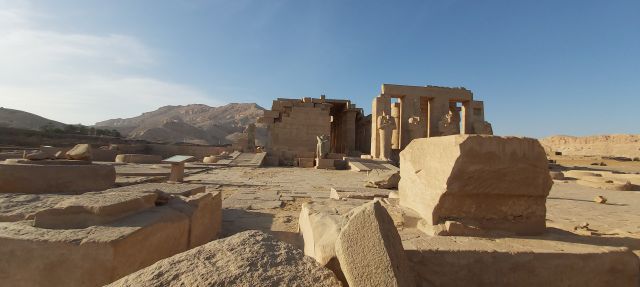
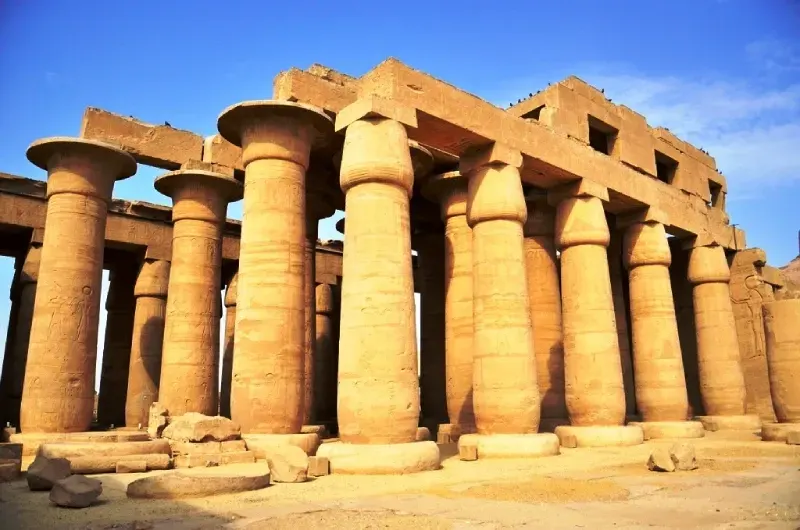
The Ramesseum at Luxor — Ramesses II's mortuary temple, which housed one of the most important Houses of Life in ancient Egypt, including one of the ancient world's great libraries.
Women and Education in Ancient Egypt
Egyptian women occupied a position in society that was significantly more autonomous than in most contemporary ancient civilisations — they could own property, conduct legal transactions, divorce, and inherit independently. However, formal scribal education was almost exclusively a male domain. The vast majority of scribes identified in the Egyptian textual record are male.
There are some exceptions. Several women are attested as sesh (scribe) in administrative titles from the Old Kingdom — though whether these titles reflect actual literacy or are honorific is debated. A small number of female physicians are documented in the medical papyri. And the evidence from Deir el-Medina — where the ostraca record the daily life of an unusually literate artisan community — suggests that some women in the community could read and write, even if they did not hold formal scribal positions.
The education of noble and royal women was different from that of scribal trainees — it focused on domestic management, music, dance, and the religious duties associated with female priestly roles (particularly the role of chantress of Amun), rather than on writing and accounting. Some royal women were certainly literate: the diplomatic correspondence of Queen Tiye and Nefertari with foreign queens implies that they could read and write, even if others composed the actual letters on their behalf.
Where to Encounter Ancient Egyptian Education Today
| Site / Collection | What to See |
|---|---|
| Grand Egyptian Museum (Giza) | Scribal palettes, writing equipment, papyrus texts, mathematical documents — the most complete collection of Egyptian intellectual life |
| Egyptian Museum Cairo | Wooden scribal palettes and writing boards · Wisdom literature papyri · statues of seated scribes (iconic Old Kingdom form) |
| Deir el-Medina, Luxor | The site that produced more ostraca (written pottery shards) than anywhere else in Egypt — including practice writing exercises, letters, accounts, poetry, and the world's first recorded strike |
| Ramesseum, Luxor West Bank | Site of one of the most important per ankh (House of Life) in ancient Egypt — its library was famous in antiquity |
| British Museum, London | Rhind Mathematical Papyrus (c. 1650 BC) — the most complete surviving Egyptian mathematical text; Satire of the Trades |
Frequently Asked Questions — Education in Ancient Egypt
Did ancient Egyptians go to school?
Yes — ancient Egypt had a formal education system in the form of scribal schools (per medjat) attached to temples and royal administration centres. These schools educated the sons of scribes, officials, and craftsmen in reading, writing, mathematics, and accounting. The curriculum began around age 5 and lasted approximately 12 years for a fully trained scribe.
Who could read and write in ancient Egypt?
Literacy in ancient Egypt was restricted to approximately 1–5% of the total population — primarily scribes, priests, physicians, and high officials. The vast majority of Egyptians (farmers, craftsmen, soldiers) were illiterate and depended on scribes for all written communication and documentation. Literacy was one of the primary markers of social status and professional advancement.
What did ancient Egyptians write on?
Students used wooden boards (whitewashed so they could be erased and reused) and ostraca (pottery shards and flat limestone flakes) for practice writing — both were cheap and disposable. More formal documents were written on papyrus — the writing material made from papyrus reed that was ancient Egypt's most important manufactured export. Rush pens dipped in black and red ink (made from carbon and ochre respectively) were the standard writing tools throughout the pharaonic period.
What was the House of Life in ancient Egypt?
The per ankh (House of Life) was an institution attached to major temples that served as a scriptorium, library, medical school, and centre of sacred knowledge. It preserved the most important religious, medical, astronomical, and magical texts of the Egyptian tradition, copying and transmitting them across generations. Access was restricted to the most highly educated priests and scribes. The most famous was at the temple of Ra in Heliopolis.
What subjects did ancient Egyptians study?
The scribal curriculum covered: reading and writing (hieratic first, then hieroglyphs), mathematics and accounting (fractions, geometry, area and volume calculations), literature and wisdom texts (copied for both reading practice and moral education), and at higher levels: foreign languages, medicine, astronomy, theology, and magical ritual.
How did ancient Egyptians learn hieroglyphs?
Ancient Egyptian students typically learned hieratic first — the cursive script derived from hieroglyphs that was used for everyday writing. Once fluent in hieratic, they could decode hieroglyphs relatively straightforwardly, since the two scripts share the same underlying sound-values. Monumental hieroglyphic inscription was a specialist skill learned by scribes who worked specifically on temple or tomb decoration projects.
Encounter ancient Egypt's intellectual legacy in person — from the scribal village of Deir el-Medina to the Grand Egyptian Museum — browse Egypt tour packages from $749 per person. Private Egyptologist guide · All monuments · Full historical context. WhatsApp: +20 155 555 2466. ETA Licence No. 1947.