Cairo earned its Arabic name — Al-Qahira, "The Victorious" — when the Fatimid general Jawhar al-Siqilli founded the city in 969 AD. From that founding moment to today, the mosque has been the beating heart of Cairene life: a place of prayer, scholarship, political power, social welfare, and architectural ambition unlike anywhere else on Earth. Cairo contains more than 1,000 mosques spanning fourteen centuries of building — ranging from mud-brick Abbasid arcades to Mamluk stone masterpieces to Ottoman marble palaces. For the traveller with limited time, deciding which mosques to visit is genuinely difficult. This guide makes that decision for you.
The ten mosques below were selected on four criteria: architectural significance (what makes this building exceptional even by Cairo's extraordinary standards), historical importance (what story does it tell about the city and the faith), visitor accessibility (can non-Muslims enter, when, and how), and the experience on the ground (what will you actually feel when you stand there). All ten can be visited across two full days. Most cost between free and 100 EGP (~$2 USD) to enter. Together they represent the most concentrated sequence of great Islamic architecture available to a visitor anywhere in the world.
Quick Facts: Cairo's Islamic Mosques
| Number of mosques in Cairo | Over 1,000 across the metropolitan area |
| Oldest mosque in Egypt | Mosque of Amr ibn al-As — founded 642 AD |
| Oldest intact mosque in Cairo | Ibn Tulun Mosque — built 876–879 AD |
| Tallest entrance portal in the Islamic world | Sultan Hassan Mosque — 38 metres high |
| Most important Islamic university | Al-Azhar — founded 972 AD, still active |
| Best rooftop view of Islamic Cairo | Bab Zuweila / Al-Muayyad minarets |
| Total entrance cost for all 10 mosques | ~500–700 EGP (~$10–14 USD) |
| Non-Muslim access | 9 of the 10 open to tourists outside prayer times |
| Best time to visit | Weekday mornings 09:00–11:30 (quietest, best light) |
Which Mosque Is Right for You? — Visitor-Type Guide
| If you are a… | Do not miss | Why |
|---|---|---|
| Architecture lover | Ibn Tulun + Sultan Hassan + Qaitbay | Three different eras, three different structural systems — collectively the finest sequence of Islamic architecture in Africa |
| History buff | Al-Azhar + Amr ibn al-As + Al-Hakim | 1,400 years of Islamic history in three sites — from the Arab conquest to the Fatimid caliphate to the world’s oldest university |
| Photographer | Muhammad Ali + Al-Muayyad/Bab Zuweila + Ibn Tulun | Dramatic skyline views, rooftop panoramas, and the spiral minaret that appears in every iconic Cairo shot |
| Short on time (half day only) | Muhammad Ali + Sultan Hassan + Al-Rifai | Three mosques, one neighbourhood (Citadel Square), 3 hours — covers Ottoman, Mamluk, and neo-Mamluk in a single visit |
| Spiritual / pilgrimage visitor | Al-Azhar + Al-Hussain + Al-Rifai | The living heart of Sunni scholarship, the most venerated Shia shrine in Egypt, and the royal mausoleum where the Shah of Iran is buried |
| Off-the-beaten-track seeker | Qaitbay (City of the Dead) + Barquq + Al-Muayyad | Three sites that almost no package tour visits — extraordinary architecture, almost zero crowds |
| Visiting during Ramadan 2026 | Al-Azhar + Al-Hussain at night (from 17 Feb) | Ramadan begins ~17 February 2026 — evening atmosphere at these two adjacent mosques is unlike anything else in Cairo |
.jpg?1781898317566)
Entrance Fees at a Glance — All 10 Mosques
| Mosque | Era & Date | Fee (EGP) | ~USD | Non-Muslim Access |
|---|---|---|---|---|
| Muhammad Ali (Citadel) | Ottoman, 1830–1848 | ~550 EGP (Citadel ticket) | ~$11 | ✅ Outside prayers |
| Ibn Tulun | Abbasid, 876–879 AD | ~220 EGP | ~$4.5 | ✅ Daily |
| Sultan Hassan | Mamluk, 1356–1363 | ~220 EGP | ~$4.5 | ✅ Outside prayers |
| Al-Rifai | Neo-Mamluk, 1869–1912 | ~220 EGP | ~$4.5 | ✅ Outside prayers |
| Al-Azhar | Fatimid, 970 AD | Free | Free | ✅ Outside prayers |
| Al-Hussain | Fatimid site / modern structure | Free | Free | ❌ Muslims only (exterior viewable) |
| Amr ibn al-As | Founded 642 AD (rebuilt) | Free | Free | ✅ Outside prayers |
| Al-Hakim | Fatimid, completed 1013 | Free | Free | ✅ Daily |
| Al-Muayyad + Bab Zuweila | Mamluk, 1420 | ~220 EGP (gate + minarets) | ~$4.5 | ✅ Minaret climb available |
| Qaitbay (City of the Dead) | Mamluk, 1474 | ~220 EGP | ~$4.5 | ✅ Daily |
The 10 Mosques — In-Depth Guide
1. Muhammad Ali Mosque (The Alabaster Mosque) — Saladin Citadel
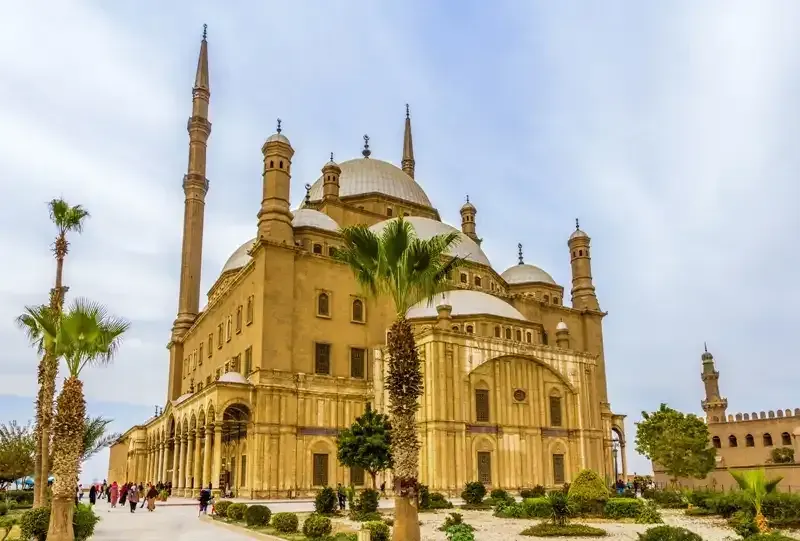
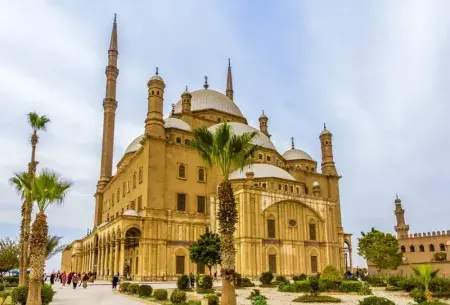
The Muhammad Ali Mosque is the most instantly recognisable building in Cairo. Its twin pencil-thin Ottoman minarets — each rising 82 metres — are visible from almost every rooftop in the city, and the lead-grey domes cluster above the Citadel's highest point like a crown over a fortress. The mosque was built between 1830 and 1848 on the orders of Muhammad Ali Pasha, the Albanian-born Ottoman officer who seized power in Egypt in 1805 and launched the country's transformation into a modern state. He modelled it explicitly on the great imperial mosques of Istanbul — Hagia Sophia and the Sultan Ahmed Mosque — and brought in a Turkish architect, Yusuf Bushnak, to execute the design.
The entire exterior and much of the interior is clad in Egyptian alabaster (a banded cream-and-white translucent stone quarried near Luxor), which gives the mosque its popular name and creates an extraordinary luminosity inside — the stone seems to glow when backlit. The interior dimensions are genuinely staggering: the central dome rises 52 metres and spans 21 metres across, flanked by four semi-domes of increasing size that step the transition to the four corner domes. The total floor area that can accommodate worshippers approaches 6,500 square metres. Hundreds of hanging glass globes — originally oil lamps, now electrified — create a constellation effect beneath the dome at any time of day. Muhammad Ali himself is buried in a white Carrara marble tomb to the right of the entrance, beside the ablution fountain in the outer courtyard — a gift from Napoleon III of France.
What no other guide tells you: The clock tower in the mosque's outer courtyard was a gift from King Louis-Philippe of France in 1845, exchanged for the Luxor Obelisk that now stands in the Place de la Concorde in Paris. The clock has never worked correctly since it arrived. Egyptians consider this quietly appropriate.
Visit strategy: Arrive at the Citadel as it opens (09:00) on a weekday. The Muhammad Ali Mosque is a 5-minute walk uphill from the main gate. After the mosque, walk the eastern ramparts for the best panoramic view of Cairo available anywhere — on a clear morning you can see from the Pyramids in the west to the Moqattam cliffs in the east. Combine immediately with Sultan Hassan and Al-Rifai Mosque below.
2. Ibn Tulun Mosque — Islamic Cairo
The Mosque of Ibn Tulun is the oldest intact mosque in Egypt and one of the architectural wonders of the Islamic world — yet it receives a fraction of the visitors that the Muhammad Ali Mosque or Al-Azhar attract. This is partly because it sits slightly off the main Islamic Cairo tourist circuit, and partly because its beauty is austere and intellectual rather than immediately spectacular. For those who know what they are looking at, it is arguably the greatest mosque in Cairo.
It was built between 876 and 879 AD by Ahmad ibn Tulun, the Abbasid governor who effectively made Egypt independent from the Abbasid Caliphate in Baghdad. Ibn Tulun built a new capital — Al-Qata'i — north of the existing city of Fustat, and placed his grand mosque at its centre. The mosque was designed by a Christian architect from Samarra (the Abbasid capital in modern Iraq), which explains its resemblance to the famous spiral-minareted Great Mosque of Samarra — the only other mosque in the Islamic world with the same distinctive exterior spiral staircase winding around the minaret.
The scale is extraordinary. The courtyard alone covers 2.5 hectares — large enough to contain the entire Citadel mosque complex. The arcaded porticos that line all four sides are built from brick rather than the stone or marble used in later Cairene mosques, and the pointed arches — among the earliest pointed arches in Islamic architecture — give the interior a soaring, almost Gothic quality. Every surface of the arches is decorated with carved stucco ornament: geometric interlace, arabesque vine scrolls, and Quranic inscriptions in a flowing Kufic script.
What no other guide tells you: The fountain pavilion at the centre of the courtyard is not original — it was added by the Mamluk Sultan Lajin in 1296 AD when he took refuge in the then-abandoned mosque during a period of political trouble and vowed to restore it if he survived. He survived, became Sultan, and kept his vow. The restored mosque is why we still have it today.
Combine with: The Gayer-Anderson Museum — two connected 16th-century Cairene merchant houses immediately beside the mosque, filled with Islamic art, antique furniture, and Orientalist paintings. Entrance approximately 100 EGP. One of the most atmospheric interiors in Cairo.
.jpg?1781898608189)
3. Sultan Hassan Mosque-Madrasa — Citadel Square
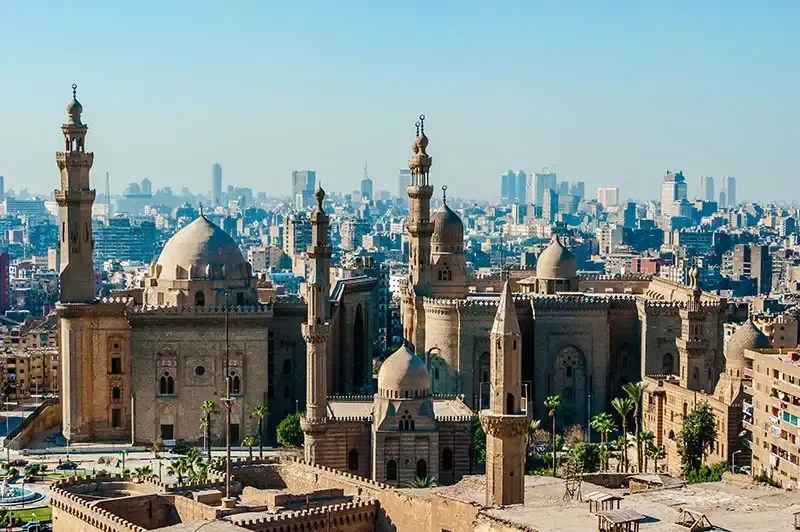
The Sultan Hassan Mosque-Madrasa is the undisputed masterpiece of Mamluk architecture — which is to say it is the masterpiece of one of the most architecturally sophisticated building programmes in human history. The Mamluks were a military slave dynasty who ruled Egypt from 1250 to 1517, and who poured their vast agricultural and trade revenues into stone: building mosques, madrasas, mausoleums, and caravanserais of extraordinary ambition and quality. Among all of it, Sultan Hassan stands apart.
The mosque was built between 1356 and 1363 during the reign of Sultan Hassan, a Mamluk ruler who was deposed, restored, deposed again, and finally assassinated before his mosque was finished — he is buried in it, but he never prayed in it complete. The building is remarkable for its sheer physical scale: the entrance portal stands 38 metres high — the tallest doorway in the medieval Islamic world — and is covered floor-to-ceiling in interlocking geometric muqarnas (stalactite carvings) of extraordinary complexity. The main dome rises 48 metres. The four great iwans (vaulted halls) that face the central courtyard are each dedicated to teaching one of the four schools of Sunni Islamic law (Hanafi, Maliki, Shafi'i, Hanbali), with students' dormitory cells stacked three storeys high above each iwan. The building was simultaneously a mosque, a university, a law school, a mausoleum, and a residential complex — one of the most functionally ambitious buildings of the medieval world.
What no other guide tells you: The two minarets on the south-east facade were originally four — two collapsed in 1361 AD, killing hundreds of people who had gathered below. The fallen minarets were not replaced. Sultan Hassan himself was murdered shortly after, and the connection between the two events was regarded by Cairenes as cosmically significant.
Visit strategy: Enter from the main portal on the north-east side. Walk to the centre of the courtyard, turn slowly 360 degrees, and look upward at the four iwans. The proportions — tall and narrow, built to create a sense of vertical compression then sudden release — are as calculated as any Gothic cathedral. Visit before noon for raking light through the courtyard.
4. Al-Rifai Mosque — Citadel Square
Standing immediately beside Sultan Hassan — designed to mirror and rival it from across a narrow street — the Al-Rifai Mosque tells a completely different story. Where Sultan Hassan is medieval power expressed in raw stone, Al-Rifai is a 19th-century dynasty's attempt to write itself into Islamic Cairo's permanent record. The mosque was begun in 1869 by the mother of Khedive Ismail (the ruler who built the Suez Canal and much of modern downtown Cairo) and completed in 1912 — a construction period of 43 years that gives the building its unnervingly perfect, almost too-polished quality.
The architect, Hussain Fahmi, studied the great Mamluk buildings of Cairo exhaustively and reproduced their vocabulary with 19th-century precision: muqarnas portals, arabesque stone carving, marble inlay, stalactite pendentives. The result is technically magnificent — every detail of Mamluk ornament is present and correctly executed — but the building lacks the structural logic of Sultan Hassan: the elements are applied rather than integrated, beautiful rather than inevitable. This makes it a fascinating study in the difference between architecture and decoration.
The mosque's great distinction is its mausoleum. Buried inside are: Khedive Ismail (the builder of modern Cairo), King Fuad I (Egypt's first king after the sultanate), King Farouk (the last king of Egypt, deposed 1952), and — in a historically resonant gesture — Shah Mohammad Reza Pahlavi of Iran, whose body was brought here in 1980 at the invitation of President Anwar Sadat after the Shah died in exile. The Shah's tomb is marked by a simple marble slab in a side chamber. No other mosque in Cairo contains the tombs of a deposed Iranian emperor and an Egyptian king in the same building.
5. Al-Azhar Mosque — Khan El-Khalili Area
Al-Azhar is not Cairo's most beautiful mosque. It is not the oldest, the largest, or the most architecturally coherent. What Al-Azhar is — and what no other mosque in the world can claim to be — is the most important centre of Sunni Islamic scholarship on Earth, in continuous operation for over 1,050 years. Understanding this is what makes a visit meaningful.
The mosque was founded in 970 AD, one year after Cairo's establishment, by the Fatimid general Jawhar al-Siqilli. The name Al-Azhar means "the Resplendent" and refers to the Prophet Muhammad's daughter Fatima al-Zahra, honouring the Fatimid dynasty's claim to descent from her. Al-Azhar University was established within the mosque complex in 972 AD — making it, by most calculations, the world's oldest continuously operating university, predating the University of Bologna (1088 AD) by over a century. Today Al-Azhar University has over 500,000 students from 100+ countries studying Islamic theology, law, Arabic language, and modern sciences across dozens of faculties across Egypt.
The mosque complex has been expanded by every subsequent dynasty that ruled Cairo — the Fatimids, the Mamluks, and the Ottomans all added structures — which is why the five minarets visible today span eleven centuries of construction and represent five completely different architectural styles in a single building. The earliest surviving Fatimid sections (visible in the prayer hall interior) date to the 10th century. Walking from the Ottoman entry gate (18th century) through the Mamluk outer court to the Fatimid inner sanctuary is a compressed architectural history of Islamic Cairo in 200 metres.
Practical: Non-Muslims enter via the main gate freely. Women are required to wear an abaya — available to borrow at the entrance at no charge. Remove shoes before entering the prayer hall. Photography is permitted in the courtyards; avoid photographing people in prayer.
6. Mosque of Amr ibn al-As — Old Cairo
The Mosque of Amr ibn al-As is the oldest mosque in Egypt, the oldest mosque in Africa, and one of the oldest mosques in the world. It was built in 642 AD — ten years after the death of the Prophet Muhammad, and one year after the Arab general Amr ibn al-As completed the Muslim conquest of Egypt by taking the Byzantine fortress of Babylon (the walls of which still stand in Old Coptic Cairo, 500 metres away). Amr established his camp beside the Nile and built a simple mosque — a rectangular enclosure of mud brick with a palm-leaf roof — as the spiritual centre of the new Arab settlement called Fustat, which would grow over the following centuries into the city we now call Cairo.
The original building does not survive. The mosque has been demolished and rebuilt at least six times over 1,400 years, most recently in the 20th century, and the current structure is a large, plain, working mosque with no surviving medieval fabric. But the ground it stands on is the ground of the original mosque, and standing in the courtyard carries a weight of historical significance that is hard to articulate: this is where Islamic civilisation in Africa began.
Combine with: Old Coptic Cairo is a 10-minute walk north — the Hanging Church, Abu Serga crypt, and Ben Ezra Synagogue. Visiting both in the same morning gives a vivid sense of the religious plurality of medieval Cairo: the first mosque in Africa and the oldest churches in Africa, within walking distance of each other.

7. Mosque of Al-Hakim bi-Amr Allah — Al-Muizz Street
At the northern end of Al-Muizz Street — Cairo's great medieval axis, once called the Street of the Coppersmiths — the Mosque of Al-Hakim looms behind the Fatimid city walls in a state of slightly eerie grandeur. The mosque was begun in 990 AD and completed in 1013 during the reign of the Fatimid Caliph Al-Hakim bi-Amr Allah — one of the most bizarre and controversial figures in the entire history of the Islamic world.
Al-Hakim ruled Egypt for 25 years and was known for a sequence of decrees that bordered on the surreal: he banned women from leaving their homes (and then banned cobblers from making women's shoes to enforce it), outlawed the game of chess, ordered all dogs in Cairo killed because their barking disturbed him, and forbade the sale of mulukhiyya (a leafy vegetable popular in Egypt) for reasons no historian has satisfactorily explained. He also periodically reversed these decrees without explanation. He disappeared in 1021 AD — probably murdered — and his body was never found. The Druze religion, which regards Al-Hakim as a divine manifestation, was founded partly in response to his disappearance and counts him as a central figure in its theology today.
The mosque's two square minarets are the oldest surviving minarets in Cairo. They were originally free-standing towers, later encased in masonry when the Fatimid city walls were built alongside them, creating the strange half-buried appearance visible today. The mosque is currently managed and maintained by the Dawoodi Bohra community, an Ismaili Shia Muslim group from South Asia, who undertook extensive restoration works and have kept the building immaculately. Entry is free.
8. Mosque of Al-Muayyad (The Red Mosque) + Bab Zuweila
The Mosque of Al-Muayyad Shaykh (built 1415–1422) is nicknamed the Red Mosque for the colour of its stonework, and it tells one of Cairo's most dramatically personal architectural stories. Sultan Al-Muayyad Shaykh built the mosque on the site of the prison where he had been incarcerated during his years as a Mamluk officer competing for power — a standard fate for ambitious Mamluk commanders. While imprisoned, he vowed that if he ever became Sultan, he would demolish the prison and replace it with a mosque. He became Sultan in 1412, and he kept his vow.
The mosque's architectural signature is its two minarets — which are not on the mosque at all. They rise instead from the twin towers of Bab Zuweila, the massive southern gate of Fatimid Cairo that stands immediately beside it, making them the only mosque minarets in Egypt to be mounted on a city gate. Bab Zuweila was the most important gate in medieval Cairo: it was where the annual Hajj caravan departed for Mecca, where public executions took place, and where — most dramatically — the severed head of the last Mamluk sultan, Tumanbay, was displayed after the Ottoman conquest of Egypt in 1517.
Climbing the minarets via Bab Zuweila (approximately 80 EGP) gives the finest rooftop panorama of Islamic Cairo available to the public: a medieval sea of stone domes, bent copper-green minarets, satellite dishes, and laundry lines stretching in every direction, with the Citadel visible to the south and Al-Azhar's minarets to the north.
9. Mosque-Mausoleum of Sultan Qaitbay — Northern Cemetery
If you visit only one off-the-beaten-track mosque in Cairo, make it Qaitbay. The Mosque-Mausoleum of Sultan Qaitbay (built 1472–1474) is located in Cairo's City of the Dead — the vast medieval necropolis east of Islamic Cairo where hundreds of thousands of Cairenes still live among the tombs of their ancestors — and it is the masterpiece of late Mamluk decorative art. The stone dome above the mausoleum is covered, on every external surface, with interlocking geometric and arabesque carvings of almost impossible intricacy: stars within stars within stars, vine scrolls that never repeat, calligraphic bands that run the full circumference without a break. This dome was never surpassed in Cairo. When the Ottomans conquered Egypt in 1517, they reportedly sent their own craftsmen to study it.
Sultan Qaitbay himself was one of the last great Mamluk sultans — a soldier who ruled for 28 years (1468–1496), maintained Egypt's independence against the Ottomans for decades, and spent vast sums on building throughout the country. The fort that bears his name in Alexandria was also built by him. The setting of the Cairo mosque — surrounded by medieval tombs, with families visibly living and working in the cemetery around it — is unlike anything else in Egypt and profoundly memorable.
Practical: A private car and guide are strongly recommended for this visit — the Northern Cemetery is not on the main tourist circuit and taxi navigation can be unreliable. Egypt For Travel's Cairo day tour can include Qaitbay on a bespoke itinerary.
10. Mosque-Madrasa-Khanqah of Sultan Barquq — Al-Muizz Street
Midway along Al-Muizz Street, the complex of Sultan Barquq (built 1384–1386) marks one of the most significant transitions in Cairo's architectural history. Barquq was the founder of the Circassian (Burji) Mamluk dynasty — the second great period of Mamluk rule — and his complex was the first royal mausoleum built within Cairo's city walls for a Mamluk sultan: all previous sultans had been buried in the desert cemeteries outside the city. Barquq's decision to build his mausoleum inside the city changed Cairo's urban fabric permanently: from this point on, Mamluk funerary complexes colonised the city's fabric, with mosques, madrasas, and mausoleums replacing older structures throughout the medieval core.
The interior prayer hall is notable for four porphyry columns — deep purple Egyptian granite repurposed from an ancient pharaonic monument, their smooth surfaces unchanged in 1,600 years — and a wooden ceiling of extraordinary painted complexity. Entry is free, the mosque is usually quiet, and the contrast with the busier sites nearby makes it a contemplative counterpoint to the tour-group activity at Sultan Hassan.
Cairo Mosques: The Complete 2-Day Visit Strategy
| Day | Morning (09:00–13:00) | Afternoon (14:00–17:00) | Total Fees |
|---|---|---|---|
| Day 1 | Saladin Citadel (Muhammad Ali Mosque + panorama) → walk down to Sultan Hassan → Al-Rifai | Ibn Tulun Mosque + Gayer-Anderson Museum | ~550 EGP (~$11) |
| Day 2 | Al-Muizz Street: Al-Hakim → Barquq → Bab Zuweila + Al-Muayyad minarets | Al-Azhar Mosque → (optional) Amr ibn al-As in Old Cairo | ~220 EGP (~$4.50) |
| Optional Day 3 | Sultan Qaitbay Mosque (City of the Dead) — requires private car | Return via Khan El-Khalili Bazaar for lunch and shopping | ~220 EGP (~$4.50) |
Visiting Cairo Mosques During Ramadan 2026
Ramadan 2026 begins approximately 17 February 2026. Visiting Cairo's mosques during Ramadan is a completely different experience to any other time of year — and for many travellers, an unexpectedly profound one. During the day, mosques are quieter than usual as worshippers fast and conserve energy. But from sunset (Iftar) onward, the atmosphere transforms: the call to prayer rings out from every minaret simultaneously as the fast breaks, the streets fill with families, and the interiors of the great mosques are illuminated with strings of coloured lights in a tradition that goes back centuries.
The two most atmospheric spots in Cairo for Ramadan evenings are the area around Al-Azhar Mosque and Al-Hussain Mosque — adjacent to each other in the Khan El-Khalili neighbourhood — where street vendors sell Ramadan-specific sweets and drinks, families spread out on the mosque steps, and the Tarawih (extended night prayers) fill the courtyards with hundreds of worshippers and the sound of Quranic recitation. Non-Muslim visitors are warmly welcome to sit in the outer courtyards and observe — simply dress modestly and ask if you are unsure where you may go.
Dress Code & Practical Visitor Rules
| Topic | Rule | Tip |
|---|---|---|
| Women’s dress | Head covered (hijab), shoulders and knees covered, no tight clothing | Abayas available to borrow free at most mosques — or bring a large scarf |
| Men’s dress | Long trousers, shoulders covered, no sleeveless shirts | Shorts are refused entry — carry lightweight trousers |
| Shoes | Always removed before entering prayer halls | Wear slip-on shoes or sandals — you will remove them at every site |
| Prayer times | Tourist access restricted during 5 daily prayers (~15–20 min each) | Friday midday Jumu’ah prayer is the longest — plan around it |
| Photography | Permitted in courtyards and architectural spaces at all listed mosques | Never photograph worshippers in prayer without explicit consent |
| Behaviour | Speak quietly, do not cross in front of people praying, turn off phone ringers | These are working mosques, not museums — the same courtesy applies regardless of your faith |
Frequently Asked Questions — Islamic Mosques Cairo
What is the most beautiful mosque in Cairo?
The most commonly cited answers among architects and historians are: Sultan Hassan Mosque for the scale and confidence of its Mamluk architecture; the Mosque of Sultan Qaitbay (City of the Dead) for the unmatched intricacy of its carved stone dome; and Ibn Tulun for the austere intellectual purity of its Abbasid design. The Muhammad Ali Mosque is the most visually dramatic from the outside but is considered by specialists a technically competent Ottoman revival rather than an original masterpiece. Beauty, here, depends entirely on what you value in a building.
What is the oldest mosque in Cairo?
The oldest mosque in Cairo — and in Africa — is the Mosque of Amr ibn al-As, founded in 642 AD. The oldest intact mosque (where original fabric survives) is the Mosque of Ibn Tulun, built 876–879 AD. The Mosque of Amr has been completely rebuilt multiple times; the structure visible today dates largely to the 20th century.
Can non-Muslims enter mosques in Cairo?
Yes — nine of the ten mosques in this guide are open to non-Muslim visitors outside prayer times. The only exception is the Al-Hussain Mosque (entrance restricted to Muslims), though its exterior and surrounding plaza are fully accessible. Modest dress and removal of shoes are required at all sites.
How much does it cost in total to visit all 10 mosques?
Approximately 500–700 EGP total (~$10–14 USD) for all ten sites, spread across two days. This is exceptional value for the quality and quantity of architecture involved — a comparable circuit of ten major churches in Rome or Istanbul would cost ten to twenty times as much.
Is Cairo's Islamic Cairo neighbourhood safe to walk around?
Yes — Islamic Cairo is a safe, populous, and welcoming neighbourhood for international visitors. It is heavily frequented by tourists and has a visible security presence at major monuments. The most common challenge is navigating the narrow medieval streets — a guide is invaluable not for safety but for orientation and context.
Do Cairo mosques have a Sound & Light show like Karnak Temple?
There is no formal Sound & Light show at Cairo's mosques, but the nighttime atmosphere around Al-Azhar and Al-Hussain mosques — particularly during Ramadan — exceeds what any staged show could provide. The natural illumination of the mosques after dark, combined with the crowds, street food, and Quranic recitation, is one of Cairo's most memorable experiences.
Should I visit mosques before or after the Pyramids?
Visit the Pyramids first (earlier in your Cairo stay), then the mosques. The Pyramids are the reason most visitors come to Egypt; the mosques, for most people, are the surprise that makes them want to come back. Saving Islamic Cairo for your second or third day also means you arrive there with more context — having already absorbed something of Egypt's ancient and Christian layers.
Explore Cairo’s Islamic mosques with a private Egyptologist guide from Egypt For Travel — browse Cairo day tours from $55 per person. Private Egyptologist guide · All entrance fees · Private air-conditioned vehicle · Fully customisable itinerary. WhatsApp: +20 155 555 2466. ETA Licence No. 1947.